

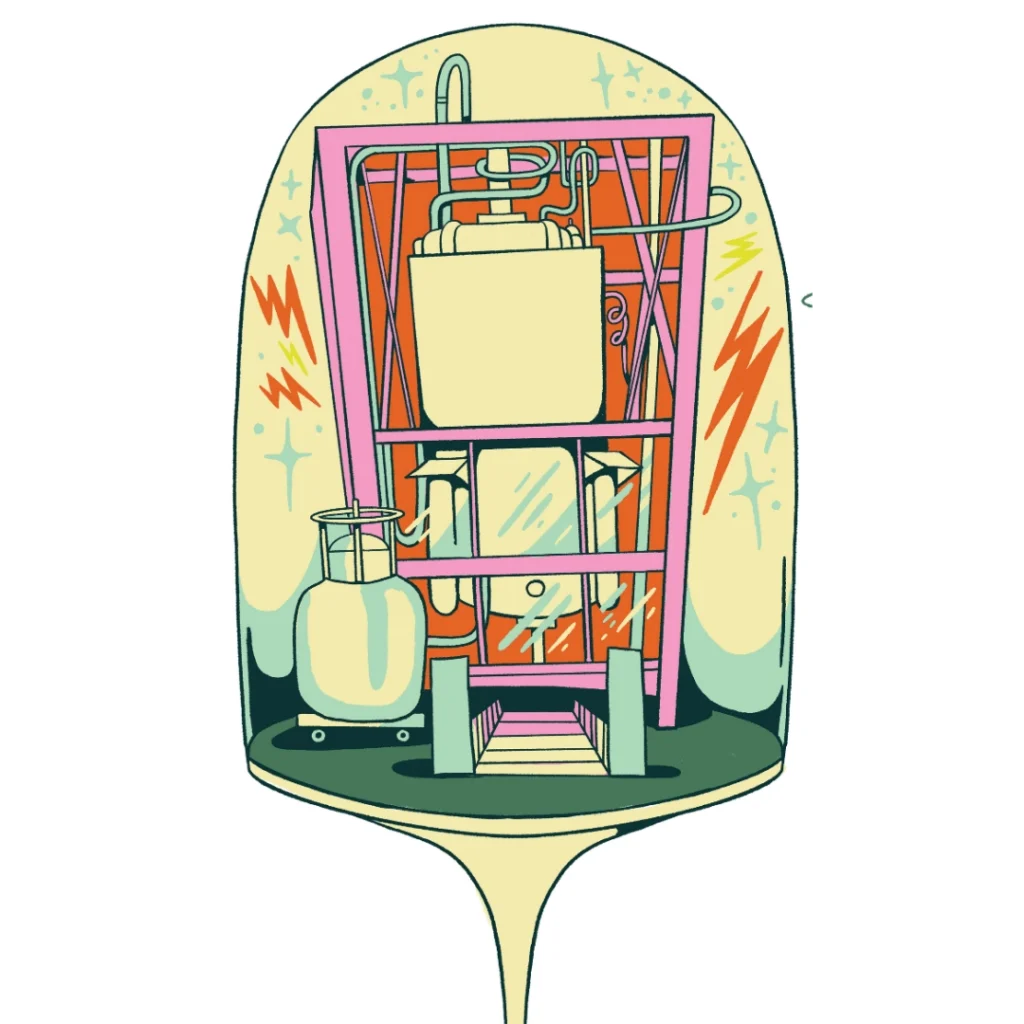
Floridians have a lot to argue about—the insurance crisis, culture wars, college football rivalries—but there’s one thing almost all of them probably agree on: the mysterious superpowers of the MagLab. The National High Magnetic Field Laboratory, as it’s officially known, enjoys a popular reputation as the state’s ace hurricane-buster, a perception based solely on an imagined clash over elemental forces and a belief that the infinite promise of scientific innovation can thwart the reckless and destructive power of nature.
Most entertain the fantasy: Every hurricane season, when the Big Bend stares down the eye of a roiling monster storm that wobbles east or west at the last minute—sparing the capital the worst of its winds—people exult in relief and shout to the glory of the mighty MagLab and its giant magnets, once again coming to the rescue and knocking certain doom off its course.
And if it’s meme-able, there must be something to it. An account on X named @The_TLH_Magnet flaunts weather maps of heavy gusters with captions like “I ate a mesocyclone for breakfast. It tasted like victory.”
Easy as pushing a button.
“It’s a good urban legend,” concedes Tim Murphy, one of the lab’s deputy directors, who greets me in his office on my first visit to the site. The 300,000-square-foot campus is a high-tech cluster of buildings tucked away in a leafy industrial park in southwest Tallahassee along a road named after Paul Dirac, the Nobel Prize-winning physicist who was one of the founders of the quantum mechanics field and a Florida State University (FSU) professor from 1972 until his death in 1984.
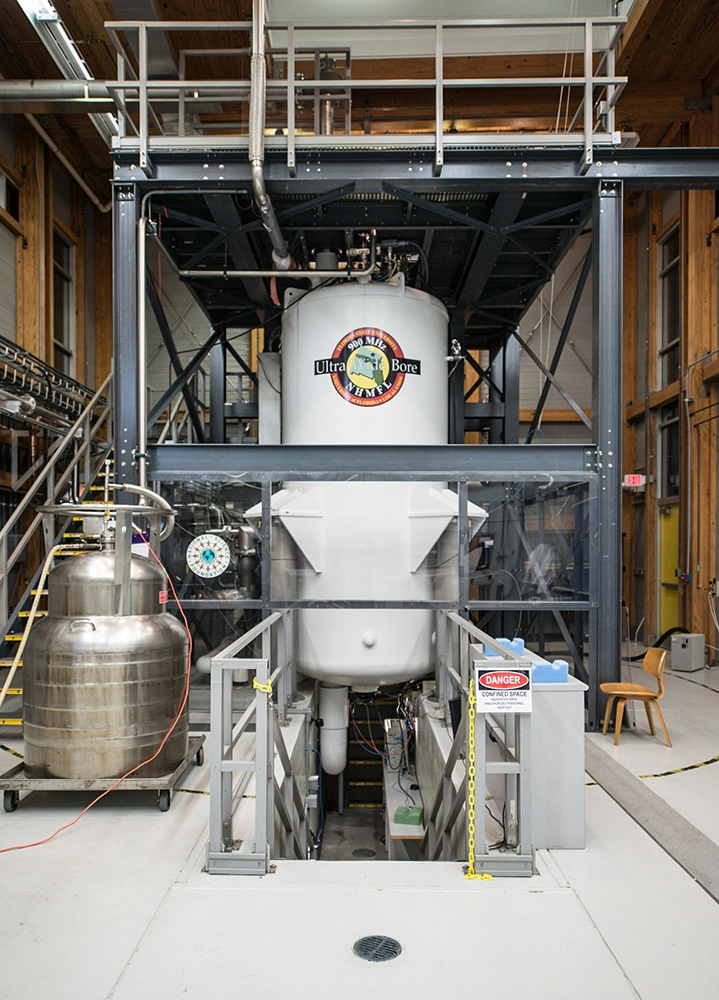 The 900MHz 105mm ultra wide bore magnet is the strongest MRI in the world used for small-animal imaging. Photography courtesy of National MagLab.
Since 1999, the lab has been home to the world’s strongest magnet when it comes to continuous magnetic field. MagLab’s signature hybrid magnet clocks in at 45 tesla (the unit measuring magnetic field strength). Standing at 22 feet high and weighing 35 tons, the magnet combines two types of magnets by wrapping a superconducting magnet rated at 11.5 tesla around a resistive magnet rated at 33.5 tesla. Girded by pipes of varying circumference, meters, metal tanks, wires and scaffolding, the lab space holding the magnet looks like the one from “Breaking Bad” on steroids.
To use the magnet, the MagLab researchers first run 740 gallons of liquid helium through the superconducting magnet to cool it down to -456 degrees Fahrenheit—80 degrees frostier than the coldest day on Uranus. The complementary magnet sucks down 4,000 gallons of coolant a minute to keep temps down. At peak operation, it uses 33 megawatts of power—enough juice to light up a small town, which feels appropriate, since the magnet uses four miles of superconducting wire. Price tag: $14.4 million. Take one of the monthly public tours and you can’t miss it. There’s a sky blue sign on the wall with an arrow and the words “World’s Strongest Magnet.”
MagLab owes its existence to Jack Crow, a physicist who, in 1990, became the director of the Center for Materials Research at FSU. Under Crow’s leadership, FSU submitted a proposal to the National Science Foundation (NSF) for a new national laboratory dedicated to magnetic research. Crow, whose life-sized bust graces the facility’s lobby, made a compelling proposal to his former employers, the NSF. FSU’s proposal won, beating out the Massachusetts Institute of Technology, where the NSF had hosted a magnetic lab since 1960. The foundation awarded funding to FSU, as well as the University of Florida and Los Alamos National Laboratory—both of which host their own smaller magnetic lab outposts. Vice President Al Gore gave the keynote at the October 1994 dedication, while Florida political legends Gov. Lawton Chiles and U.S. Senator Bob Graham sat behind him. “It’s the story,” Gore said, “of the triumph of vision and faith over cynicism.”
We’re living in a world that we donʼt really understand all the rules of, so itʼs important to figure that out.
—Tim Murphy
It’s an inspiring backdrop for what the MagLab has expanded into over its three-decade history: a nucleus for global innovation where rigorous scientific endeavor pushes toward revolutionary advances in everything from the development of more powerful MRI machines in the health care field to energy and the environment with the creation of more heat-efficient materials for use in AI data centers.
Like a lot of newbies on their first visit, I had to bring up the weather. Entertaining as it is, the presumption of the lab’s hurricane-busting powers obscures its actual accomplishments. “There are some folks who will actually take that seriously,” Murphy says. “The energy scales are wrong. We can’t.”
But what they actually do at MagLab is at least as head spinning, although it doesn’t easily break down into everyday shorthand.
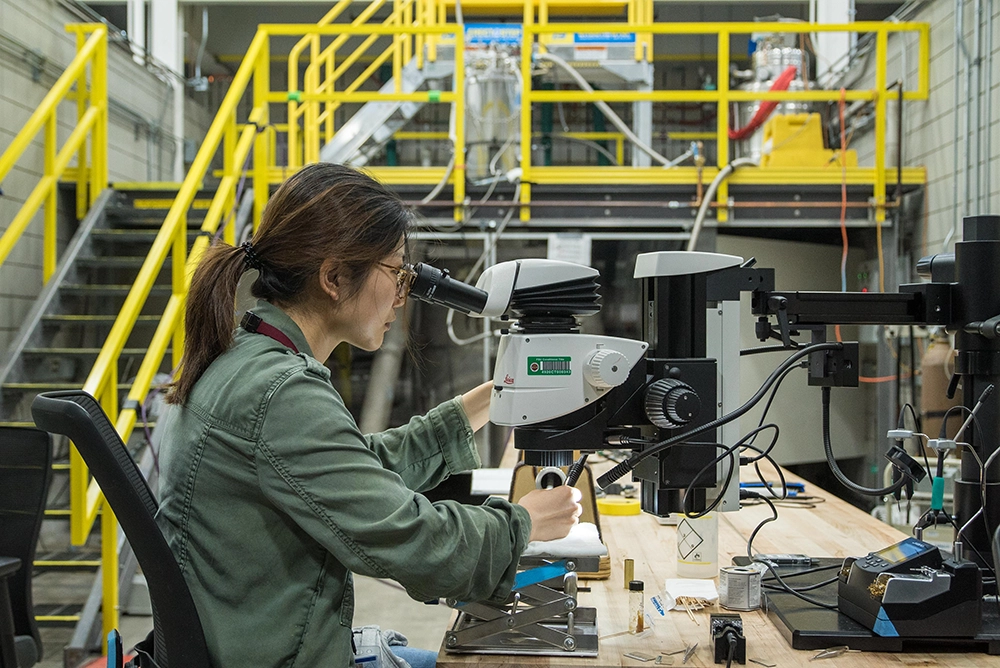 Physicist Yawen Fang studies electrons in superconductors. Photography courtesy of National MagLab.
Magic of Quantum Mechanics
The place is remarkably quiet for all the heavy machinery. Most of the audible excitement comes from a group of local school kids responding to an educational demonstration of magnetic properties that cause a small puck to levitate and fly in a circle.

Nonetheless, my brain is still awhirl with the fantastical and extremely fictional visions of movies like Christopher Nolan’s black hole-hopping “Interstellar,” in which humanity’s very existence hinges on Matthew McConaughey bending time and space to get access to the fifth dimension.
At the very least, I wondered, is there anyone racing to save the world?
“Well, we all are in a way—or at least we think we are,” Murphy says. “We’re trying to understand how things work.”
That means about 1,500–2,000 researchers from around the world visit the MagLab every year. Most will spend a week, employing the lab’s array of magnets for research and technological advancement in the fields of health, the environment and energy—all to aid in what Murphy describes as “solving the mysteries of the universe.”
Let’s try to unpack that last part.
“So the world that we live in, the Newtonian world, is based (on) quantum mechanics, and we don’t understand a great deal about quantum mechanics,” Murphy says. The theory, which has evolved since Max Planck introduced its founding concepts some 125 years ago, is best described as an
explanation of the behavior of atoms and particles.
“We’re living in a world that we don’t really understand all the rules of, so it’s important to figure that out,” he says.
Yet, it’s challenging to give the public an easy handle on all that. Condensed matter physics or materials science, for which the MagLab engages some of the planet’s deepest thinkers, “doesn’t have a really good story like astrophysics, space science (or) high-energy physics (where) we’re recreating conditions at the beginning of the universe,” he continues. Astronomy, for instance, has the cosmic web—the seemingly infinite backbone of the universe. “We don’t have those good stories to snag people’s interest, which has been a long-term failing for condensed matter physics.”
It might be why so many people embraced the hurricane idea. All those magnets, they must be up to something.
And they are. Some of the potential breakthroughs promise world-altering impacts on everyday life but don’t sound quite so dramatic. The copious accomplishments documented online include recent projects analyzing the positive effect of whale poop on ocean ecology, the discovery of a new DNA structure and the impact made by wildfires on soil composition.
“One of the big things that’s happening now is with data centers,” Murphy says, referring to the massive computing centers that are driving the AI boom as they burn up astonishing amounts of power. Projections from the International Monetary Fund expect worldwide electricity consumption for AI and data centers to triple by 2030. But research into what are known as topological materials would lead to reductions in consumption by lowering the current resistance of materials conducting electricity. “Something simple like this has tremendous benefits for technology.”
As public funding for scientific endeavors faces severe DOGE-era cutbacks, there is more urgency for researchbinstitutions to make clear, as Murphy frames the question, “why should we be spending hundreds of thousands or millions of dollars doing this?” His answer is at everyone’s fingertips: the phones in our pockets. “All the technology in that smartphone, from a physics perspective, is old,” he says. “All those materials (are from the) 1950s, 1960s, 1970s … that came about from work that was done in the ’20s, ’30s, ’40s and ’50s. What we’re doing now, if it’s going to be in a consumer product, you’re looking at five, 10, 15 years down the road. As we keep going, that time gets shorter, but being able to forecast that is pretty difficult.”
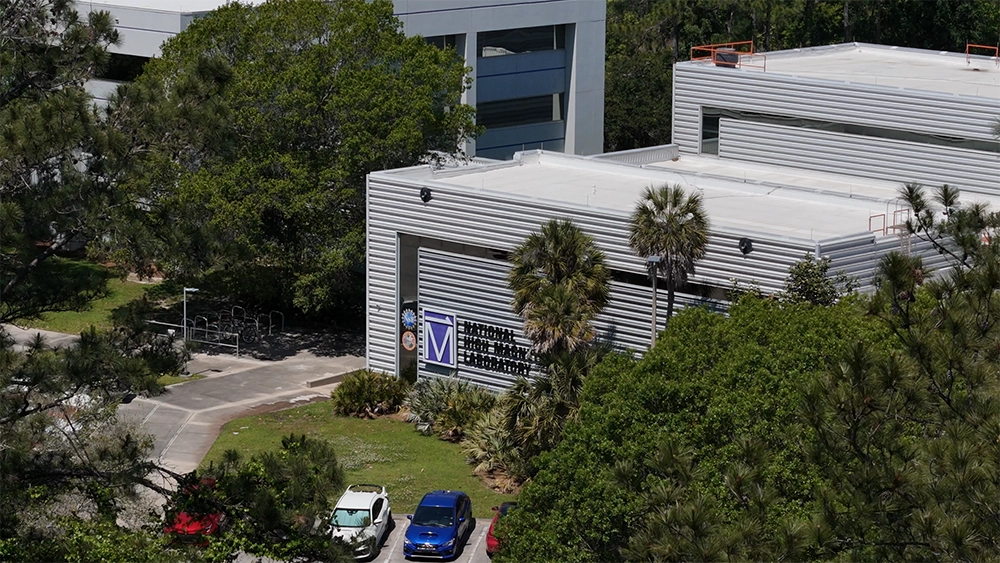 Over 500 in-house researchers study at MagLab. Photography courtesy of National MagLab.
Tomorrowland, Tallahassee
My visits evoke a good bit of wonder and also take me back to the 1960s when, as a child, I would hang out with my father, a technician at FSU’s nuclear physics lab, home to the EN Tandem Van de Graaff accelerator—one of only two in the United States at the time. The lab had all the bells and whistles out of a 1950s sci-fi movie, from the blinking, wall-sized control banks to the massive, room-filling cylinder of the accelerator itself. My dad’s pals were engineers who designed nuclear generators for third-world countries and invented things like the air-bearing turntable. The Space Race was on, and I even scored the autograph of an FSU chemistry professor named Anthony Llewellyn, who had been taught to dive by none other than Jacques Cousteau and trained at NASA for future Apollo missions. The missions never ended up happening, and Llewellyn dropped out of the program after a year. While none of this impelled me toward a career in the sciences—I barely made it out of 12th-grade physics with a C—my proximity to this world showed me that my hometown played a crucial role in exploring the New Frontier. All these decades later, it’s reassuring to see that Tallahassee has maintained its scientific edge.
On an afternoon in early December, I joined physicist Ali Bangura, a director in the lab’s DC (direct current) Field Facility, to observe some visiting scientists at work. The DC Field Facility is the largest of MagLab’s four user facilities located at FSU. The facility houses 14 magnets and 15,000 square feet of cooling technology, enabling scientists to make cutting-edge discoveries. At the moment, the researchers using the facility are from Sandia National Laboratories, which is part of the National Nuclear Security Administration. While Sandia’s origins lie in the Manhattan Project, America’s top-secret endeavor to invent the atomic bomb, the laboratory’s mission today is wide-ranging.
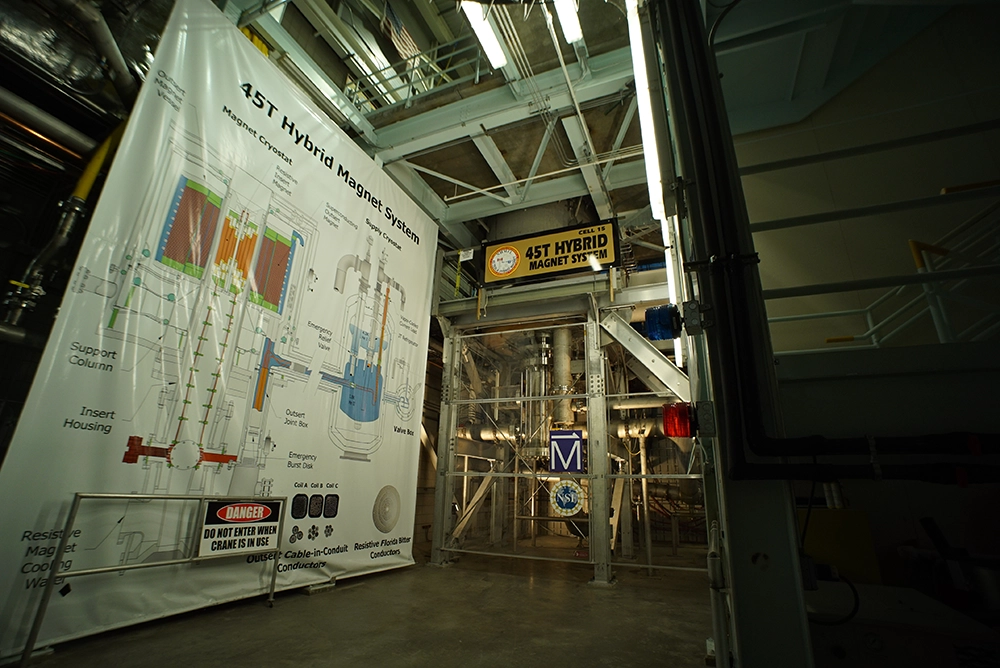 The 45 Tesla hybrid magnet takes up two stories and is the world’s strongest continuous-field magnet. Photography courtesy of National MagLab.
“They’re here to measure two-dimensional electron gas,” explains Bangura, who goes on to outline their research, which involves a material known as graphene—a honeycomb structure of carbon atoms and the thinnest two-dimensional material that exists. Used in everything from touchscreens to water purification, graphene is prized for its conductivity and strength, which exceeds that of copper and steel. The material was first isolated in 2004 by a pair of scientists who later won the Nobel Prize for their discovery, but graphene’s potential as a miracle material has only just begun to be realized.
Cool graphene down, and it behaves a certain way; apply a magnetic field, and graphene acts completely different. “There’s nothing predictive of what you end up with,” Bangura says. Its unique characteristics and ability to transform potentially give graphene limitless applications—from electronics and energy storage to drug and cancer treatments. Much of the work on graphene attempts to better understand and control its structure to best utilize it. “The aim is ultimately to model how this comes about and from that be able to design materials,” he says.
I believe that science can help everybody.
—Kathleen Amm
As Bangura is outlining all this, and a lot more, the Sandia scientists are busy on the second-level platform lab where we’re standing. The space has a warehouse vibe with bright overhead lighting, metal grates in the walls, fans, desktops cluttered with notepads, water bottles and gear. There’s the custom whiteboard with diagrams drawn in colored marker and a large metal rack stacked with electronic devices and cables sprouting everywhere, like the nerve system of a techno club.
As my eyes wander around, I notice a sign on the wall. “DANGER,” it shouts in bold red letters, and then in white: “OXYGEN DEFICIENCY HAZARD. Leave The Area Immediately If Blue Light Is Flashing.” Not to worry: Bangura assures it’s only an emergency if there’s a “major quench”—a rapid release of heat from the superconducting magnet that causes the space to fill with helium that’s expanded by a factor of 700. “The blue light would be on,” says Bangura, reassuringly. “We calculate to make sure that we don’t get stuck in here.”
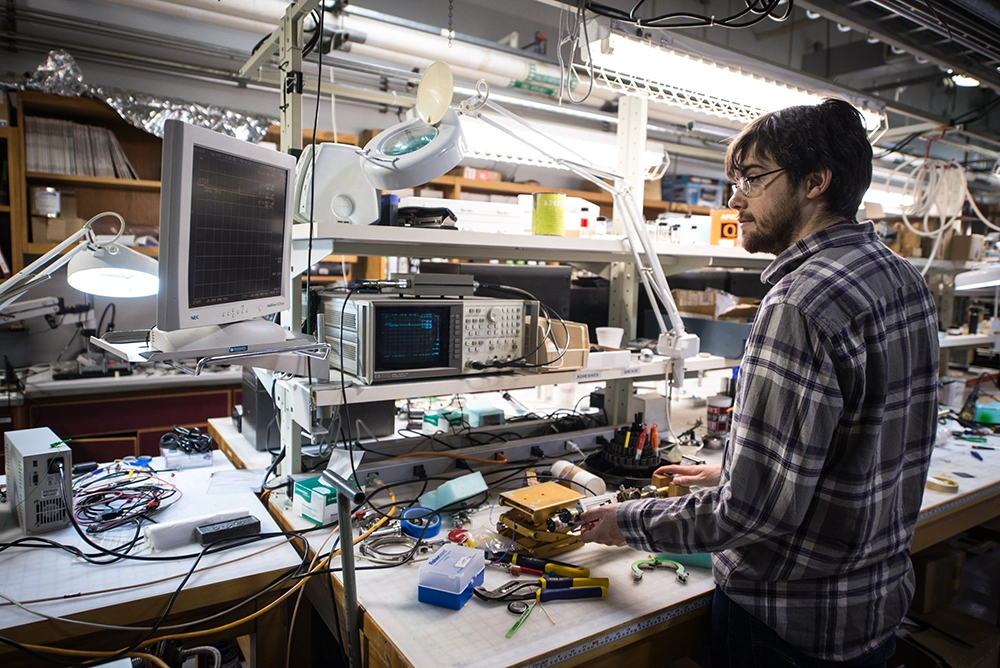 A researcher tests a probe, which is used to place samples inside magnetic fields. Photography courtesy of National MagLab.
In fact, we are standing inside what’s known as a Faraday cage. Inside, the windows are wrapped in copper mesh that blocks external energy, such as radio waves, from interfering with experiments. “Everything is very clean electrically,” Bangura says.
The facility feels unexpectedly transparent. It’s seemingly laid out for the public tours that happen once a month and the frequent sessions with Big Bend-area students. The site’s annual February open house draws up to 10,000 guests.
“I always like to say to people, ‘This is your MagLab,’” says Kathleen Amm, MagLab’s director, who began in May 2024 after having previously worked for GE Global Research and running the Magnet Division at Brookhaven National Laboratory in New York. “Your tax dollars are paying for it.”
Amm explains that a big part of MagLab’s mission to educate and to clarify public perceptions of their work. “I just finished watching the fifth season of ‘Stranger Things’ … (and) national labs are always mysterious things with these weird people that work there, and God knows what they’re doing.” She promises there are no Demogorgons lurking, “and we don’t have a black hole that we’re holding with magnets on top of the roof.”
Amm remembers the first time she saw the lab. It was 1993, on homecoming weekend, and she had driven south from Illinois while considering transferring to the FSU physics department as a graduate student. “It was under construction,” she says. “It was a very exciting time.” Jack Crow became her academic co-adviser. “He was really positive and full of energy. He just had a very bold vision that he made happen, and brought the team together to deliver the vision, too.”

As complex as the technological details can be, that vision remains fundamentally human. “I really do like the Star Trek universe,” Amm says. “I believe that science can help everybody. That’s what we’re about.”
High on the list of quantum leaps is the lab’s work on high-temperature superconducting magnets, developing new techniques essential to the fusion industry like one called torque magnetometry, which pushes toward the commercialization and promise of unending clean energy by the middle of the next decade. When that happens, the phrase “The MagLab did it again” is sure to resonate, as it has amid countless advancements over the past 30 years. All except one, as Amm reiterates with a note of regret. “We do not control the weather,” she says. “I really wish we could. But I just want to say to the poor people of Perry, we would never have directed hurricanes over you twice. We would have sent them out away from all the boats and away from everybody.”
For more Tallahassee tales, click here.
Illustration by Carly Berry.
Steve, a Tallahassee native and Flamingo contributor since 2017, has written about film, music, art and other popular culture for publications including The Wall Street Journal, The Washington Post, the Atlanta-Journal Constitution, GQ, and The Los Angeles Times. He is the artistic director for the Tallahassee Film Festival and writes a monthly film newsletter for Flamingo, Dollar Matinee.