
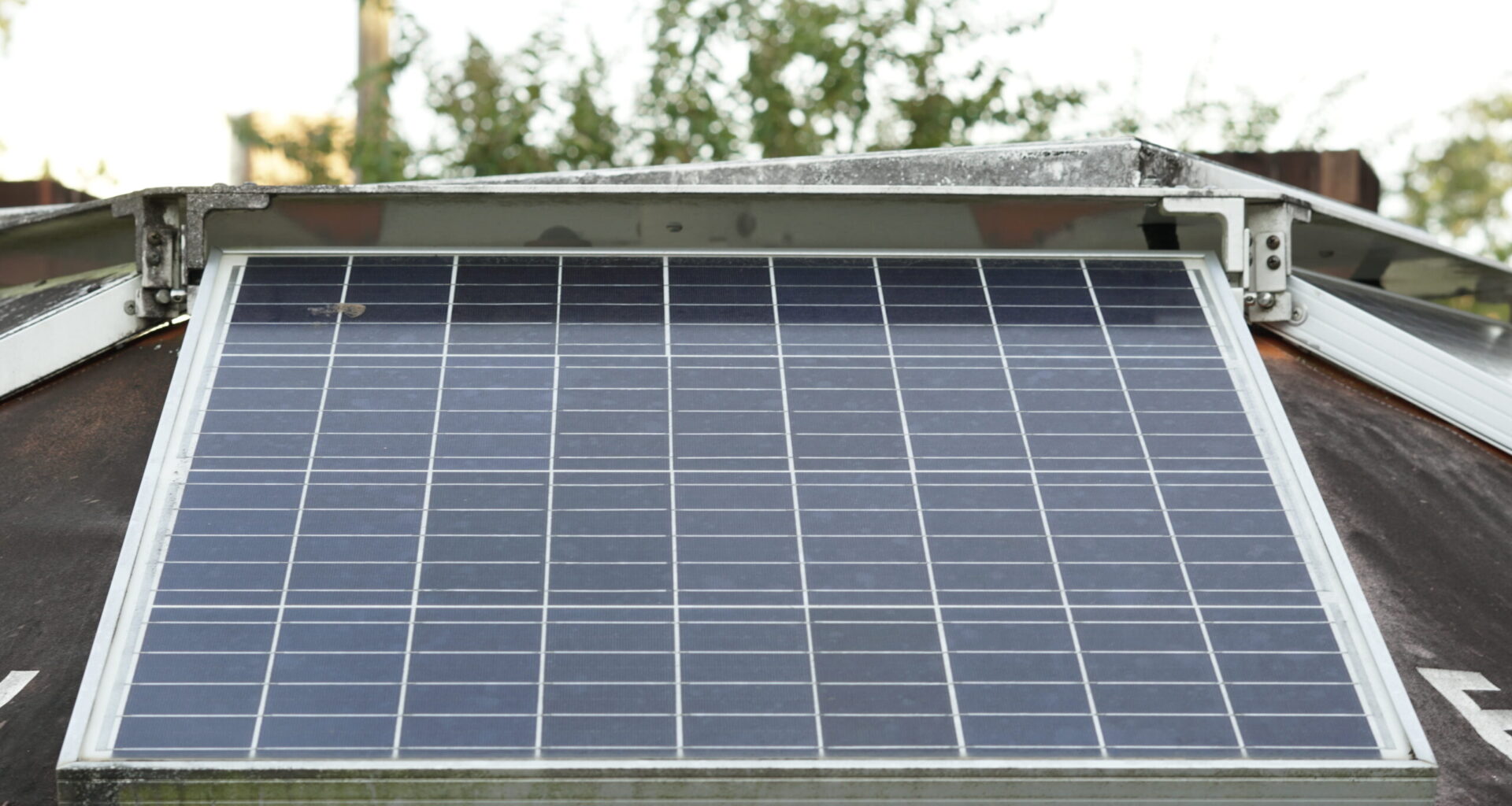
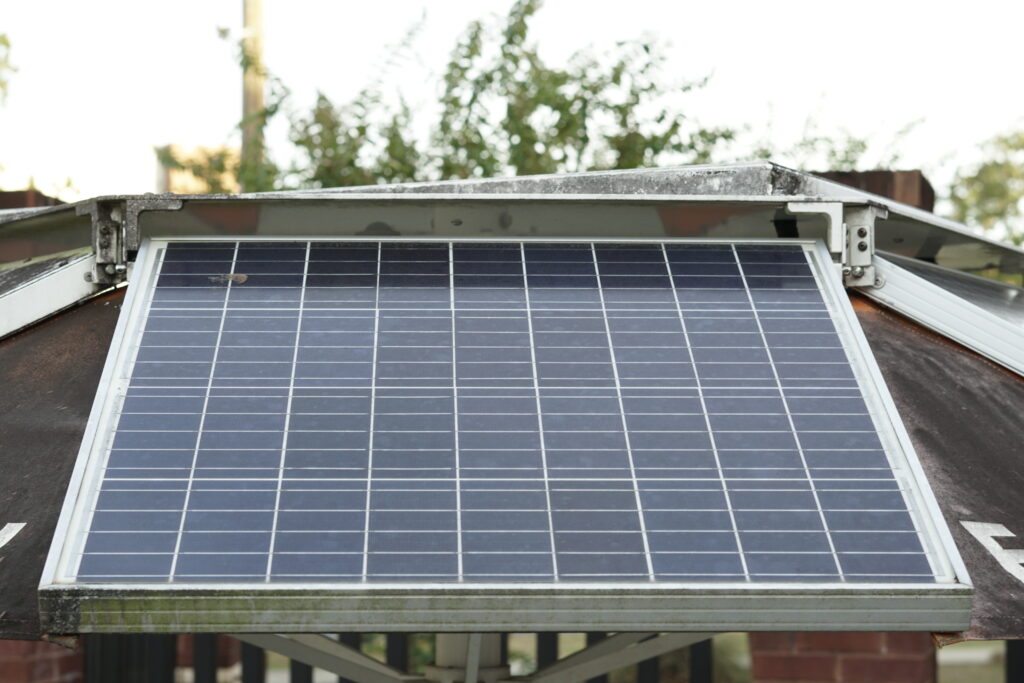
Solar panels spotted on FAMU’s campus. (Khalil-Lullah Ballentine/FAMUAN)
Despite the city of Tallahassee’s ambitious plan to achieve 100 percent net clean energy by 2050, residents and environmentalists argue that the current efforts implemented to effect change are insufficient, giving the overall progress a “C+.”
Introduced in 2023, Tallahassee’s Clean Energy Plan aims to address climate change through increased solar panel farming capacity, a focus on energy efficiency and the implementation of clean transportation.
“It was a herculean effort by several community groups spearheaded by ReThink Energy Florida,” said Bruce Strouble, Board Chair of environmental advocacy group ReThink Energy Florida. “The idea was that climate change is real. It’s a threat.”
Florida ranked third in total carbon dioxide emissions in 2023, according to the U.S. Energy Information Administration. The state totaled nearly 223 million metric tons that year, trailing behind California and Texas.
As record-breaking snowfall and dangerous heatwaves swept the city in 2025, climate change proved to be a pressing issue for Tallahassee and its surrounding areas.
FAMU’s Sustainability Club President Jasmine Winston identified how climate change affects surrounding areas.
“Take Jamaica, for example,” Winston said. “Lowest carbon footprints on Earth, but they’re the victims of catastrophic events caused by the increase of temperatures of water temperatures.”
“It’s the first step to system change in relation to climate advocacy,” Maya Shenefelt, a third-year environmental studies student at Florida A&M University, said. “[That’s] pretty much what the Clean Energy Plan is implementing. It’s a litany of problems that will cascade if we don’t take serious climate action as a species.”
However, some activists and residents are criticizing the plan’s progression, emphasizing the need to hold officials accountable.
According to PowerTLH, 42 percent of StarMetro buses switched to battery-electric, improving air quality. Talgov hybrid and electric vehicles have logged over 6.2 million miles, reducing more than 5.5 million pounds of carbon dioxide emissions.
Overall, the plan has been positively received by most residents.
“I think [the plan] would help,” said Maya Mancle, a master’s entomology student at Florida A&M University and longtime resident. “I think that [the climate issue] needs to be addressed.”
De’Jah Charles, a third-year political science student at FAMU and a member of genCLEO Action, an organization focused on climate education, believes that while ambitious, Tallahassee’s Clean Energy Plan is “very attainable.”
“It ultimately has a good intention behind it for the betterment of Tallahassee overall,” Charles said. “What’s so wrong with working hard for something that’s going to be good for us?”
In Tallahassee, natural gas is also a vital energy source, powering the majority of the city’s power plants. Approximately 95 percent of the city relies on natural gas, including many household appliances.
While considered the cleanest fossil fuel, burning natural gas still emits air and water pollutants, such as carbon dioxide and nitrogen oxides. The most unforgiving pollutant released from natural gas is methane, a greenhouse gas that makes a significant contribution to global warming.
While still in the experimental phase, the Clean Energy Plan aims to expand solar energy production with additional farms to combat this.
Michael Ohlsen, manager of Tallahassee’s Clean Energy Plan, said that various studies conducted by Tallahassee Electric Utilities have identified the need for additional plans to implement more solar energy as a reliable source of power for the city.
The study measured cost-effectiveness, energy efficiency and reliability to reduce the community’s energy footprint.
“The idea that if we invest in making our customers more savvy consumers of energy, that makes our role at the utility easier and easier,” Ohlsen said.
He also highlighted the need for a more streamlined approach to Tallahassee’s utilities and customer municipalities.
“[This] means [its] more cost-effective, less risk, more reliable system,” he said.
A proposal for additional solar panels is currently in the works.
“The outcome of that process is hopefully another solar farm or two,” Ohlsen said. “And that’s going to be a function for a number of things.”
Additionally, Adia Richardson, a member of FAMU’s Sustainability Club, proposed the idea of nuclear fission to be another source of reliable energy.
“It’s more efficient, it’s better on labor … people are just worried about nuclear fallout,” she said. “It’s definitely a big scare, … but nuclear energy can be an option.”
According Stanford University’s Understand Energy Learning Hub, nuclear energy accounts for about 9 percent of the world’s electricity generation and provides 20 percent of the world’s carbon-free electricity.
Nuclear energy is a zero-carbon resource that emits no air pollutions, however, radioactive waste is still a pressing challenge for nuclear energy, and around 4,000 uranium mines are abandoned and often on Native American reserves.
However, Tallahassee residents still seem frustrated with the progress made three years later.
“With the pace that it’s progressing, it’s so off track from the progress that should be made in the original outline,” Charles said.
Charles Jagoe, FAMU environmental studies professor, examined the need for environmental accountability.
“We all live in the same environment – we experience the same weather, and we depend on the environment for goods and services like food, clean air, and fresh water,” he said. “Things like climate change, pollution, and overuse of resources threaten all of these and will affect our economy and our health.”
Strouble, of ReThink Energy, called for more transparency in the plan’s progression, suggesting more public reports, opportunities for public comments and consistent updates.
“[The city] should be doing annual reports on this, and I don’t think that they have,” he said. “It’s getting to the point where we kind of need to go back and demand the city to show us kind of where we are in the process.”
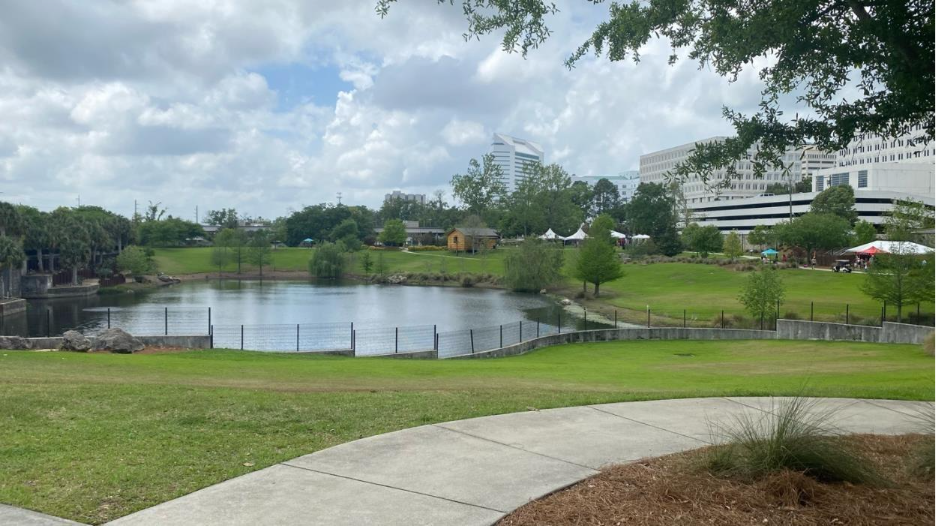
The view of Cascades Park. (Naji Rutherford/FAMUAN)