
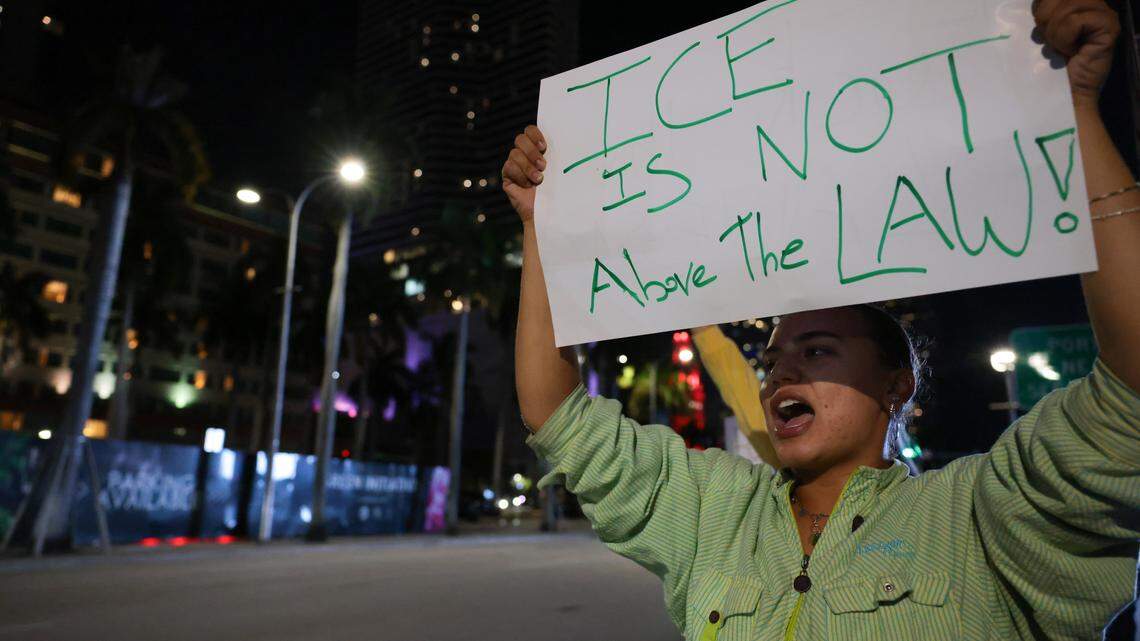
File photo of an ICE protest at the Torch of Friendship monument at 401 Biscayne Blvd, in downtown Miami on Jan. 7, 2026.
SAM NAVARRO
Special for the Miami Herald
The reality of President Trump’s campaign promise to carry out “mass deportations” has taken shape — and it’s ugly, even for some of the people who supported his return to the White House. His chaotic and cruel immigration enforcement tactics should weigh the heaviest on Miami-Dade, a Hispanic-majority county built largely by immigrants that Trump flipped in 2024.
Florida now has the distinction of leading the nation for Immigration and Customs Enforcement arrests, according to an analysis by the New York Times published Friday. The state outpaces places like Minnesota, which had widely announced surges in enforcement. ICE’s Miami field office — which covers the state, Puerto Rico and the U.S. Virgin Islands — made 41,310 arrests since Trump returned to the White House last January, the most of any office. Florida also had one of the highest numbers of arrests per capita — ahead of New York and California, which also have large immigrant populations — but lower than Texas’ border towns, the Times found.
Is this what Miami voted for? When voters heard “mass deportations,” did they envision undocumented migrants without criminal records who had been in the U.S. for decades being deported? What about the people — some married to U.S. citizens — arrested during their immigration hearings? Or Trump’s efforts to bypass due process?
The Trump administration, many voters assumed, would go after the “worst of the worst” — immigrants with serious criminal records. But many people who have not been accused or convicted of crimes have been caught up, too.
The number of people held by ICE increased nearly 75% in 2025 — but there was a 2,450% increase in arrests of people with no criminal record, according to the nonprofit American Immigration Council. The percentage of migrants held in detention with no criminal record rose from 6% in January 2025 to 41% by December.
How did ICE achieve these lamentable numbers? Through tactics like “at-large” arrests, worksite raids and the “re-arrests of people attending immigration court hearings or ICE check-ins,” according to the organization.
Certainly, some immigration hardliners will say that every migrant here illegally should be deported. As Gov. Ron DeSantis said recently, “This idea that unless you’re an axe murderer you should be allowed to stay, that is not consistent with our laws, and it’s also not good policy.”
But presidents don’t win elections simply by energizing their most ardent ideological supporters. Trump won because he brought new voters to his coalition, notably Latinos who were concerned about the cost of living. Trump’s approval erosion among this particular group of voters suggests that many people gave Trump a chance to prove he would ease inflation and bring more order to an immigration system that he convinced them was erratic under Democrats. Instead, in electing Trump they chose someone who would allow the pendulum to swing too far the other way, creating more chaos and, above all, unnecessary suffering.
Republicans are starting to acknowledge this reality. Last week, a group of conservative Florida sheriffs criticized mass deportations of undocumented migrants who haven’t committed crimes. The White House has told U.S. House Republicans to avoid mentioning mass deportations ahead of the midterms and focus only on deportations of violent criminals, the Washington Post reported.
“This is not what we voted for,” Miami Republican state Sen. Ileana Garcia, co-founder of Latinas for Trump, said in a statement last June in which she called the administration’s mass-deportation campaign “inhumane.”
Understandably, her words were met with derision by critics: This is exactly what she and others voted for. How can we forget Trump accusing undocumented immigrants of invading the U.S. during the presidential campaign, or standing on the debate stage and accusing Haitians in Ohio of eating people’s pets? What did people assume “mass deportations” would entail?
Perhaps what Garcia and millions of others thought they voted for was a sense of security and order — with the details arranged later. We’re over a year into Trump’s second term and Miami is witnessing, in real time, that Trump has given us exactly the opposite.
BEHIND THE STORY MORE What’s an editorial?
Editorials are opinion pieces that reflect the views of the Miami Herald Editorial Board, a group of opinion journalists that operates separately from the Miami Herald newsroom. Miami Herald Editorial Board members are: opinion editor Amy Driscoll and editorial writers Isadora Rangel and Mary Anna Mancuso. Read more by clicking the arrow in the upper right.
What’s the difference between an op-ed and a column?
Op-Eds, short for “opposite the editorial page,” are opinion pieces written by contributors who are not affiliated with our Editorial Board.
Columns are recurring opinion pieces that represent the views of staff columnists that regularly appear on the op-ed page.
How does the Miami Herald Editorial Board decide what to write about?
The Editorial Board, made up of experienced opinion journalists, primarily addresses local and state issues that affect South Florida residents. Each board member has an area of focus, such as education, COVID or local government policy. Board members meet daily and bring up an array of topics for discussion. Once a topic is fully discussed, board members will further report the issue, interviewing stakeholders and others involved and affected, so that the board can present the most informed opinion possible. We strive to provide our community with thought leadership that advocates for policies and priorities that strengthen our communities. Our editorials promote social justice, fairness in economic, educational and social opportunities and an end to systemic racism and inequality. The Editorial Board is separate from the reporters and editors of the Miami Herald newsroom.
How can I contribute to the Miami Herald Opinion section?
The Editorial Board accepts op-ed submissions of 650-700 words from community members who want to argue a specific viewpoint or idea that is relevant to our area. You can email an op-ed submission to oped@miamiherald.com. We also accept 150-word letters to the editor from readers who want to offer their points of view on current issues. For more information on how to submit a letter, go here.