
By: Cassidy Delamarter, USF College of Education, and Jeremy Maready, Bellini College of Artificial Intelligence, Cybersecurity and Computing
As the demand for cybersecurity professionals continues to rise, new research from
the University of South Florida identified a growing interest among higher education
institutions to incorporate work-based learning in cybersecurity programs to help
close the gap between academic preparation and the skills employers are seeking.
The study, by Associate Professor Oscar A. Aliaga and Assistant Professor Noémi Nagy in the College of Education’s Leadership, Policy and Lifelong Learning department,
examines work-based learning in cybersecurity programs in higher education institutions
around the country.
Published in the Journal of Cybersecurity and Privacy, the research highlights the importance of hands-on learning to better prepare students
for the rapidly evolving workforce.
“This is critical in an environment where technology is rapidly changing and the workforce
has to adapt to those changes,” Aliaga said. “Strengthening programs with the use
of work-based learning can create a more scalable, inclusive and career-ready cybersecurity
talent pipeline.”
USF College of Education graduate students, Bonnie Gómez Torres, Ajara Mahmoud and
Courtney Callahan, helped map how work-based learning vary across programs and found
opportunities are most prevalent in associate degrees, which are two-year degree programs.
Aliaga recommends expanding these opportunities and strengthening partnerships between
higher education institutions and employers to provide the talent pipeline with experiential
learning and close potential skill gaps.
The findings in the study reflect the model being advanced in USF’s Bellini College of Artificial Intelligence, Cybersecurity and Computing, where partnerships with industry leaders such as Idaho National Laboratory, ConnectSecure,
Rapid7, Timus Networks and help provide students with invaluable experiential learning
opportunities through training, course collaboration and internship opportunities.
“Experiential learning is essential in a field like cybersecurity, where the tools,
threats and technologies are constantly evolving,” said Kurt Friday, an assistant professor in the Bellini College. “By working closely with industry
partners, we give students unique classroom opportunities to apply classroom lessons
to real-world challenges and better prepare them for careers in the field.”
Friday teaches two experiential learning courses, Cybersecurity Tools for Workforce
Readiness and Computing Tools for Workforce Readiness, developed with input from industry
partners, advisory board members and faculty members, along with an analysis of job
market trends and in-demand skills valued by employers.
These efforts are designed to equip students with practical experience in areas such
as threat detection, threat intelligence and AI-enabled security operations. These
skills are increasingly important, particularly in Florida, as the Tampa Bay region
grows into a cybersecurity hub.
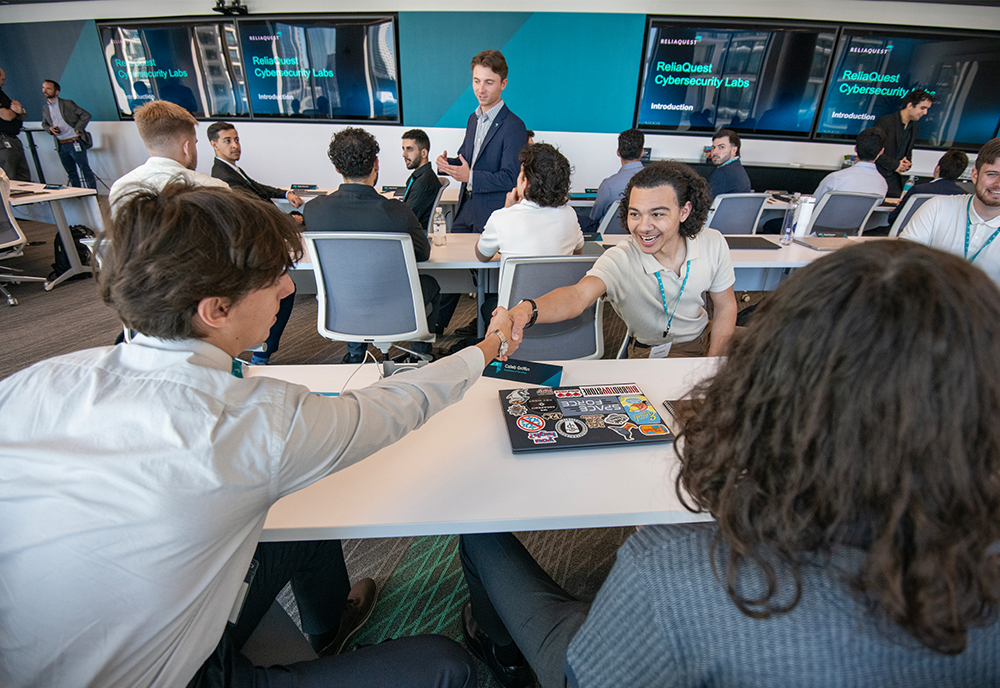
One of the college’s key partnerships is through the annual RealiQuest Labs program.
The highly competitive program, which is a partnership between ReliaQuest and the
USF’s Bellini College, gives students the opportunity to work through real-world security
scenarios, collaborate with industry professionals and gain experience using the tools
and processes found in modern security operations centers.
Students work in teams to analyze threats, investigate simulated incidents and develop
the practical skills needed to defend organizations from cyberattacks.For many, the
experience is their first glimpse into what cybersecurity looks like beyond the classroom.
Since it began in 2018 – originally led by the Muma College of Business – more than
300 USF students have participated in the program. Many go on to interview for paid
internships or full-time roles with ReliaQuest.
“Our goal is to create an educational environment where students don’t just learn
about cybersecurity and AI, they have opportunities to actively practice it in real-world
settings,” said Sudeep Sarkar, launch dean USF’s Bellini College. “Through experiential
learning and strong industry collaboration, our graduates are prepared to contribute
from day on