
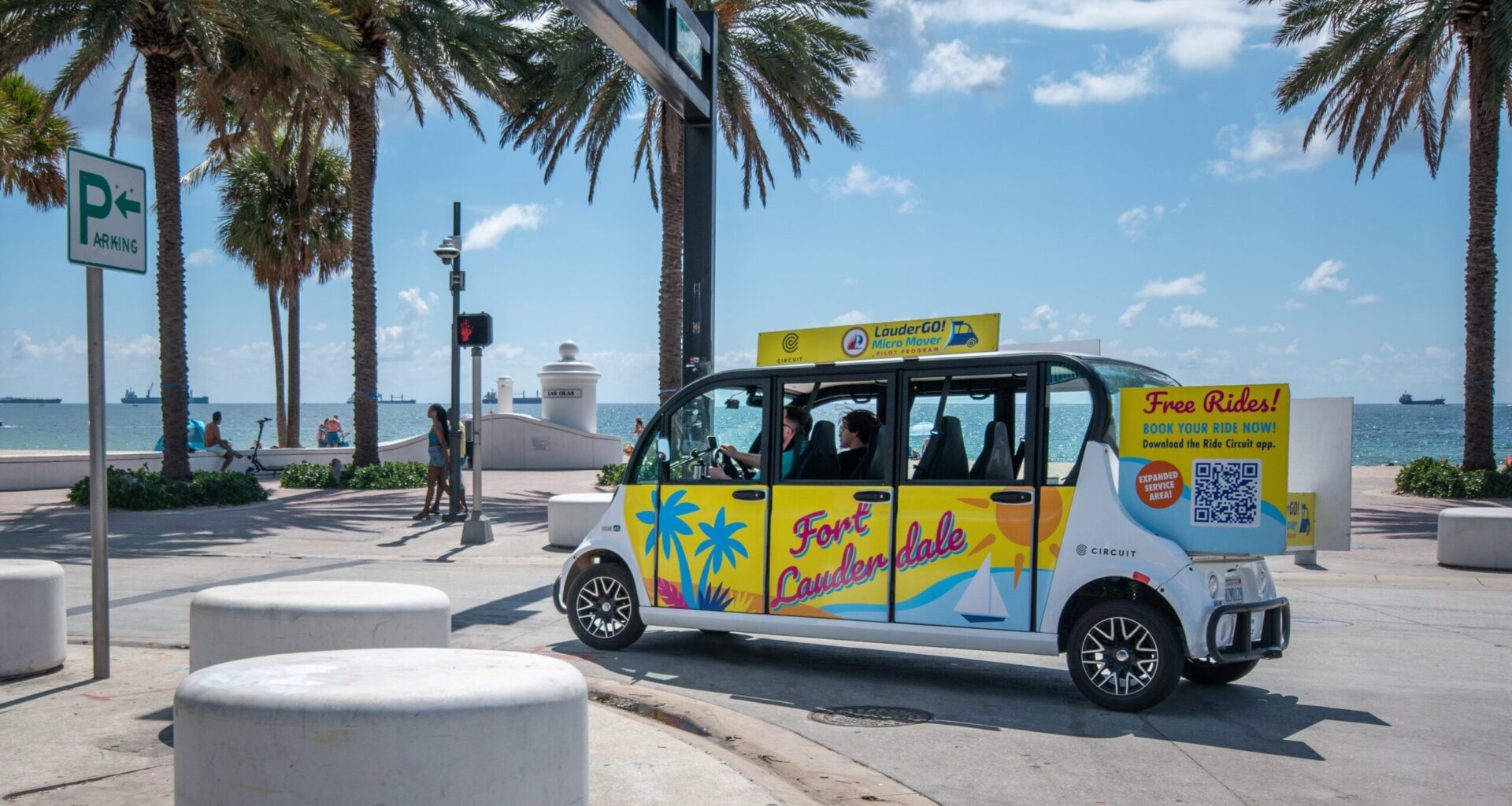
 A LauderGO! shuttle travels along the beach in Fort Lauderdale. [Odessa Buell]
By Nile Fortner | New Pelican Writer
Along Broward County’s coastline, microtransit has finally come into its own.
Electric shuttles now glide through downtown corridors, along A1A, and between neighborhood hubs, connecting communities from Fort Lauderdale to Lauderdale-By-The-Sea and north to the streets of Pompano and Deerfield. What began as local transportation pilots has evolved into a connected coastal network.
Over the last several months, the electric shuttle services in Pompano Beach (Pompano Circuit), Fort Lauderdale (LauderGO!), and Lauderdale-By-The-Sea (Circuit-By-The-Sea) have reported ridership milestones; 500,000, 700,000, and 250,000, respectively and over 1.4 million, collectively.
Together, those figures signal more than isolated achievements. They reflect a regional shift in how short trips are handled in cities built long before today’s traffic volumes.
“Reaching 700,000 riders shows that people are actively seeking flexible, convenient, and sustainable ways to move around their cities,” said Katie Cook, head of marketing for LauderGO! “It’s proof that urban mobility is shifting toward more adaptable, community-focused solutions.”
Public transit can carry riders most of the way, like to a train platform, a bus stop, or the edge of a commercial district, but not always to the final destination. That “last mile” often becomes a barrier, especially in South Florida’s heat. Microtransit is designed to close that gap.
When the City of Fort Lauderdale launched LauderGO!, the mission was simple: connect the dots. The free, app-based service complements Broward County Transit and links riders to hubs such as Brightline and Tri-Rail while weaving through neighborhoods from Galt Ocean Mile to northwest Fort Lauderdale. The program now handles more than 500 ride requests per day.
In Lauderdale-By-The-Sea, the setting is smaller, but the impact is equally visible. In the compact beach town, where the surf draws diners and beachgoers, Circuit-By-The-Sea has operated since April 2023 as a 100 percent electric shuttle service. Riders can request trips throughout town and to nearby parts of Fort Lauderdale, including the Coral Ridge Mall, for a modest fare. Shuttles run seven days a week and accommodate up to five passengers, including wheelchair-accessible vehicles.
“Reaching 250,000 riders is a wonderful achievement for our Circuit-By-The-Sea program,” said Mayor Edmund Malkoon. “The service has quickly become a convenient and sustainable way for residents to get around town and visit our local businesses and lodging options, all without needing a car.”
Popular stops include Plunge Beach Resort, 101 Ocean, and Aruba Beach Café, underscoring how microtransit supports both mobility and local commerce.
“Circuit-By-The-Sea is about more than transit,” said Circuit Partner Jason Bagley. “By creating local W-2 jobs and driving riders to neighborhood restaurants, groceries, and attractions, this program makes it easier for residents and visitors to benefit from everything the community has to offer.”
The momentum extends beyond two municipalities. From Pompano Beach’s redeveloping downtown to Lighthouse Point, Deerfield Beach, Hollywood, and Wilton Manors, coastal communities are exploring flexible electric fleets as tools to manage growth without widening already constrained roads. Every milestone in one city appears to strengthen the next.
“In South Florida, where cities like Fort Lauderdale, Hollywood, Pompano, and Wilton Manors are closely connected, that creates a network effect,” said Cook. “People travel to neighboring areas and look for Circuit in each place they go.”
In Pompano Beach, Circuit’s electric shuttles circulate through the city’s revitalized downtown and beachfront areas, reinforcing redevelopment efforts. Circuit’s fare-free electric shuttle has carried more than 10,000 passengers per month as part of the city’s beach and downtown mobility grid, helping residents and visitors navigate local destinations without driving. In Deerfield Beach, the Freebee electric rideshare, a free service connecting neighborhoods west of Federal Highway to businesses east of the corridor, logged 2,778 passengers in October 2025 alone, showcasing substantial uptake even in a smaller pilot zone.
Cook added that operating in close proximity makes each local program stronger.
“We can operate more efficiently,” said Cook. “Scale faster, and deliver a more consistent rider experience across the area.”
About 65 percent of LauderGO! trips are shared rides, meaning multiple passengers travel in a single vehicle instead of separate cars. Since its launch, Fort Lauderdale’s program has prevented more than 325 metric tons of carbon dioxide emissions, aligning with broader local climate goals. “Microtransit is designed to connect riders to larger transit hubs and corridors, not replace them,” said Cook.
In a region shaped by tourism, growth, and tightening roadways, solutions that ease congestion don’t stop at city limits. They strengthen mobility and sustainability across South Florida’s coastal communities. “Over the next decade, microtransit will become even more integrated into city transportation systems,” said Cook. “As cities work to reduce congestion and emissions, on-demand electric shuttles will play a central role in how people move.”
From Fort Lauderdale to Lauderdale-by-the-Sea and beyond, electric shuttles are becoming part of the region’s transportation fabric, and quietly redefining what it means to get from here to there.