
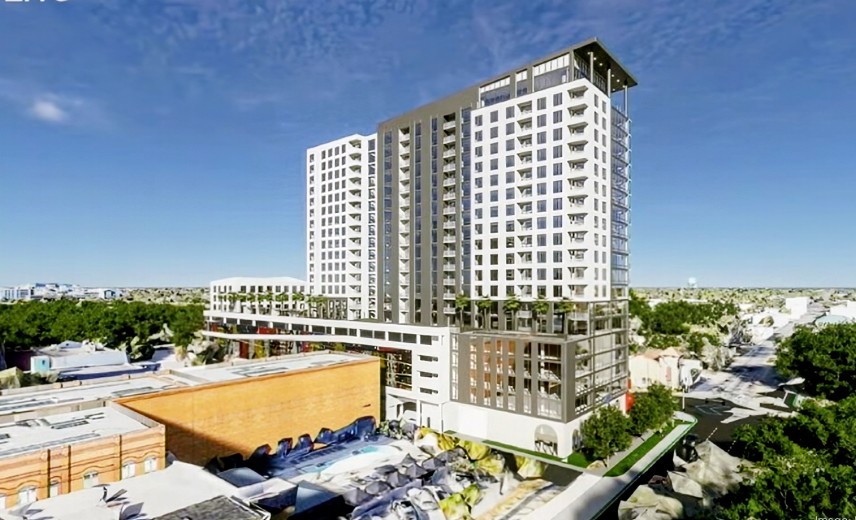
The St. Petersburg City Council denied an appeal from Preserve the ‘Burg Thursday, clearing the way for the controversial Pelican apartment development to move forward.
The appeal stemmed from a January 2026 decision by the Development Review Commission.
Subsequently, on Jan. 20, Preserve the ‘Burg, a nonprofit organization dedicated to protecting, educating and celebrating the historic, architectural and cultural heritage of St. Petersburg, formally challenged that approval.
Under city procedures, the burden of proof rested on the appellant. In defense of their appeal, Preserve the Burg’s Advocacy Chair Peter Belmont argued that the project was inconsistent with multiple sections of the city’s Land Development Regulations (LDR), particularly regarding compatibility with surrounding neighborhoods.
Preserve the ‘Burg contended that the development’s height and overall “intensity” would negatively impact nearby homes and fail to transition appropriately from denser downtown areas into lower-scale neighborhoods.
While the group raised concerns about the demolition of existing historic structures, its appeal was grounded in code compliance and compatibility standards, not a formal historic designation effort.
“The argument [against the Pelican apartments] is deeply rooted in code,” said Manny Leto, executive director of Preserve the ‘Burg, during Thursday’s meeting. “[The development is] incompatible in mass and scale [with the surrounding neighborhood]; it does not taper down from the city center; it demolishes historic resources with no mitigation; it’s over-parked by nearly 50% per city code.”
Preserve the ‘Burg emphasized that its appeal was not part of broader, overzealous opposition to development, noting that out of 68 development proposals reviewed since 2024, the organization has only opposed three. This marked its first formal appeal since 2019.
Their core argument focused on compatibility: that the project exceeds what current code intends by introducing a level of density and scale not reflected in adjacent development.
They also argued the project represents an “area of greater intensity than any other building under current code,” raising concerns about precedent if approved.
Representing the developer, attorney Don Mastry pushed back, contending that the appeal misinterpreted the city’s regulations and that the project meets all applicable LDR standards, including those governing height, density and compatibility.
“The appellants misapply and misinterpret the Land Development Regulations,” Mastry said. “There’s no basis to accept the appeal.”
He further argued that city staff and review bodies had consistently found the project compliant, noting that all relevant departments recommended approval.
“I don’t think you have the right,” Mastry pleaded to council members, “not to enforce the laws of the city.”
The appeal required a supermajority vote to overturn The Pelican project’s approval. It ultimately fell short, receiving four votes in favor, one shy of the five needed.
Council members Gina Driscoll, Deborah Figgs-Sanders, Richie Floyd and Lisset Hanewicz voted to support the appeal, while Copley Gerdes, Corey Givens and Mike Harting voted to uphold the development. District 2 Councilwoman Brandi Gabbard was absent and did not cast a vote.
A final appeal may still be filed within 30 days.