
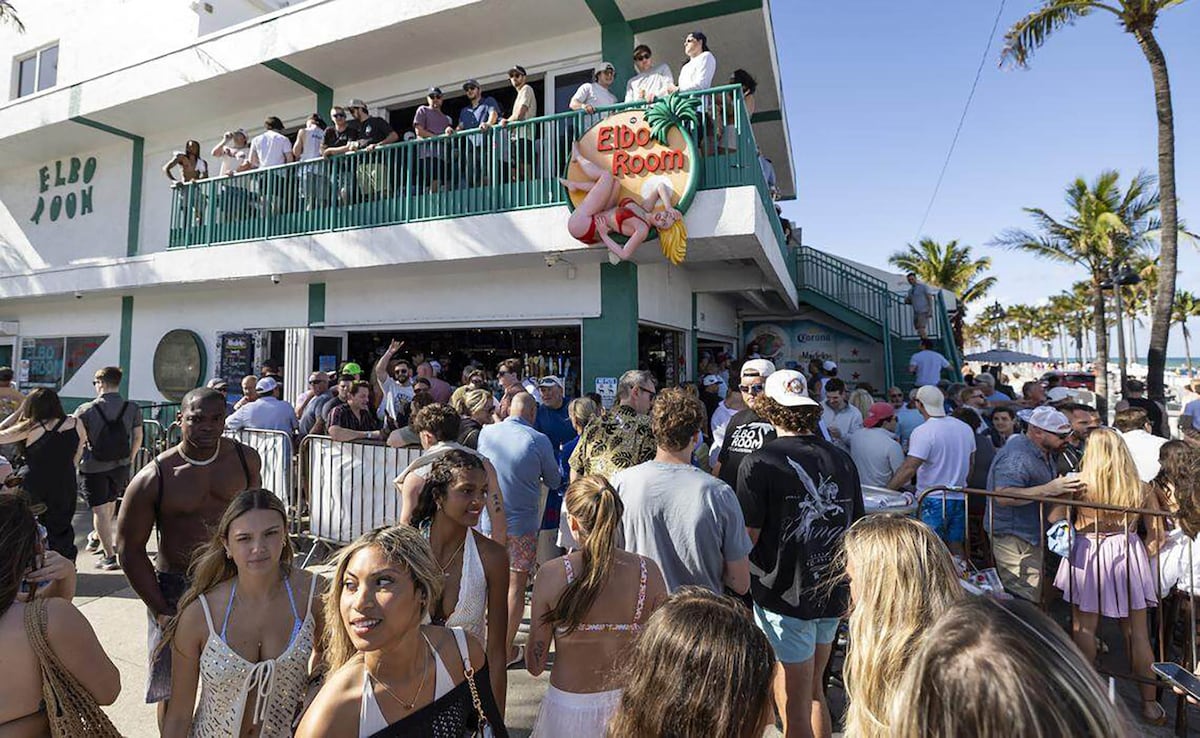
The change took some young people by surprise as they arrived in Miami Beach this week for spring break — the vacation period in the United States when millions of students travel to tourist destinations, especially beaches. In South Beach, there were a few sunbathers, but the scene was nothing like previous years, when a sea of people filled the central Ocean Drive, the cafés and bars, the dunes, and the sand. They soon learned through social media that “everyone” was at the neighboring beach in Fort Lauderdale, in Broward County, about 40 miles to the north.
“They didn’t get the memo. Miami Beach dumped spring break,” joked one person in a TikTok video that received dozens of comments. “Now there’s a fitness event instead,” wrote one. “Pathetic,” said another.
For decades, Fort Lauderdale was the spring break mecca of South Florida. But in the late 1980s, after years of unrest, authorities tightened the rules, and the flow of spring breakers began to shift to Daytona Beach to the north and Miami Beach to the south. That pattern seems to be repeating itself now.
Miami Beach, the epicenter of spring break for nearly two decades, “divorced” itself from spring break two years ago due to a record increase in crime during the season, which peaked in 2023 with two fatal shootings. “The city of Miami Beach was concerned about public safety, not only in relation to crime, but also because of the perception among residents and visitors that it was not a safe place,” explains Alex Piquero, a professor of criminology at the University of Miami.
The city launched an advertising campaign with the pun “Miami Beach Is Breaking Up With Spring Break […] And it’s not us, it’s you. We just want different things,” seeking to discourage large parties and disorder. Authorities implemented curfews, banned alcohol consumption on the beach, closed municipal parking lots, and increased fines.
This week, local authorities celebrated that the measures have worked, reporting 253 arrests in the area during the season, a 24% reduction compared to last year.
“We can welcome visitors from all over the world while still protecting the quality of life for our residents,” says Commissioner Alex Fernandez, one of the initiative’s main proponents. “Great cities don’t choose between fun and order; they demand both, and that’s exactly what we’ve achieved.”
A city spokesperson noted that businesses have “strongly” supported the plan and praised “the shift toward a more welcoming and wellness-focused environment” with “key safety measures.” The spokesperson also highlighted that hotel occupancy is 7.5% higher than last year.
But the economic impact has been uneven, depending on the type of business. Over the past two years, bars and nightclubs in South Beach, as well as restaurants and cafés, have reported a drop in sales, and some business owners say the new rules have driven away some of their traditional clientele. The city will hold public meetings with residents and business owners next month to assess the results.
Rubén Torres, a retiree who lives near South Beach, is pleased with the changes. “The beach is empty, there’s no trouble,” he says, in contrast to previous years when he witnessed police chases and groups leaving restaurants without paying.
Although Fort Lauderdale has implemented similar measures, the shift of spring breakers to that beach suggests that it’s not just the restrictions themselves that matter, but how they are perceived and enforced. The atmosphere and official language are different. “Welcome, spring breakers! We’re happy to have you here,” says the city’s website.
Fort Lauderdale police say the influx of tourists has not resulted in an increase in serious incidents. According to statistics provided to this newspaper, more than 1,100 citations have been issued so far this month, with only 49 arrests, mostly of local residents. The majority of the violations are related to alcohol consumption and disorderly conduct.
“In U.S. popular culture, there’s a perception that spring break is a time for young people to ‘let loose,’ a notion often reinforced by the media. This fuels the idea that groups of young people travel to behave inappropriately. However, it’s important not to fall into these prejudices,” says Marta Soligo, a tourism expert and professor at the University of Nevada, Las Vegas. In many cases, students simply enjoy this vacation to relax and behave responsibly, she adds.
This week, hundreds of young people crowded the beach at the end of the central Las Olas Boulevard in Fort Lauderdale Beach, while mounted police patrolled the area. Some vacationers took pictures with the horses, played volleyball, and others live-streamed everything. Although some have complained about the heavy police presence and the fact that the beach closes after 5:00 p.m., the general perception is one of greater permissiveness.
An employee at Nanou French Bakery and Café in Las Olas says the visitors have been “very nice people” and he’s happy they’ve had more customers this season. “We can’t complain.”
As night falls, the atmosphere in Las Olas transforms. Some walk barefoot in bikinis, while others wear beach shirts, dresses, and heels. At the bars where there’s a live band or a DJ, there are lines to get in.
Sign up for our weekly newsletter to get more English-language news coverage from EL PAÍS USA Edition