
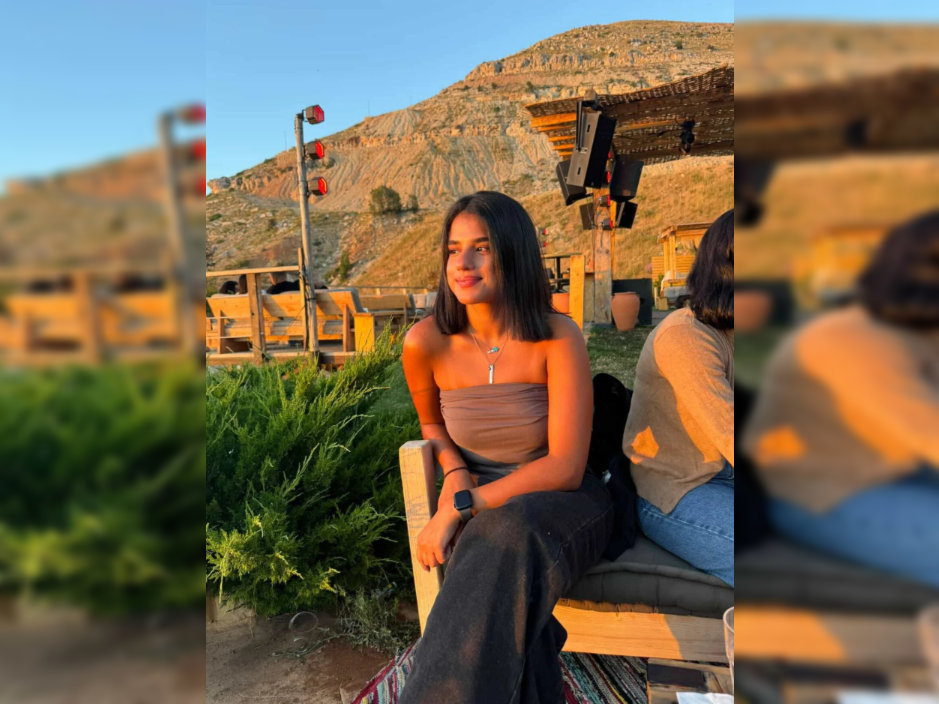

Graduate student Sarah Al Asmar immigrated from Lebanon to the United States, with plans of using her public policy degree to approach systemic issues that affect her home country.
Courtesy of Sarah Al Asmar
When Sarah Al Asmar arrived at UCF in 2024 to pursue her master’s degree in public policy, she brought more than just a desire to excel in academia.
She brought the weight of lived experience; growing up in Lebanon during political and economic turmoil, and a defining moment that would shape her future career: the Beirut port explosion of 2020.
“When the explosion happened, everything changed; how I approach my personal life, the way I view the citizens, the way I view Lebanon, everything changed,” Al Asmar said. “I truly believe that there was a life before the explosion.”
Al Asmar is from Jezzine, a village 25 miles south of Lebanon’s capital, Beirut. At a young age, Al Asmar moved to Broummana, a town in the Matn District of the Mount Lebanon Governorate. She said that the explosion led her to pursue a degree in public policy.
“I’m here on a Fulbright scholarship because I’m researching how weak policymaking led to the Beirut explosion,” Al Asmar explained. “I want to prove that all the policymakers in Lebanon knew about the presence of the explosive material but chose to do nothing about it.”
On Aug. 4, 2020, a major explosion tore through the Port of Beirut, taking the lives of more than 218 people. Thousands were injured and hundreds were left homeless due to the devastation. Over 2,750 tones of ammonium nitrate stored in a port warehouse were to blame, according to Al Jazeera.
The National Library of Medicine reported that Lebanese government agencies failed to adequately identify the hazard risk associated with the storage of large volumes of explosive chemicals in an urban site.
For Al Asmar, the explosion is one of many events that affected her life while growing up in Lebanon. When Al Asmar was four years old, the 2006 Lebanon war between Israeli forces and the Iranian-backed militia, Hezbollah, broke out. The conflict lasted from July 12 to Aug. 15, according to EBSCO.
“My earliest childhood recollection is seeing smoke over Beirut,” Al Asmar said when talking about the war. “Every few months, a bomb would go off in random towns to kill politicians and journalists.”
Now, Lebanon is stuck in a similar conflict as Israeli forces continue to trade ballistic missile strikes with Hezbollah once again. This comes after United States and Israeli forces used missiles to strike Iranian senior officials, killing the country’s Supreme Leader, Ayatollah Ali Khamenei, according to Al Jazeera.
“This conflict is going on for two reasons,” said Dr. Houman Sadri, a political science professor at UCF. “Hezbollah wants to punish Israelis for killing the supreme leader of Iran, while Israel is targeting those Hezbollah strongholds that restarted the conflict between the two groups.”
Regardless of all the turmoil that Al Asmar found herself in for most of her life, one former colleague of Al Asmar said that she still found a way to be optimistic amidst these challenges.
“Despite the challenges and tensions that people in Lebanon experience, she continues to show up with optimism, commitment, and a strong work ethic,” Safa Salem, a former colleague of Al Asmar, said. “Sarah genuinely loves her country and always keeps Lebanon at the forefront of her thinking, even when working on international projects.”
Salem lives in Lebanon and formerly worked with Al Asmar on Lebanese comedian John Achkar’s content team. She believes that Al Asmar approaches everything she does with curiosity and rigor.
“She [Sarah] approaches everything she does with a deep sense of curiosity, rigor and responsibility,” Safa said. “Sarah also has a rare ability to bring out the best in others.”
Al Asmar first came to the United States in 2018 as a high school exchange student through the U.S. Department of State’s Kennedy-Lugar Youth Exchange and Study program. According to the department, the program brings high school students from countries of strategic importance around the world to live and study for an academic year in the United States.
“So, I spent one year at a high school in Arizona in 2018, where my whole purpose was to be a young ambassador for Lebanon,” Al Asmar said. “After that year, I went back home and finished my senior year and then completed my bachelor’s degree.”
Al Asmar originally wanted to be a doctor, but after coming to the United States when she was 16, she said she realized that there were misconceptions about Lebanon.
“I wanted to become a doctor and study medicine, but when I came to the U.S. at 16, I realized that there’s a lot of misconception and misunderstanding about where I come from,” Al Asmar said. “I would say that I’m from Lebanon, and people would not know what Lebanon or the Middle East was.”
During her first stay in America, Al Asmar had the opportunity to visit Capitol Hill and met former Arizona U.S. Rep. Debbie Lesko.
“The conversation I had with Lesko changed my life,” Al Asmar said. “She [Lesko] told me that she’s never met someone as passionate about their country as me.”
After finishing her junior year in Arizona, Al Asmar returned to Lebanon and graduated from high school. She then graduated with her bachelor’s in political science and international affairs, with a minor in legal studies from the Lebanese American University in Beirut. After this, she received a scholarship to attend the University of Helsinki.
“During the bachelor’s, I got another scholarship to do a semester abroad at the University of Helsinki in Finland,” Al Asmar said. “I did politics, media and communication.”
Staying connected to Lebanon remains central to her goals. While she is focused on completing her graduate degree, she hopes the knowledge and skills she gains will eventually allow her to contribute to policy solutions that address issues that have rocked Lebanon to its core.
Batroun, Lebanon, is UCF graduate student Sarah Al Asmar’s home. After the Beirut port explosion of 2020, Al Asmar said she wants people to know that Lebanon is a place where people thrive and want to make a good life for themselves.
Courtesy of Sarah Al Asmar
“I have a passion for policy making because I saw what it means to live in a developed country,” Al Asmar said when talking about her time in Helsinki. “Lebanon is not developed because citizens don’t have adequate water, power or public transportation.”
Salem said that a sense of analytical thinking is what sets Al Asmar apart.
“Professionally, Sarah stands out because she combines strong analytical thinking with a very human approach to her work,” Salem said. “I love how she thinks deeply about the impact of the work and she always looks for ways to elevate it.”
As Al Asmar looks forward to completing her master’s degree and pursuing a doctorate, she represents a growing group of international students whose academic paths have been shaped by global events.
Al Asmar said she hopes people know that there is more to Middle Eastern countries than just war.
“My only hope is that our stories get told because often, countries in the Middle East always get lost in the stories of war,” Al Asmar said. “I feel like I want people to think of Lebanon as a place that is not masked by terror or conflict, but as a place where people thrive and want to make a good life.”