
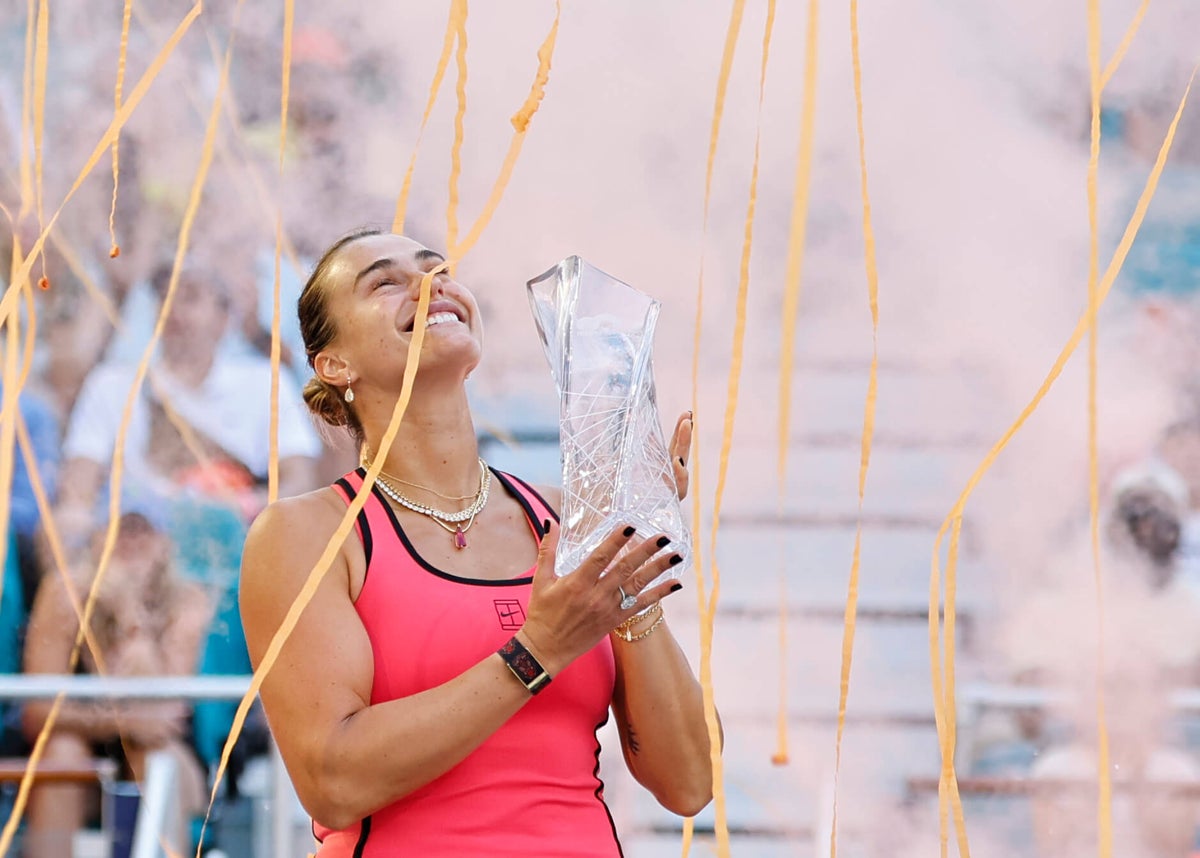
MIAMI GARDENS, Fla. — This was all set up to go the wrong way for Aryna Sabalenka.
Coco Gauff. In a final. In Gauff’s backyard at the Miami Open.
All that looked like it might spell trouble for the world No. 1. But with a multidimensional attack that had Gauff guessing all afternoon, Sabalenka powered to a second consecutive triumph at Miami Gardens with a resilient and redemptive 6-2, 4-6, 6-3 victory over the hometown favorite.
With the win, Sabalenka became just the fifth woman to complete the trick known as the Sunshine Double — winning the BNP Paribas Open at Indian Wells and the Miami Open in the same year.
Thirteen days ago, Sabalenka had to save match point in a championship-deciding tiebreak against Elena Rybakina to prevail on a 97-degree day in the Coachella Valley. Nearly two weeks later and some 2,500 miles away, the Miami Open brought a far different challenge.
The head-to-head record between Sabalenka and Gauff was tied at 6-6. But Gauff had beguiled Sabalenka in two of their biggest matches. She twice came back from a set down, first in the 2023 U.S. Open final and then in the 2025 French Open final. Sabalenka’s lone victory over Gauff in a final came at last year’s Madrid Open.
When Sabalenka sliced a backhand into the net to give Gauff the second set, the planets looked like they were lining up for another heartbreaking collapse in a rowdy and rocking building.
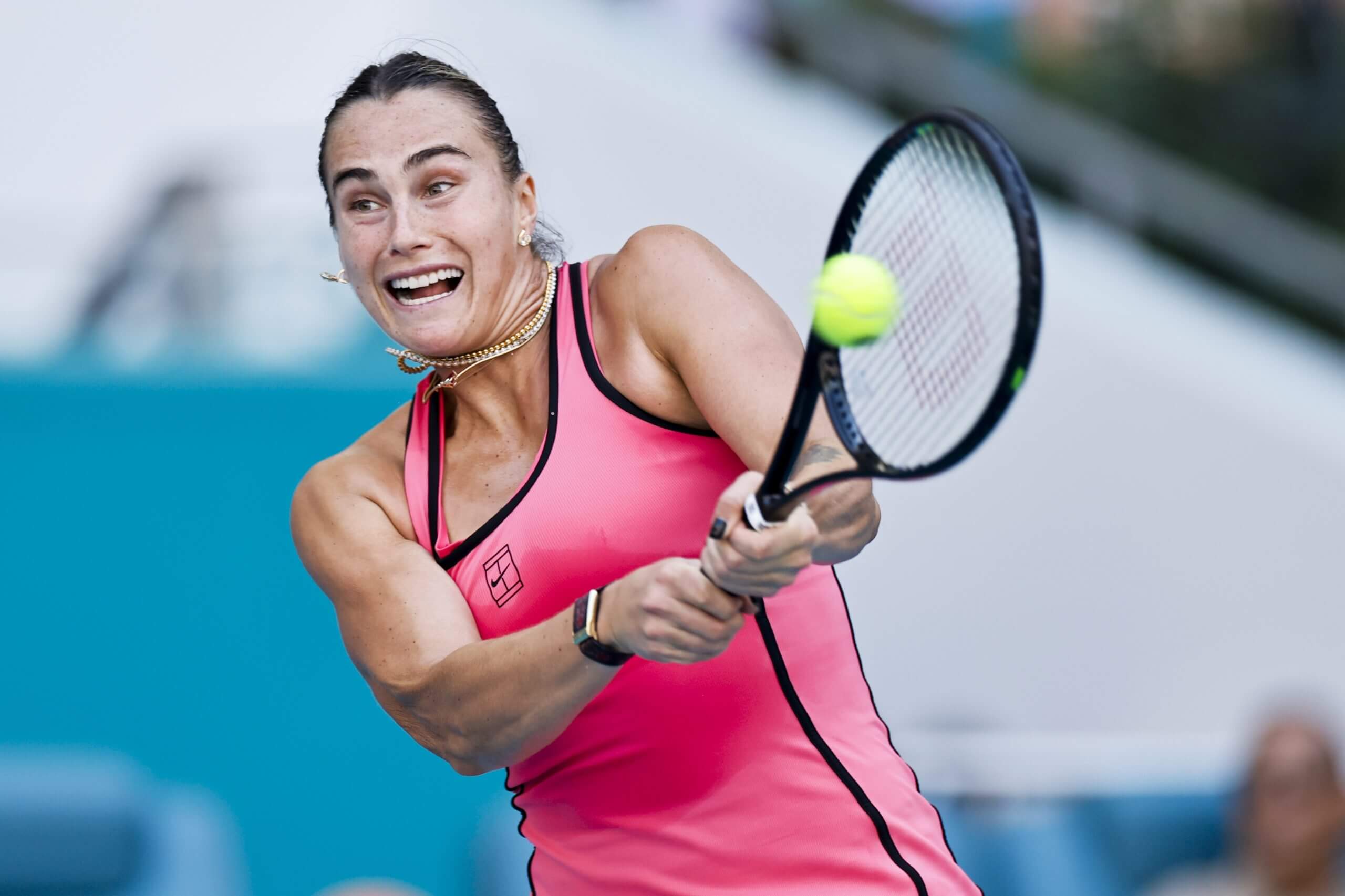
Aryna Sabalenka returns a shot against Coco Gauff during the Miami Open women’s singles final at Hard Rock Stadium. (Carmen Mandato / Getty Images)
Sabalenka makes her home in Miami and felt the love in all of her matches the last 10 days, especially with Brazilians who flock to this tournament and have adopted her since she became engaged to a Brazilian entrepreneur. Still, facing Gauff 45 minutes from her childhood home is a unique dynamic.
Sabalenka, though, has evolved both mentally and as a tennis player since that French Open loss. On Saturday afternoon, with a bit of tennis history on the line, she never let the crowd or the moment get to her, staying calm amid the “Let’s Go Coco!” chants and occasional jeers when Sabalenaka committed the inevitable untimely errors that come with her power game.
She also has more reliable weapons at her disposal. So often when Gauff has staged her dramatic big-match comebacks, Sabalenka has gone down with her power, trying to hit through Gauff, who uses her speed to keep getting balls back until Sabalenka made an error.
On Saturday in Miami, Sabalenka resisted overhitting. Instead, sometimes she broke sidelines with soft, curling topspin forehands that were too far and too soft for even Gauff to catch up to. She played balls high over the net that pinned Gauff in the back of the court and let her opponent make errors.
She kicked in serves that sent Gauff off the court and gave Sabalenka a huge open target to shoot at with her next shot. She swiped a gorgeous topspin lob to get to match point. One was all she needed. She roped a backhand return to the middle of the court, watched Gauff’s backhand sail long, and swung her arms in the air.
In truth, the key moment had occurred about 30 minutes before. Just when Gauff had grabbed the momentum, Sabalenka seized it right back, getting the decisive break in the first game of the third set.
Gauff seemed to have that game under control, spinning an ace to reach 40-30. But then she double-faulted for a sixth time to let Sabalenka back in at deuce. On the next point, she sent a deep, hard backhand an inch over the baseline. Sabalenka had an opening and didn’t waste it, leaning into a short backhand and rolling it down the line for a break.
Sabalenka front-ran from there. She didn’t allow Gauff another break point, then broke her serve once more to clinch the title.
Speed and precision from @SabalenkaA 💪#MiamiOpen pic.twitter.com/mylpCB09uW
— wta (@WTA) March 28, 2026
It was a fitting end for Sabalenka, who had broken Gauff to start the day, and for Gauff, who hinted at a breakthrough for most of the afternoon. She repeatedly took early leads in Sabalenka’s service games.
Too often, perhaps wanting to do too much to give the hometown crowd a reason to roar, she hit long or into the net on rally balls. She didn’t earn her first chance to break Sabalenka’s serve until the second game of the second set, when her running backhand passing shot looped past Sabalenka as she moved toward the net. Gauff pumped her fists and let out a scream.
Hard Rock Stadium, the building where Gauff has come for years to cheer on her NFL team, the Miami Dolphins, erupted and shook. Something was about to happen, wasn’t it? It sure seemed like it when Sabalenka floated a short, high-bouncing ball and Gauff stepped in for the kill. But she topped the ball and spun it into the middle of the net.
Gauff would finally draw even, giving what sounded like 15,000 of her friends and members of her family who dominated the building a chance to scream like they wanted to.
That was all Sabalenka needed to hear to put her on notice that letting Gauff get ahead would be a very dangerous idea. She didn’t. There wasn’t going to be another collapse this time.
It’s not clear when there will be another one. Sabalenka is 23-1 this season. She has played four tournaments, won three and made the finals of the other.
Sabalenka lost her temper momentarily when a fan yelled during a point and cursed at the crowd, earning a warning for obscenity from the chair umpire. Sabalenka apologized for the profanity during the awards ceremony.
The moment did nothing to sap the joy from what has been a magical March for Sabalenka. She won two of the biggest tournaments outside of the Grand Slams, she got engaged, and she got a puppy.
“Dog, engagement, Sunshine Double, it’s surreal,” she said after the match.
Everyone else can only look on with awe.
“She trusts her game, I think 100 percent, and trusts herself, and when you’re playing like that, it’s so easy,” Gauff said in her news conference. “I’ve had moments in my career where I felt very similar, where you just feel like no matter what happens today, you’re going to win.”
That feeling, and the results that come with it, do not get old. But Sabalenka’s hatred of coming up short keeps her motivated more than her love of winning.
“I hate that feeling of losing a match,” she said in her own news conference. “I cannot sleep. I dream tennis. I hate myself for making several mistakes that cost me a match. So I hate that feeling, and just because of that, whenever I go out there, I just really try my best, and I try to do everything that is possible to get the win.”
She also knows she hasn’t achieved anything like the past legends have, and she wants to see how close she can get.
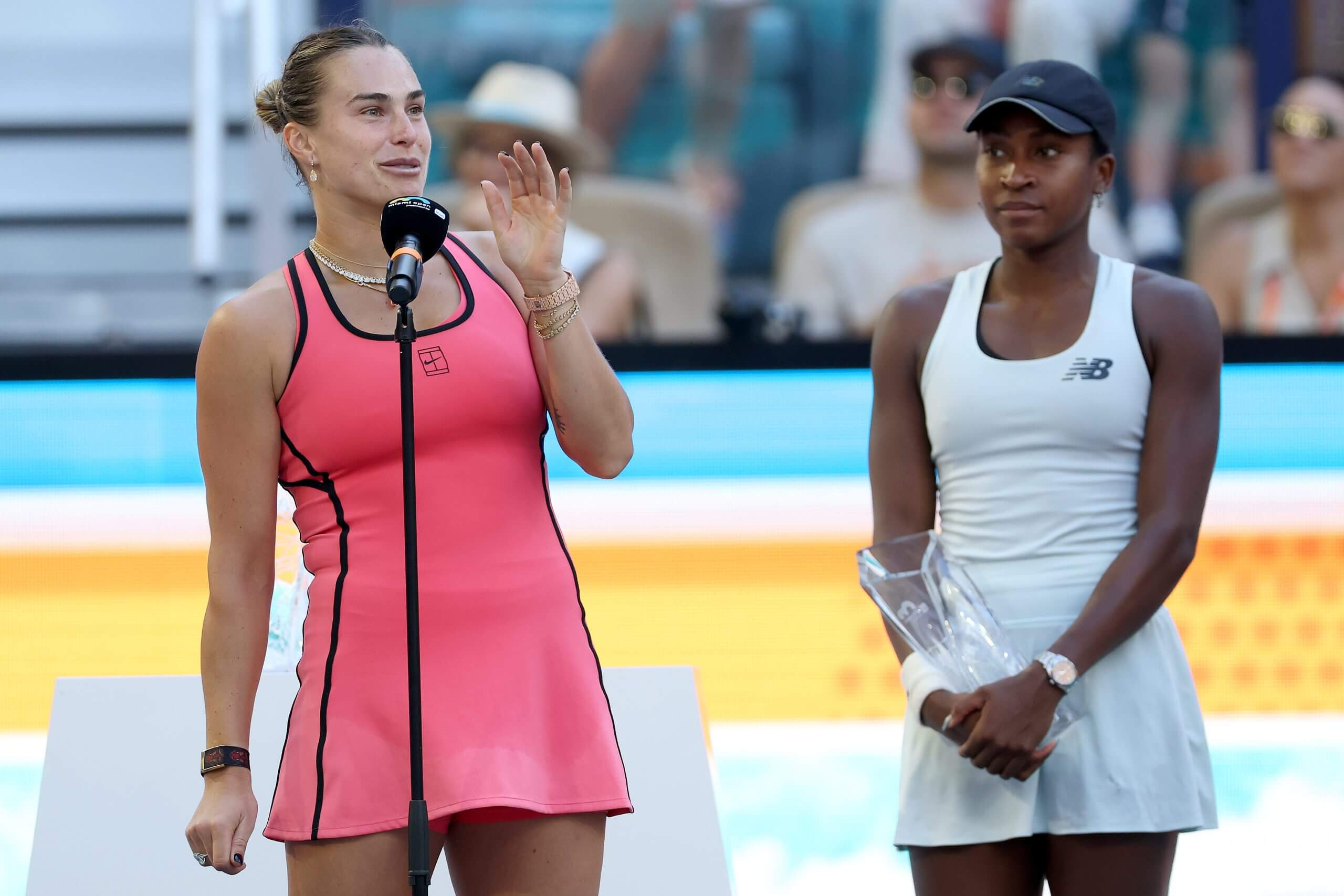
Aryna Sabalenka addresses the crowd at the trophy ceremony after defeating Coco Gauff (right) in three sets. (Matthew Stockman / Getty Images)
For Gauff, there were a couple of minutes of sad eyes as she sat on her bench waiting for the awards ceremony to begin. Then, as she started to speak, they passed quickly. Before long, Gauff was smiling on the stage, amazed that she had made this run to the finals after months of frustration as she tries to retool the two most important shots in the game, her serve and forehand.
She found success in a tournament where the slick, hard courts often don’t help her much, and where she had never advanced past the fourth round before this year. Despite losing, this tournament could eventually represent a pivot point in her career.
After months of frustration and not knowing if she would be able to complete the most basic shots from match to match, or even game to game, she appeared to find some solutions. Throughout the tournament, she had success turning up the gas on her first and second serves in tight spots, or hitting high kickers out wide that baffled opponents.
By the finals, she had largely eschewed the awkward defensive forehand that she had been hitting off her back foot, though it still appeared from time to time. In its place, she’s shortened her swing, bent her knees and leaned into shots.
More than that, though, tennis seemed to stop wearing on Gauff in Miami the way it has ever since she won her second Grand Slam title in Paris last June. Being home helped. So did entering the tournament with no expectations after retiring from a match at Indian Wells with a nerve issue that caused pain in her left arm.
Winning helps, too. But there have been big tournaments where the pressure has grown and the enjoyment has dropped as she has marched through the draw. That didn’t happen in South Florida.
“I can be a very result-based person at times and revolve my life around if it’s going good or not based on my tennis, and I don’t think that’s healthy,” Gauff said.
“Sometimes in the past, especially when I’ve played tournaments, maybe I’ve never played it well here, but when I played tournaments that I’m defending or things like that, in the first round I’m thinking about the final, and this week I wasn’t doing that, so I think it’s something that I can take on.”
Sabalenka has taken on a version of that. She used to tighten up in key moments. Now she has decided that there really are no key moments, just moments.
They all require the same thing: Stick with the game plan, play solid tennis and remember that she is good enough and strong enough to handle just about anything. And then she proves that she is.