
By Paul Guzzo, University Communications and Marketing
The landscaping around the University of South Florida’s Fine Arts Building is neat
and organized – trees planted in straight rows along the sidewalks in a grid formation.
But outside the adjacent Contemporary Art Museum, a small cluster of trees breaks
formation – zigzagging unexpectedly away from the sidewalk.
Hard to spot at first, but once noticed, impossible to ignore.
It looks like an error or natural growth — maybe even a long‑ago prank — but it’s
neither.
It’s art.
The pattern is a spontaneous installation its creators never imagined would survive.
As the story goes, six decades ago, students quietly shifted flags marking where the
trees were supposed to be planted. The landscaping crew followed the markers exactly.
To many observers, the tale has all the ingredients of an April Fools’ stunt. But
the students behind it were firm: this wasn’t mischief. It was intention — a living
installation by USF’s charter class, a subtle disruption woven directly into the emerging
campus.
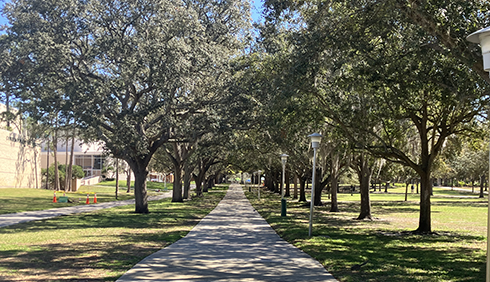
The trees around USF’s Tampa campus typically line the sidewalks [Photo by Paul Guzzo,
University Communications and Marketing]
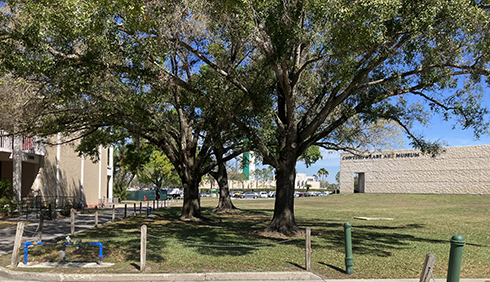
But these outside the USF Contemporary Art Museum are haphazard [Photo by Paul Guzzo,
University Communications and Marketing]
Today, as USF celebrates its 70th anniversary, those trees still stand as a quiet
monument to the university’s earliest creative spirit.
“It was an aesthetic decision,” said Robert Stackhouse, an internationally renowned
artist and member of USF’s charter class who participated in the activity. “We were
advanced arts students and very protective of our building. We didn’t want our building’s
landscaping to look exactly like everywhere else. We wanted it to be unique, like
us. And now it’s part of USF history.”
A campus finding its shape
When USF opened to students in 1960, the campus looked less like a university and
more like a desert mirage — three buildings, lots of sand, almost no sidewalks and
just scattered trees.
Art students didn’t have their own space. Instead, during USF’s inaugural year, they
used classrooms in the Administration Building and were without dedicated studios
or performance venues.
The following year, when Harrison Covington was named chairman of the Department of
Art, he moved them into the basement of the student center.
“We were in a windowless basement, right next to the ping pong table and billiards
room,” Stackhouse said with a laugh.
Construction of the Fine Arts Building began in 1962 as part of USF’s first major
expansion. It opened in June 1964, giving the campus’s most colorful students a long‑overdue
place of their own.
“Years later, Harrison told me that the artists, thespians and musicians were our
football team back then,” Stackhouse said. “We didn’t have any sports, but our productions
and art shows brought people to campus and kept us in the news.”
And at the time, Covington mimicked a hard‑nosed football coach.
“We loved him, but he was a disciplinarian,” Stackhouse said. “He always scheduled
master painting classes at 8 a.m.”
The tree-planting episode was made possible largely by circumstance.
When access meant possibility
Artist-in-residence and abstract painter Friedel Dzubas was given studio space inside
the new facility.
“We never would have been in any position to move the flags without that studio created
just for him,” Stackhouse said.
When Dzubas’ residency ended, Stackhouse was allowed to use the same space for a three-month
term — giving him and his friends rare after-hours access to a building and grounds
still taking shape.
“They figured someone might as well make use of it,” Stackhouse said. “It was on the
northeast corner of the arts building. My friends would come in to hang out, and we’d
listen to Miles Davis’ ‘Sketches of Spain’ over and over again.”
Meanwhile, it was at that time, according to the USF Library’s Special Collections
records, that the university began sprucing up campus with a major landscaping push
that transplanted mature magnolias, oaks and cedars around keyacademic areas, including
the Fine Arts Building.
“One night, my friends showed up and said that flags had been placed on either side
of the walkways, noting where they would plant trees,” Stackhouse said. “We went outside
to look and someone said something like we didn’t want trees in a boring row leading
up to the arts building. So, we picked up the flags and placed them haphazardly. It
was our art project for the night. We wanted it to look more natural. Consider it
an artistic intervention.”
When Stackhouse graduated in the fall of 1965, the flags were still waiting to be
replaced by trees. Once they were, as the mismatch became more noticeable, it was
assumed the trees were naturally growing rather than transplanted – as was the students’
intention.
From playful act to permanent mark
Stackhouse went on to earn a master’s degree from the University of Maryland and display
paintings and sculptures in art museums throughout the United States and internationally
before returning to USF for an exhibition of his work in 1981 and another in 1992.
It was during that second one that Covington, who had since heard of the flag prank
from other graduates, pointed out the trees to Stackhouse.
“I was certainly surprised,” Stackhouse said with a laugh. “I remember once writing
my name between some bricks as a student, thinking I could come back one day and find
it — a little legacy. That didn’t work out, but the trees did.”
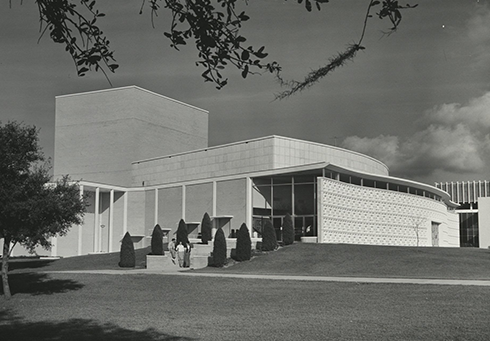
The Fine Arts Building in the 1960s [Photo courtesy of USF Special Collections]
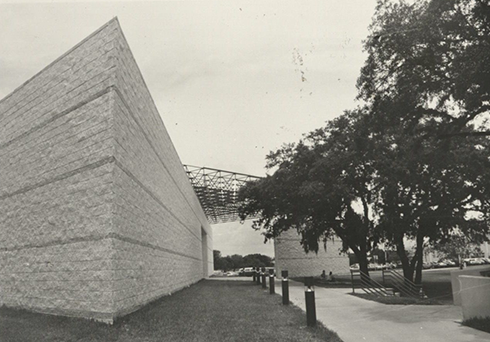
The Contemporary Art Museum in 1989 [Photo courtesy of USF Special Collections]
Stackhouse also said that Covington told him the trees had influenced the planned
footprint of the neighboring Contemporary Art Museum, which opened in 1989 — prompting
architects to adjust the building’s placement rather than remove the trees.
A late-night act of spontaneous artistic expression may have quietly shaped one of
USF’s signature buildings.
“I guess the architects looked at those randomly placed oak trees and said that because
they were natural growth, they shouldn’t cut them down,” Stackhouse said. “Instead,
they designed the museum around them. I remember saying, ‘Wow, I didn’t realize we’d
done something that monumental.’”
Campus lore confirmed
The museum’s architect, Peter Gottschalk, said he can’t recall whether trees impacted
his work, so that part of the story might be forever unsubstantiated, even if true.
But the relocation of the flags has been verified by others.
Peter Foe, who studied photography at USF from 1972 to 1976, said one of his instructors,
Jim Oliver, told him he participated in the flag‑moving and tree‑planting.
“I know that I had heard the story from a couple of other sources during my time at
USF too,” said Foe, who also worked at USF’s Contemporary Art Museum for more than
20 years. “It’s accurate.”
And Kristin Soderqvist, who has been at USF for more than 40 years — first as an arts
student and now as director of sales and marketing for Graphicstudio — said she’s
heard it from a number of Stackhouse’s former classmates who recall when it happened.
“When you are walking across campus, do you ever notice the perfectly manicured landscaping?”
Soderqvist said. “Every tree in a perfect line, crepe myrtles in happy rows, palm
trees standing at attention, until you get to the Fine Arts Building. Some of the
oldest oaks on campus seem out of place, a bit haphazard. Well, you can thank the
artist Robert Stackhouse and his friends.”
It’s a reminder that sometimes art doesn’t hang on a wall. Sometimes, it takes root.