
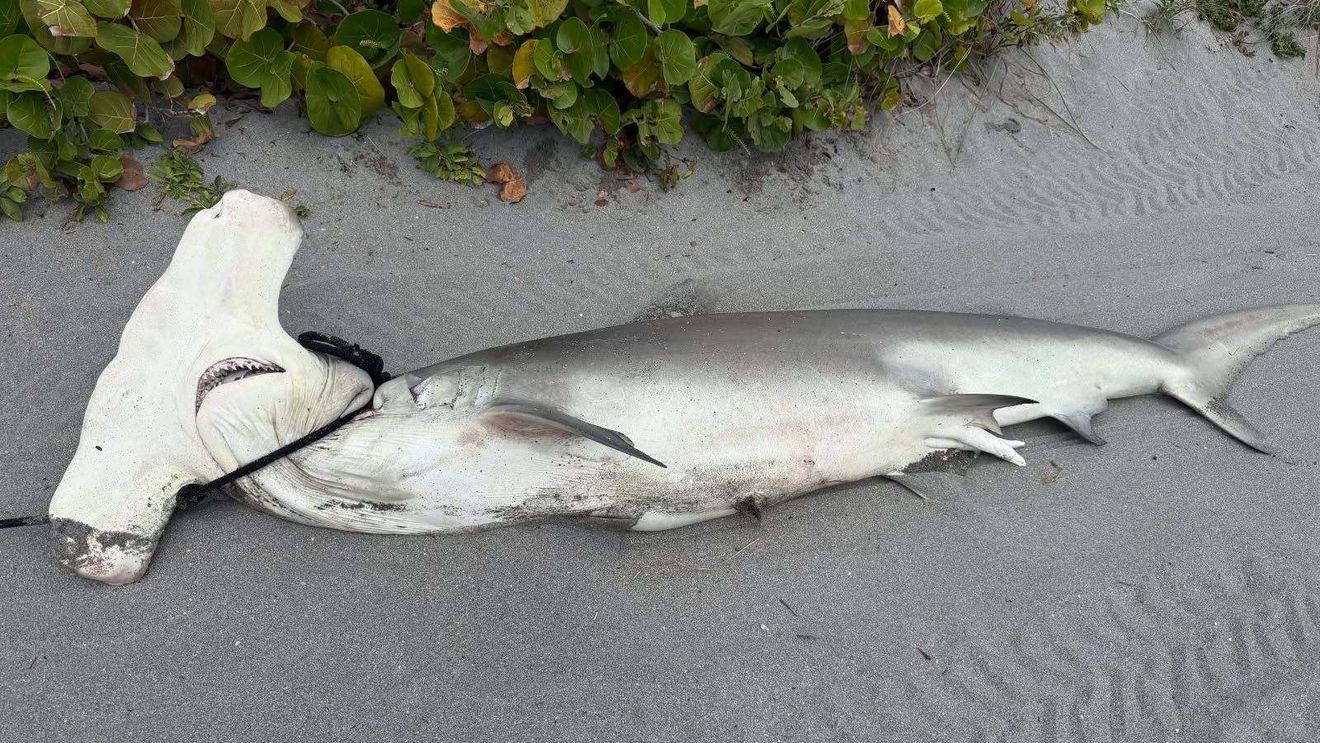
HOBE SOUND, Fla. (CBS12) — A dead great hammerhead shark found on the sand in Hobe Sound over the weekend is raising new concerns among scientists and conservation groups, who say the animal’s death was likely tied to human activity.
Beachgoers discovered the endangered shark lifeless on the shore with a rope wrapped around its head.
It was the second dead great hammerhead found in the area this month.
Two weeks ago, another great hammerhead was found in Juno Beach that had been finned, with its dorsal fin and tail cut off.
The cases have drawn national attention, including from the Center for Biological Diversity.
“Great hammerheads are globally critically endangered. The primary threat is actually fishing,” said Elise, who spoke on behalf of the Center for Biological Diversity.
See also: West Palm Beach approves museum expansion with new parking, visitor center
The group said the species’ population has declined more than 50% over the last 70 years. It also added $4,000 to a reward offered by Florida Fish and Wildlife for information leading to an arrest in the Juno Beach finning case.
“Our hope was if somebody witnessed this and maybe they were on the fence or unsure about whether to come forward, maybe we could offer some additional incentive to bring justice to the person who did this to the shark,” Elise said.
University of Miami shark scientist and Ph.D. student Spencer Roberts said sharks found dead near shore are often the result of human interaction, not natural causes.
said sharks that die naturally typically sink rather than wash ashore.
“These animals are not just dropping dead; they are being killed by land-based shark fishing primarily for social media photos,” Roberts said.
Roberts said land-based shark fishing uses heavy-duty hooks and metal lines strong enough to hold hundreds of pounds, making it difficult for sharks to escape.
“I don’t think it’s an accident when hammerheads are being caught,” Roberts said.
Great hammerheads are especially vulnerable, and a recent report found nearly one in five sharks caught and released in land-based fishing die within six hours.
Roberts, who helped ban land-based shark fishing in Miami Beach, said he is now pushing for restrictions in Palm Beach County and along the Treasure Coast.
“There is something we can do about it, and it’s happening around the state, and we just need to engage our lawmakers,” Roberts said.
Florida Fish and Wildlife had not responded to questions about whether it has received any tips or whether federal investigators are involved.