
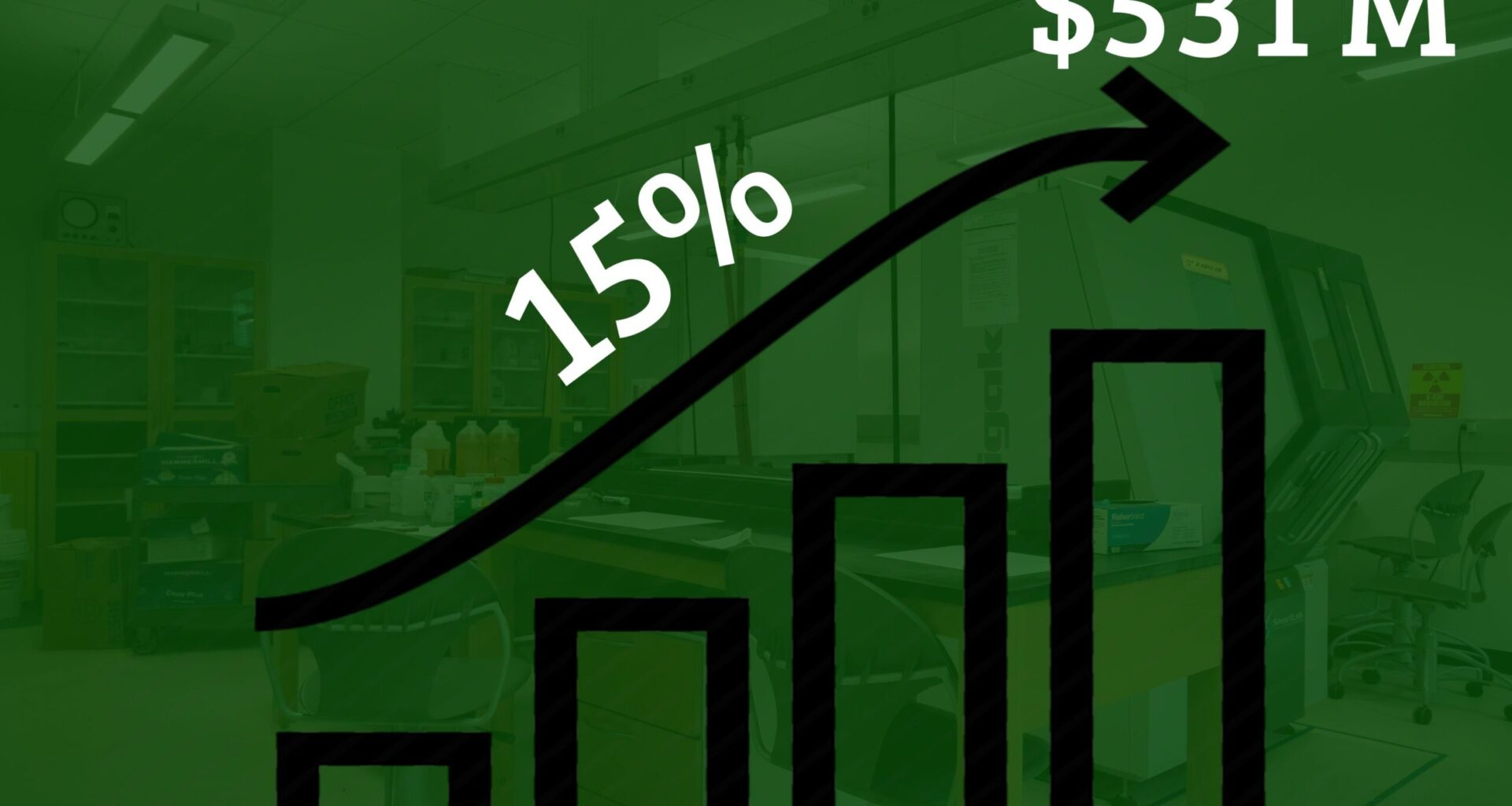
 USF reached $531 million in research activity and expenditures in 2025. ORACLE GRAPHIC/HAYLEY REED
USF reached $531 million in research activity in 2025, continuing a steady rise in funding across fields including health, artificial intelligence and engineering.
This total marks a 15% increase over the past two years and reflects USF’s growth and presence in national research, according to the USF Newsroom.
USF’s increase in research activity is tied to competitive federal funding from the National Science Foundation, National Institute of Health and U.S. Department of Defense, along with a 25% rise in corporate-sponsored research, according to USF Newsroom.
USF President Moez Limayem said the university’s growth demonstrates the scale of research and its impact on fields including health care, technology and economic development.
“Sustained growth like this does not happen by accident,” Limayem said in a March 10 article. “It reflects the reputation of USF’s scholars who push the boundaries of discovery.”
But for USF researchers, research activity goes beyond funding totals and is seen in how quickly research is transformed into real-world applications.
Related: USF receives $14M in federal funding for seven projects
Zhao Han, an assistant professor at USF’s Bellini College of Artificial Intelligence, Cybersecurity and Computing, said his research focuses on improving how robots communicate and interact with people in everyday environments.
“We’re working on projector-based augmented reality so robots can visually communicate what they’re going to do,” Han said.
Han said the establishment of Bellini College in fall 2025, alongside growth in AI research and investment at USF, has expanded funding and collaboration opportunities.
“More access to research funding makes it more likely that our colleagues will want to work with us,” he said. “That, in turn, increases the ease of acquiring more research funding.”
And while USF’s overall research figures signal institutional growth, Han said the impact of these figures is more evident in the way research is evolving toward real-world applications.
“I think we see a kind of trend for real-world use,” Han said. “The robotics field is transitioning into more general-purpose robotics.”
Han added that increased research activity has also strengthened collaboration among researchers and across fields, providing more opportunities for student researchers.
“When there are more professors and more funding, there are more research opportunities, including for undergraduate students,” he said.
Related: USF’s new president wants to position USF as a ‘model university’
Usha Menon, the dean and senior associate vice president for USF Health, said her work focuses on narrowing the gap between research and clinical practice.
“My focus right now is on implementation science,” Menon said. “It’s about integrating research findings into clinical settings so it doesn’t take, on average, 17 years for that translation to happen.”
Menon said USF’s growth in research activity has gained momentum in recent years, especially in areas such as digital health and behavioral science.
“The changes that have stood out to me are the ability to do more digitally related work, including web-based interventions,” she said.
She said these web-based interventions include digital health programs such as cognitive behavioral therapy–based counseling, as well as nurse-led care models to deliver treatment and monitor patients outside traditional clinical settings.
This shift toward digital health and community-based care is also reflected in community-based research projects, she said.
In one initiative, Menon said faculty and students worked with residents at the Salvation Army Red Shield Center in Tampa, using nurse-led case management to improve care.
“Over three months, we reduced 911 calls for residents by about 85%,” Menon said.
Still, Menon said rapid growth in research activity can create challenges in managing projects and building trust when working in communities with “underserved” populations or rural regions of the Tampa Bay area.
“You have to be careful not to grow too fast,” she said. “Understanding the communities we work in is critical, and that takes time.”
Related: USF’s Bellini College of AI marks rapid growth in its first semester
Jennifer O’Brien is an associate professor and the St. Pete chair of the Department of Psychology, and her research focuses on understanding and preventing cognitive decline in older adults.
“We’re really interested in risk factors for cognitive decline and ways that we can delay it, slow it down or even prevent it,” O’Brien said.
She added that USF has had a strong presence in brain health and cognitive aging research for many years.
Still, she said the recent growth in research activity in these fields has brought more funding and recognition to cognitive aging and dementia research.
“Not everyone realizes dementia is a disease that can be prevented, and that’s what our work is really trying to address,” O’Brien said.
O’Brien said there are often challenges in recruiting and retaining participants for long-term studies.
Still, she noted that increased research activity could attract stronger research teams and expand student involvement.
“That makes the science better when you have a strong research team,” O’Brien said.
And while research figures do not directly impact researchers’ day-to-day, she said it helps researchers recruit participants, manage datasets and run long-term studies.
“We’ve really seen growth in our research support and infrastructure,” she said. “That support is critical for us to be successful.”