
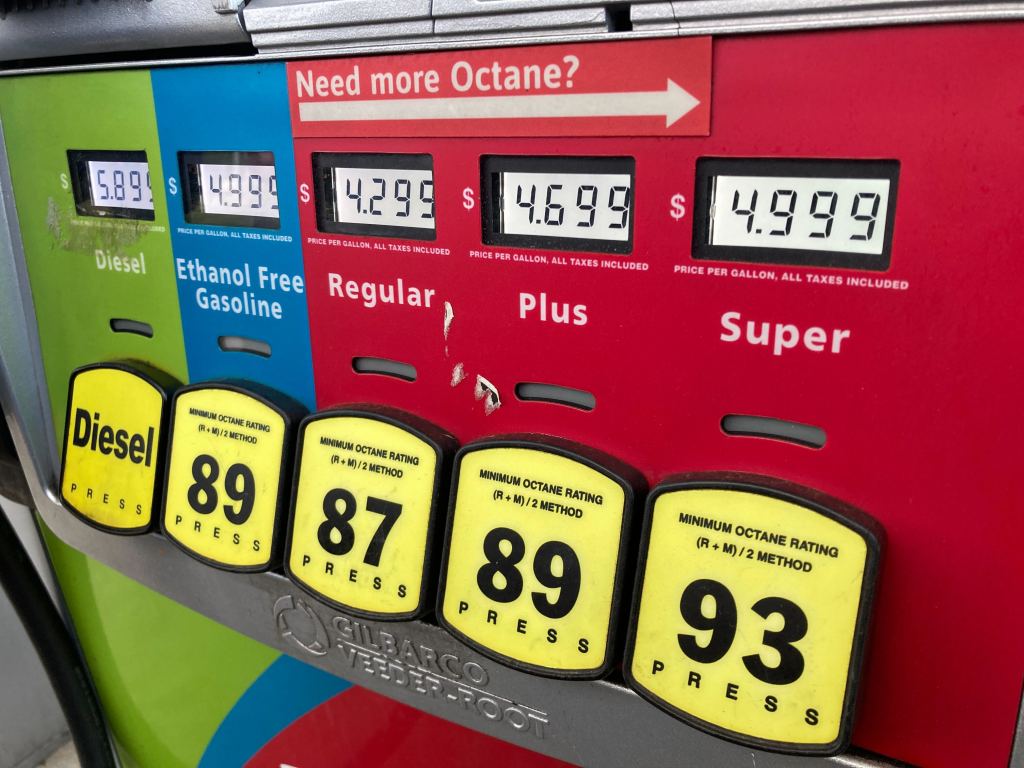
After holding just shy of the $4 a gallon mark for a couple of weeks, the floodgates broke open Monday in Florida with consumers seeing major hikes at the pump.
Starting mid-morning Monday, some stations across Florida jumped more than 30 cents a gallon with several in Central Florida topping out at $4.29 for a gallon of regular unleaded.
As of Tuesday morning, the average price across the state sits at $4.12 a gallon, a 20-cent climb since Sunday’s average of $3.96, according to data tracked by AAA.
“Oil prices are doing most of the driving right now,” said AAA spokesperson Mark Jenkins. “About half of what drivers pay at the pump comes down to the cost of crude oil. When oil prices spike this quickly and remain volatile, gas prices almost always follow.”
Last week, U.S. crude oil prices had risen to $99.14 per barrel, which had been the highest since July 2022 after a similar global disruption soon after Russia invaded Ukraine. Those prices broke $100 a barrel on Monday amid the latest threats in the Middle East.
Osceola’s prices lead the region with an average of $4.22 a gallon followed by $4.21 in Orange, $4.19 in Seminole, $4.17 in Lake, $4.16 in Volusia and $4.15 in Polk and Brevard counties.
The climb in prices has been fueled by the global oil supply disruptions amid conflict in Iran. The average price for gas had not been over $4 in nearly four years, but is now within striking distance of the record high of $4.89 a gallon seen in June 2022. Florida’s prices were at an average of $2.88 at the beginning of March.
That’s $1.24 climb in a month, which means a 15-gallon fill up costs an extra $18.6.
Higher gas prices are making Angel Jaramillo drive shorter distances when possible, as filling up his 1996 Dodge Ram now costs about $80.
“That’s like half a day of work for me at least,” said Jaramillo, 19, who works as a car detailer and pours concrete on the side to make some extra money.
On late Monday afternoon, Jaramillo was filling up the car for one of his clients at a RaceTrac gas station in Apopka, where the price for regular unleaded gas hit $4.29 per gallon. The full tank of gas for his client’s Ford Expedition cost over $150.
Jaramillo lives in Mount Dora but works in Apopka. His 30-minute commute to work means he has to limit how much he’s driving as much as he can.
“I can’t go too far to be honest ‘cause I know I’m going to have to refill and refill,” he said.
The surge in gas prices makes saving money much more difficult. He’s finding himself saving up to get gas –– “a necessity for everyday life” –– rather than for school or to buy a newer car.
Ethan Campbell-Reid isn’t just worried about gas prices. His mind is also on the other items getting pricier as a result, including plane tickets.
Campbell-Reid makes sure to find the “cheapest quality gas” before pumping. That’s what brought him to a Mobil gas station in Apopka where unleaded gas late Monday cost $3.79.
“The gas station up the road is 20 cents more expensive… the one down the road is probably 10 cents or more expensive,” said Campbell-Reid, who works as a content creator and entrepreneur.
He’s only driving for necessities now, he said, such as grocery shopping, work or to buy gas.
More expensive fuel can also push up other spending, from utility bills to the price of many goods consumers buy each day.
In the immediate future, analysts point to groceries, which have to be restocked frequently and could also see price hikes as businesses’ transportation costs pile up.
But hauling other cargo and packages has also been impacted. The United Postal Service, for example, is seeking a temporary 8% added charge on some of its popular products including Priority Mail.
U.S. diesel prices — the fuel used for many freight and delivery trucks — is now going for an average of $5.45 a gallon, up from about $3.76 a gallon before the war began, per AAA.
If the war drags on, it’s possible that those prices could tick up even higher. Most tanker movement in the key Strait of Hormuz, where roughly one-fifth of the world’s oil typically sails through, remains at a halt. That’s led to cuts from major producers in the region who have no way of getting their crude to market. Meanwhile, Iran, Israel and the U.S. have all struck oil and gas facilities, worsening supply concerns.
In a search for some relief, the International Energy Agency pledged to release 400 million barrels of oil from emergency stockpiles of member nations. That includes the U.S., despite Trump initially downplaying the need for reserve oil.
The Trump administration has also eased sanctions to free up some oil from Venezuela, and temporarily Russia. The White House also says it’s waiving maritime shipping requirements under a more than century-old law, known as the Jones Act, for 60 days.
It’s not yet clear if those efforts will bring relief for consumers. A lot of factors contribute to gas prices.
Refineries buy crude oil in advance, meaning some could be work with more expensive oil for a while, and it will take time for any new supply to trickle down to consumers.
And while steep crude prices are a leading driver behind today’s surge, U.S. gas prices typically tick up a bit at this time of year. More drivers are hitting the road and trying to fuel up while they can, so there’s higher demand. Warming weather also brings a shift to summer blend fuel, which is more expensive to produce than winter blend.
The Associated Press contributed to this report.