
For the first time in more than half a century, astronauts are preparing to venture beyond low Earth orbit and travel toward the Moon. >> WESH 2 will have live team coverage all day on Wednesday for the launch NASA’s upcoming Artemis II mission represents a major milestone in the United States’ plan to return humans to the lunar environment and eventually send crews onward to Mars. Although the mission will not land astronauts on the Moon, it is one of the most important test flights NASA has undertaken in decades.For those who have not been paying close attention, Artemis II is the first crewed flight of NASA’s Artemis program—a campaign designed to establish a sustained human presence on and around the Moon. Understanding why the mission matters requires a look at its purpose, the spacecraft involved, the crew, and how it fits into NASA’s long-term exploration plans.BEST PLACES TO VIEW LAUNCH | ROAD CLOSURES ON LAUNCH DAY | MEET THE CREW | ABOUT THE PILOT | 400,000 VISITORS EXPECTED | LIVE COUNTDOWN CLOCK | ARTEMIS PROGRAM OVERVIEW | WIND COULD IMPACT LAUNCH Artemis Program: NASA’s roadmap back to the MoonArtemis II is the second mission in NASA’s Artemis program, a multi-mission initiative intended to return astronauts to the Moon for the first time since the Apollo era. The program’s ultimate goal is not just to revisit the Moon briefly, but to create a sustainable human presence there and use that experience as preparation for eventual missions to Mars.The first step in this effort was Artemis I, which launched in 2022. That mission sent the Orion spacecraft around the Moon without a crew in order to test the spacecraft and the rocket systems that would be used on later missions. Artemis I demonstrated that the systems could survive the long journey through deep space and re-enter Earth’s atmosphere at extremely high speeds.Artemis II builds on that success. While Artemis I tested the spacecraft without astronauts, Artemis II will carry a crew and evaluate how the systems perform with humans aboard. NASA considers this step essential before attempting a lunar landing on Artemis III, which aims to return astronauts to the lunar surface later in the decade.Launch timeline, mission durationNASA has targeted April 1 as the earliest launch date for Artemis II, with liftoff scheduled from Launch Complex 39B at Kennedy Space Center.Once launched, the mission is expected to last about 10 days. During that time the spacecraft will travel far beyond Earth orbit, swing around the Moon, and return to Earth for splashdown in the Pacific Ocean.This trajectory is known as a free-return lunar flyby. In such a path, the spacecraft loops around the Moon and naturally returns to Earth without requiring major propulsion corrections. The design ensures that, if something goes wrong, gravity alone will guide the spacecraft back toward Earth.The mission will carry astronauts farther from Earth than any humans have traveled before, potentially reaching thousands of miles beyond the Moon’s far side.The rocket and spacecraftTwo key pieces of hardware make Artemis II possible: the Space Launch System rocket and the Orion spacecraft.Space Launch System (SLS)The mission will launch aboard the Space Launch System, NASA’s most powerful rocket ever built. The SLS was specifically designed to send large payloads and astronauts beyond low Earth orbit. Its massive boosters and core stage provide the power necessary to propel Orion and its crew toward the Moon.The rocket stands over 300 feet tall and produces millions of pounds of thrust at liftoff, enabling it to escape Earth’s gravity and send the spacecraft on its lunar trajectory.Orion spacecraftThe astronauts will ride inside Orion spacecraft, a capsule designed for long-duration deep-space missions. Orion serves as both the crew habitat and the vehicle that will carry astronauts safely back through Earth’s atmosphere.Orion includes systems for life support, navigation, communication, and protection from radiation and micrometeoroids. During Artemis II, many of these systems will be tested in real operational conditions with astronauts aboard.One of the most critical tests will involve Orion’s heat shield. When the spacecraft returns to Earth, it will re-enter the atmosphere at speeds of about 25,000 miles per hour, generating extreme temperatures that the shield must withstand to keep the crew safe.Meet the Artemis II crewArtemis II will carry four astronauts—three from NASA and one from the Canadian Space Agency.The crew members are:Reid Wiseman – CommanderVictor Glover – PilotChristina Koch – Mission SpecialistJeremy Hansen – Mission SpecialistThis crew represents an important moment in spaceflight history. If the mission succeeds, it will mark the first time a woman, a person of color, and a Canadian astronaut have traveled beyond low Earth orbit toward the Moon.Each astronaut brings extensive experience in spaceflight or aviation. Several have already served aboard the International Space Station, making them well-prepared for the challenges of a deep-space mission.How the mission will unfoldThe Artemis II flight plan consists of several key phases.Launch and Earth OrbitAfter liftoff, the SLS rocket will place Orion into an initial orbit around Earth. During the first day or two, astronauts will conduct system checks to confirm that the spacecraft’s life-support systems, propulsion, and communications equipment are functioning correctly.NASA intentionally schedules many early tests while the spacecraft is still relatively close to Earth so that mission controllers can respond quickly if any problems arise.Translunar injectionOnce systems are verified, the spacecraft will perform a critical engine burn known as translunar injection, which will send Orion toward the Moon.Over the next several days, the crew will monitor spacecraft systems while coasting through deep space.Lunar flybyAs Orion approaches the Moon, it will swing around the far side in a large figure-eight trajectory. The Moon’s gravity will bend the spacecraft’s path and accelerate it back toward Earth.Although the spacecraft will not enter lunar orbit or attempt a landing, it will travel deep into the Moon’s vicinity, demonstrating navigation and communication capabilities required for future missions.Return to EarthOn the return trip, astronauts will conduct additional experiments and system tests.Finally, Orion will re-enter Earth’s atmosphere at extreme speed before parachuting into the Pacific Ocean for recovery by U.S. Navy ships.Why Artemis II Is So ImportantAt first glance, a mission that simply flies around the Moon might seem less exciting than a lunar landing. But Artemis II is arguably one of the most critical steps in NASA’s exploration plans.Testing human systems in deep spaceArtemis II will validate the life-support and environmental control systems that keep astronauts alive in deep space. Unlike missions to the International Space Station, which remain close to Earth, Artemis II will venture far beyond the protective magnetic field that shields astronauts from radiation.Testing how astronauts and spacecraft systems function in this environment is essential before committing crews to longer lunar missions.Evaluating the spacecraft with a crewWhile Artemis I proved that Orion could fly around the Moon un-crewed, Artemis II will test how the spacecraft performs with people aboard. Crew operations—navigation, manual piloting capabilities, communication procedures, and emergency responses—will all be evaluated.Preparing for Artemis IIIThe mission’s data will directly inform the planning of Artemis III, which aims to land astronauts on the Moon. Artemis III is expected to test new technologies, including a lunar lander and upgraded spacesuits for surface exploration.In short, Artemis II is the dress rehearsal that ensures the next mission can safely attempt a lunar landing.A Return to Deep Space After Five DecadesAnother reason Artemis II is so significant is that it marks humanity’s first crewed journey beyond low Earth orbit since the final Apollo mission in 1972.For decades, human spaceflight has focused primarily on operations in Earth orbit, including the space shuttle program and the International Space Station. Artemis II represents a return to deep-space exploration, with astronauts venturing thousands of miles beyond the Moon’s far side.This milestone carries both symbolic and practical significance. It demonstrates that modern spacecraft technology can once again support human missions far from Earth, opening the door to more ambitious exploration.International CooperationThe Artemis program also reflects a growing international approach to space exploration. Artemis II itself includes an astronaut from the Canadian Space Agency, and future missions will involve contributions from multiple international partners.For example, Canada is providing robotic technologies for the planned Gateway space station that will orbit the Moon, while European partners contribute components such as Orion’s service module.This cooperative model is intended to spread the cost and expertise of deep-space exploration across multiple nations.What Comes After Artemis IIIf Artemis II succeeds, NASA plans to move quickly to the next phase of the Artemis program.The most anticipated upcoming mission is Artemis III, which aims to land astronauts on the Moon—potentially the first lunar landing since Apollo and the first to include a woman astronaut.Later missions, such as Artemis IV and beyond, are expected to help construct the lunar Gateway station and establish more sustained exploration on the lunar surface. Ultimately, NASA hopes to use the Moon as a training ground for future missions to Mars.ConclusionFor people who have not been following developments closely, Artemis II may appear to be just another space mission. In reality, it represents a turning point in human exploration of space.The mission will test the most powerful rocket NASA has ever built, fly astronauts farther from Earth than any humans have traveled, and validate the technologies needed for sustained exploration beyond Earth orbit.More importantly, it marks the beginning of a new era in which humans once again venture into deep space—not just for short visits, but with the goal of building a lasting presence beyond our planet.If Artemis II succeeds, it will bring humanity one step closer to returning to the Moon—and eventually traveling to Mars.
CAPE CANAVERAL, Fla. —
For the first time in more than half a century, astronauts are preparing to venture beyond low Earth orbit and travel toward the Moon.
>> WESH 2 will have live team coverage all day on Wednesday for the launch
NASA’s upcoming Artemis II mission represents a major milestone in the United States’ plan to return humans to the lunar environment and eventually send crews onward to Mars. Although the mission will not land astronauts on the Moon, it is one of the most important test flights NASA has undertaken in decades.
For those who have not been paying close attention, Artemis II is the first crewed flight of NASA’s Artemis program—a campaign designed to establish a sustained human presence on and around the Moon. Understanding why the mission matters requires a look at its purpose, the spacecraft involved, the crew, and how it fits into NASA’s long-term exploration plans.
BEST PLACES TO VIEW LAUNCH | ROAD CLOSURES ON LAUNCH DAY | MEET THE CREW | ABOUT THE PILOT | 400,000 VISITORS EXPECTED | LIVE COUNTDOWN CLOCK | ARTEMIS PROGRAM OVERVIEW | WIND COULD IMPACT LAUNCH
Artemis Program: NASA’s roadmap back to the Moon
Artemis II is the second mission in NASA’s Artemis program, a multi-mission initiative intended to return astronauts to the Moon for the first time since the Apollo era. The program’s ultimate goal is not just to revisit the Moon briefly, but to create a sustainable human presence there and use that experience as preparation for eventual missions to Mars.
The first step in this effort was Artemis I, which launched in 2022. That mission sent the Orion spacecraft around the Moon without a crew in order to test the spacecraft and the rocket systems that would be used on later missions. Artemis I demonstrated that the systems could survive the long journey through deep space and re-enter Earth’s atmosphere at extremely high speeds.
Artemis II builds on that success. While Artemis I tested the spacecraft without astronauts, Artemis II will carry a crew and evaluate how the systems perform with humans aboard. NASA considers this step essential before attempting a lunar landing on Artemis III, which aims to return astronauts to the lunar surface later in the decade.
Launch timeline, mission duration
NASA has targeted April 1 as the earliest launch date for Artemis II, with liftoff scheduled from Launch Complex 39B at Kennedy Space Center.
Once launched, the mission is expected to last about 10 days. During that time the spacecraft will travel far beyond Earth orbit, swing around the Moon, and return to Earth for splashdown in the Pacific Ocean.
This trajectory is known as a free-return lunar flyby. In such a path, the spacecraft loops around the Moon and naturally returns to Earth without requiring major propulsion corrections. The design ensures that, if something goes wrong, gravity alone will guide the spacecraft back toward Earth.
The mission will carry astronauts farther from Earth than any humans have traveled before, potentially reaching thousands of miles beyond the Moon’s far side.
The rocket and spacecraft
Two key pieces of hardware make Artemis II possible: the Space Launch System rocket and the Orion spacecraft.
Space Launch System (SLS)
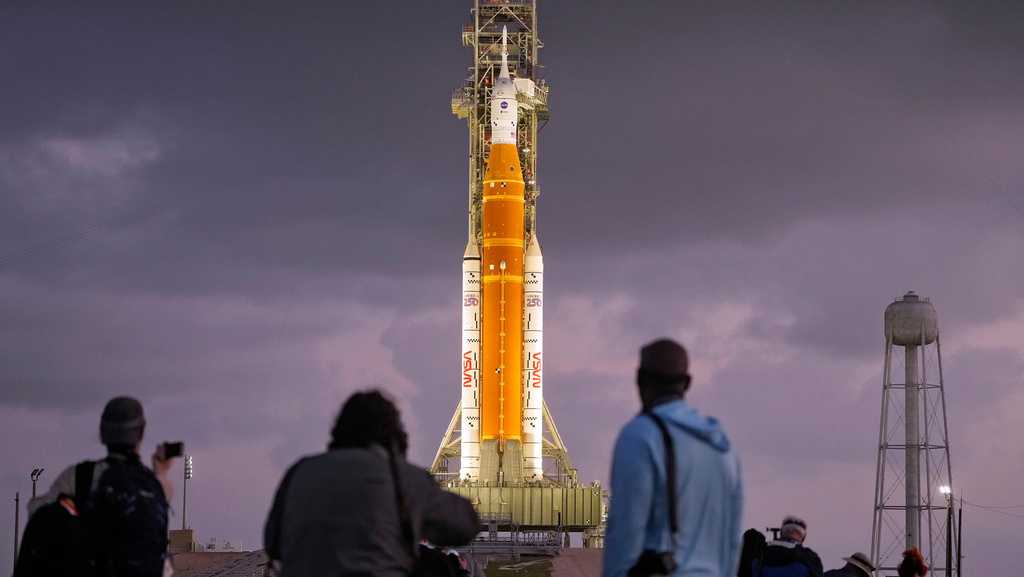
The mission will launch aboard the Space Launch System, NASA’s most powerful rocket ever built. The SLS was specifically designed to send large payloads and astronauts beyond low Earth orbit. Its massive boosters and core stage provide the power necessary to propel Orion and its crew toward the Moon.
The rocket stands over 300 feet tall and produces millions of pounds of thrust at liftoff, enabling it to escape Earth’s gravity and send the spacecraft on its lunar trajectory.
Orion spacecraft
The astronauts will ride inside Orion spacecraft, a capsule designed for long-duration deep-space missions. Orion serves as both the crew habitat and the vehicle that will carry astronauts safely back through Earth’s atmosphere.
Orion includes systems for life support, navigation, communication, and protection from radiation and micrometeoroids. During Artemis II, many of these systems will be tested in real operational conditions with astronauts aboard.
One of the most critical tests will involve Orion’s heat shield. When the spacecraft returns to Earth, it will re-enter the atmosphere at speeds of about 25,000 miles per hour, generating extreme temperatures that the shield must withstand to keep the crew safe.
Meet the Artemis II crew
Artemis II will carry four astronauts—three from NASA and one from the Canadian Space Agency.
The crew members are:
Reid Wiseman – CommanderVictor Glover – PilotChristina Koch – Mission SpecialistJeremy Hansen – Mission Specialist
This crew represents an important moment in spaceflight history. If the mission succeeds, it will mark the first time a woman, a person of color, and a Canadian astronaut have traveled beyond low Earth orbit toward the Moon.
Each astronaut brings extensive experience in spaceflight or aviation. Several have already served aboard the International Space Station, making them well-prepared for the challenges of a deep-space mission.
How the mission will unfold
The Artemis II flight plan consists of several key phases.
Launch and Earth Orbit
After liftoff, the SLS rocket will place Orion into an initial orbit around Earth. During the first day or two, astronauts will conduct system checks to confirm that the spacecraft’s life-support systems, propulsion, and communications equipment are functioning correctly.
NASA intentionally schedules many early tests while the spacecraft is still relatively close to Earth so that mission controllers can respond quickly if any problems arise.
Translunar injection
Once systems are verified, the spacecraft will perform a critical engine burn known as translunar injection, which will send Orion toward the Moon.
Over the next several days, the crew will monitor spacecraft systems while coasting through deep space.
Lunar flyby
As Orion approaches the Moon, it will swing around the far side in a large figure-eight trajectory. The Moon’s gravity will bend the spacecraft’s path and accelerate it back toward Earth.
Although the spacecraft will not enter lunar orbit or attempt a landing, it will travel deep into the Moon’s vicinity, demonstrating navigation and communication capabilities required for future missions.
Return to Earth
On the return trip, astronauts will conduct additional experiments and system tests.
Finally, Orion will re-enter Earth’s atmosphere at extreme speed before parachuting into the Pacific Ocean for recovery by U.S. Navy ships.
Why Artemis II Is So Important
At first glance, a mission that simply flies around the Moon might seem less exciting than a lunar landing. But Artemis II is arguably one of the most critical steps in NASA’s exploration plans.
Testing human systems in deep space
Artemis II will validate the life-support and environmental control systems that keep astronauts alive in deep space. Unlike missions to the International Space Station, which remain close to Earth, Artemis II will venture far beyond the protective magnetic field that shields astronauts from radiation.
Testing how astronauts and spacecraft systems function in this environment is essential before committing crews to longer lunar missions.
Evaluating the spacecraft with a crew
While Artemis I proved that Orion could fly around the Moon un-crewed, Artemis II will test how the spacecraft performs with people aboard. Crew operations—navigation, manual piloting capabilities, communication procedures, and emergency responses—will all be evaluated.
Preparing for Artemis III
The mission’s data will directly inform the planning of Artemis III, which aims to land astronauts on the Moon. Artemis III is expected to test new technologies, including a lunar lander and upgraded spacesuits for surface exploration.
In short, Artemis II is the dress rehearsal that ensures the next mission can safely attempt a lunar landing.
A Return to Deep Space After Five Decades
Another reason Artemis II is so significant is that it marks humanity’s first crewed journey beyond low Earth orbit since the final Apollo mission in 1972.
For decades, human spaceflight has focused primarily on operations in Earth orbit, including the space shuttle program and the International Space Station. Artemis II represents a return to deep-space exploration, with astronauts venturing thousands of miles beyond the Moon’s far side.
This milestone carries both symbolic and practical significance. It demonstrates that modern spacecraft technology can once again support human missions far from Earth, opening the door to more ambitious exploration.
International Cooperation
The Artemis program also reflects a growing international approach to space exploration. Artemis II itself includes an astronaut from the Canadian Space Agency, and future missions will involve contributions from multiple international partners.
For example, Canada is providing robotic technologies for the planned Gateway space station that will orbit the Moon, while European partners contribute components such as Orion’s service module.
This cooperative model is intended to spread the cost and expertise of deep-space exploration across multiple nations.
What Comes After Artemis II
If Artemis II succeeds, NASA plans to move quickly to the next phase of the Artemis program.
The most anticipated upcoming mission is Artemis III, which aims to land astronauts on the Moon—potentially the first lunar landing since Apollo and the first to include a woman astronaut.
Later missions, such as Artemis IV and beyond, are expected to help construct the lunar Gateway station and establish more sustained exploration on the lunar surface. Ultimately, NASA hopes to use the Moon as a training ground for future missions to Mars.
Conclusion
For people who have not been following developments closely, Artemis II may appear to be just another space mission. In reality, it represents a turning point in human exploration of space.
The mission will test the most powerful rocket NASA has ever built, fly astronauts farther from Earth than any humans have traveled, and validate the technologies needed for sustained exploration beyond Earth orbit.
More importantly, it marks the beginning of a new era in which humans once again venture into deep space—not just for short visits, but with the goal of building a lasting presence beyond our planet.
If Artemis II succeeds, it will bring humanity one step closer to returning to the Moon—and eventually traveling to Mars.