
WINDOWS IF YOU PLAN ON BEING IN BREVARD COUNTY TOMORROW EVENING. ALLEN ALSO MET WITH THE BREVARD COUNTY SHERIFF’S OFFICE SAYS THEY’RE EXPECTING UP TO 400,000 VISITORS IN THE AREA FOR TOMORROW’S LAUNCH. TITUSVILLE IS GOING TO BE YOUR BEST PLACE TO WATCH, BUT THERE ARE SEVERAL PARKS ON THE OTHER SIDE OF THE MAX BREWER BRIDGE, INCLUDING SAND POINT PARK, SPACE VIEW PARK, GEMINI PARK, VETERANS PARK, AND SCOBY PARK. SOME PEOPLE WILL WATCH FROM THE BRIDGE ITSELF OR AT PARRISH PARK NOW FURTHER DOWN THE COAST. YOU HAVE WILLIAM J. MANSELL MEMORIAL PARK, ROTARY, RIVERFRONT PARK, KIRK POINT, RIVERSIDE PARK AND KENNEDY POINT PARK. I KNOW THERE’S A LOT OF PLACES TO WATCH. GOOD NEWS IS
Artemis II launch from Florida’s Space Coast | Live updates, team coverage

Updated: 3:30 PM EDT Mar 31, 2026
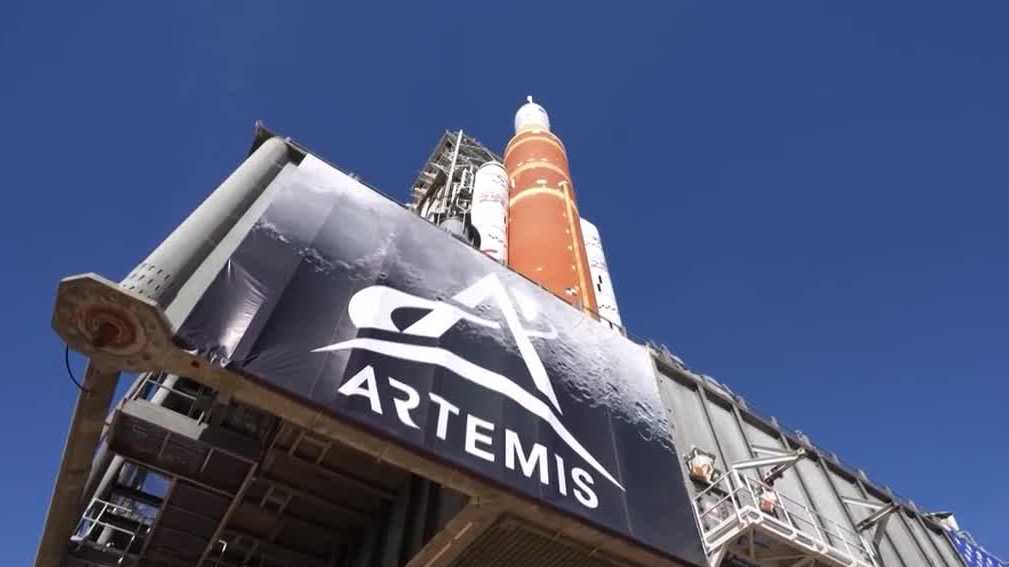
Artemis II is preparing for launch from the Kennedy Space Center, where the rocket will carry the Orion spacecraft for a second time, on its journey around the moon – an update to the original plan, which put astronauts on the surface. The earliest the rocket will launch is 6:24 p.m. on April 1. >> WESH 2 will stream the launch live in the player above | Live team coverage will start at 4:30 a.m. BEST PLACES TO VIEW LAUNCH | ROAD CLOSURES ON LAUNCH DAY | MEET THE CREW | ABOUT THE PILOT | 400,000 VISITORS EXPECTED | LIVE COUNTDOWN CLOCK | ARTEMIS PROGRAM OVERVIEW Artemis II countdown On Wednesday, launch day, tanking operations to load fuel into the Space Launch System rocket will begin at 7:45 a.m., nearly 12 hours before the launch window opens at 6:24 p.m.The fueling process will take hours. NASA builds in extra time in case something comes up.They could enter a “hold,” where they pause operations to fix any issues along the way. At 12:44 p.m., the crew begins dressing in launch and entry spacesuits.At about 1:44 p.m., the crew will head to the padAt 5:54 p.m., NASA’s test director will conduct a final briefing.The launch window opens at 6:24 p.m. The crewFour astronauts are aboard NASA’s Space Launch System.Commander: Reid WisemanPilot: Victor GloverMission Specialist: Christina KochMission Specialist: Jeremy HansenArtemis Program OverviewArtemis is NASA’s long-term Moon exploration campaign.The program’s main goals include returning humans to the moon, building a sustained lunar presence, maturing technology and operations needed for human missions to Mars, and doing this all with international and commercial partners.The missions are each designated to different milestones, strategies and individual goals.Artemis IThis mission is complete.It was an uncrewed integrated flight test of the Space Launch System, which is a heavy-lift rocket that launches crews and large cargo toward the moon, and Orion, which is a crew spacecraft that carries astronauts to lunar orbit and returns them to Earth.SLS and Orion went around the moon and came back to Earth.The purpose of this mission was to validate deep-space performance and reentry before flying with a crew.>> Relive the launch of Artemis I here.Aretmis IIThis mission is planned.Artemis II will be the first crewed mission to the moon, with the plan to fly around itThe purpose of the crewed flight is to prove life support, operations and high-speed returns with astronauts.Artemis III (This mission has changes as of Feb. 27)This mission is planned.Artemis III will be the first crewed lunar landing of the program, targeting the lunar South Pole region.The 10-day mission will include field geology, sample collection/return and deployed experiments.Four astronauts will launch in Orion, two will land on the moon for surface work, and then they will return to Orion for the journey back to Earth.Artemis IV and beyondThe future missions will aim to expand on capabilities toward sustained operations on the moon, such as more surface time, more cargo and infrastructure delivery, increased use of Gateway as a staging node, and progression toward an “Artemis Base Camp” style sustainable presence.Why the lunar South Pole?It has scientifically valuable terrain and ancient geology.It contains regions with water ice and other volatiles in permanently shadowed areas, which is key for science and potential resources.Its challenging conditions will help prove the systems needed for Mars-class missions.More information
Artemis II is preparing for launch from the Kennedy Space Center, where the rocket will carry the Orion spacecraft for a second time, on its journey around the moon – an update to the original plan, which put astronauts on the surface.
The earliest the rocket will launch is 6:24 p.m. on April 1.
>> WESH 2 will stream the launch live in the player above | Live team coverage will start at 4:30 a.m.
BEST PLACES TO VIEW LAUNCH | ROAD CLOSURES ON LAUNCH DAY | MEET THE CREW | ABOUT THE PILOT | 400,000 VISITORS EXPECTED | LIVE COUNTDOWN CLOCK | ARTEMIS PROGRAM OVERVIEW
Artemis II countdown
On Wednesday, launch day, tanking operations to load fuel into the Space Launch System rocket will begin at 7:45 a.m., nearly 12 hours before the launch window opens at 6:24 p.m.
The fueling process will take hours. NASA builds in extra time in case something comes up.
They could enter a “hold,” where they pause operations to fix any issues along the way.
At 12:44 p.m., the crew begins dressing in launch and entry spacesuits.
At about 1:44 p.m., the crew will head to the pad
At 5:54 p.m., NASA’s test director will conduct a final briefing.
The launch window opens at 6:24 p.m.
The crew
Four astronauts are aboard NASA’s Space Launch System.
Commander: Reid WisemanPilot: Victor GloverMission Specialist: Christina KochMission Specialist: Jeremy Hansen
Artemis Program Overview
Artemis is NASA’s long-term Moon exploration campaign.
The program’s main goals include returning humans to the moon, building a sustained lunar presence, maturing technology and operations needed for human missions to Mars, and doing this all with international and commercial partners.
The missions are each designated to different milestones, strategies and individual goals.
Artemis IThis mission is complete.It was an uncrewed integrated flight test of the Space Launch System, which is a heavy-lift rocket that launches crews and large cargo toward the moon, and Orion, which is a crew spacecraft that carries astronauts to lunar orbit and returns them to Earth.SLS and Orion went around the moon and came back to Earth.The purpose of this mission was to validate deep-space performance and reentry before flying with a crew.
>> Relive the launch of Artemis I here.
Aretmis IIThis mission is planned.Artemis II will be the first crewed mission to the moon, with the plan to fly around itThe purpose of the crewed flight is to prove life support, operations and high-speed returns with astronauts.Artemis III (This mission has changes as of Feb. 27)Artemis III will be the first crewed lunar landing of the program, targeting the lunar South Pole region.The 10-day mission will include field geology, sample collection/return and deployed experiments.Four astronauts will launch in Orion, two will land on the moon for surface work, and then they will return to Orion for the journey back to Earth.
Artemis IV and beyondThe future missions will aim to expand on capabilities toward sustained operations on the moon, such as more surface time, more cargo and infrastructure delivery, increased use of Gateway as a staging node, and progression toward an “Artemis Base Camp” style sustainable presence.Why the lunar South Pole?It has scientifically valuable terrain and ancient geology.It contains regions with water ice and other volatiles in permanently shadowed areas, which is key for science and potential resources.Its challenging conditions will help prove the systems needed for Mars-class missions.More information