
Time to read [5 minutes]
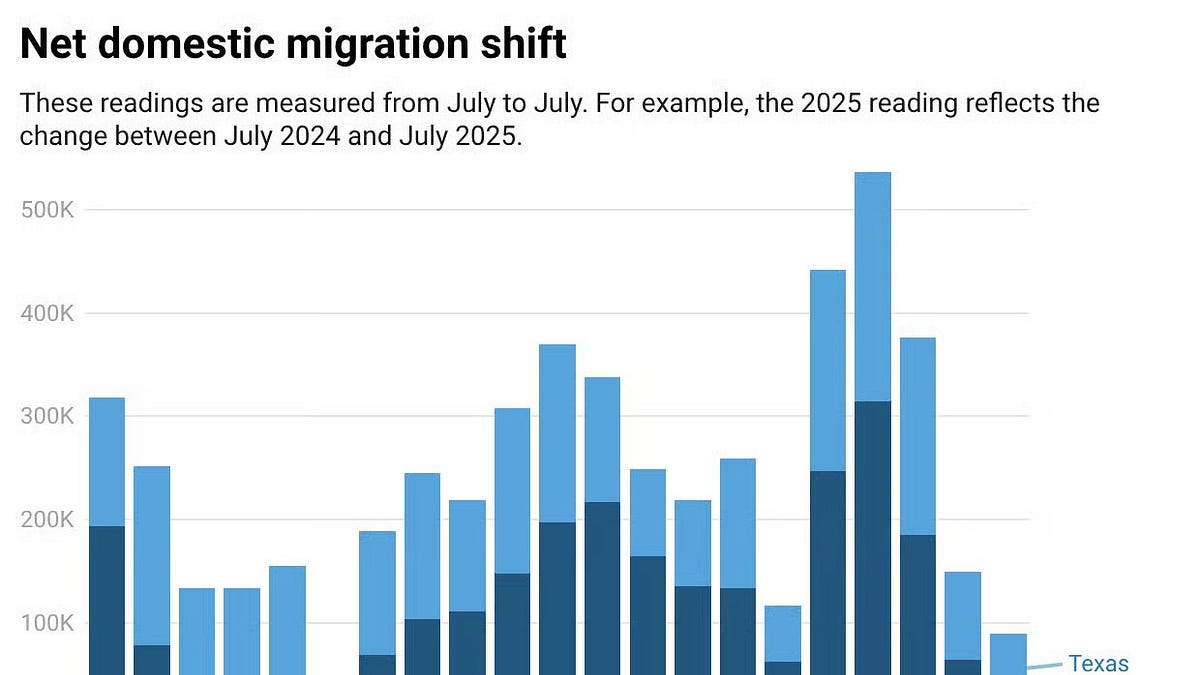
Florida’s domestic migration boom has ended: After a surge in state-to-state moves during the pandemic, Florida (and Texas) now sees sharply reduced inbound migration. High housing costs and reduced affordability have weakened the “escape from the Northeast and California” narrative.
Miami’s growth is now driven by natural increase and immigration, not new domestic arrivals: Despite high-profile tech billionaire moves, Miami actually has one of the highest outbound migration rates among U.S. metros, signaling a reversal.
NYC’s recovery and housing adaptation stand out: The New York metro area’s population has rebounded, buoyed by strong job markets and adaptive reuse of offices into rentals, while Midwest and Carolina metros are attracting affordability-driven domestic migration instead of traditional Sunbelt destinations.
Warning: a chart-intensive post, but I promise it is helpful for understanding domestic migration given today’s very low immigration levels.
Domestic migration (state-to-state) in Florida and Texas is way down after a heady couple of years following the pandemic lockdown era.

Recently, I saw Jed Kolko’s tweet that Miami is the new San Francisco and his explainer on Substack. What I love about the following chart is how it clearly presents the growth in Miami’s domestic population during and immediately after the pandemic lockdown in 2020 and 2021, then going in the opposite direction as New York thrived in 2022. I’m still excited about the future of Miami, but I’d say the narrative of forever growth driven by domestic migration is probably dead. The idea that consumers are still fleeing the Northeast and California for Florida to improve affordability is likely over, because Florida housing prices have undergone extreme New York-ification, and the pull there now has much less strength.

The Miami metro area’s population is still growing, but not because of domestic migration, as illustrated in the following thread. Remember this when talking about all the billionaire tech bros moving from California to Florida because of a proposed wealth tax there. That situation would appear to be an outlier, since Miami has the highest outbound migration rate of any US metro area. So the macro narrative of tech bros like Sergei Brin buying mega mansions in Miami doesn’t reflect the overall Miami trend (but it does get good SEO).

The release of new Census data has sparked a slew of analyses of domestic migration patterns and population trends. There is a terrific WSJ piece: Where the U.S. Is Growing—and Shrinking—in Charts (gift link). The search for affordable housing through domestic migration seems to be occurring in the Midwest, which is surprising, as well as in the Carolinas.
 Source: WSJ
 Source: WSJ
Once again, NYC defeats adversity and continues to draw inbound migration despite federal limits on (international) immigration that NYC depends on. I loved this chart because it illustrates the NYC population situation but cuts through the fog of misinformation.

What’s especially interesting about NYC metro, besides record Wall Street compensation and profits, is the surge in office-to-rental conversion activity.
The high amount of new office-to-rental conversions is welcome, despite their skew towards the higher end of the market. Developers have little choice given the high cost of a development site, materials, and labor. While this activity might seem ineffective given the high-end skew of these new rentals, it actually is effective. If we think of it in the context of a layer cake, it will boost affordability at the high end by providing more competition there, lowering prices to compete with the layer below, which then begins to compete with the layer below, and so on. While adaptive reuse is not a perfect solution, it should take some of the edge off rising rents for open-market apartments over the next few years.
In addition, rents are rising because the quality of new products entering the market is better than it was a decade ago, IMHO, which also helps skew rents higher.

Despite the population decline, the region still faces a housing shortage in both sales and rentals, so the idea that LA is on its way to becoming much more affordable because of its falling population seems premature.

Low inventory in California was made worse by the high inheritance tax rate (gift tax) from the 1978 change with Proposition 13. It encouraged intergenerational inheritance transfers, which accounted for 18% of property transfers in California in 2025, double the national rate. In other words, the law created a “lock-in effect” from high inheritance taxes, much like unusually low mortgage rates from the pandemic era created a lock-in effect. Both discourage homeowners from listing their homes, keeping inventory low, helping to drive prices higher.
 Source: WSJ
Domestic migration is increasingly a within‑region reshuffle rather than a simple “coastal-to-Sunbelt” story, with those leaving Miami remaining in the South and trading up to cheaper metros like Orlando, Tampa, and Atlanta rather than moving long distances. At the same time, there has been a small shift toward the Midwest, where housing prices remain relatively low.
Some of the current housing slowdown in Florida and Texas reflects a pull‑forward effect from the 2021–2022 boom, when households that might have moved later already did so, and it is now being made more difficult by elevated home prices and higher mortgage rates, helping to cool migration levels.
The Actual Final Thought – After a game ending for the ages, here’s a quick reminder that the UConn mascot is a husky, and its first name is “Jonathan.”