
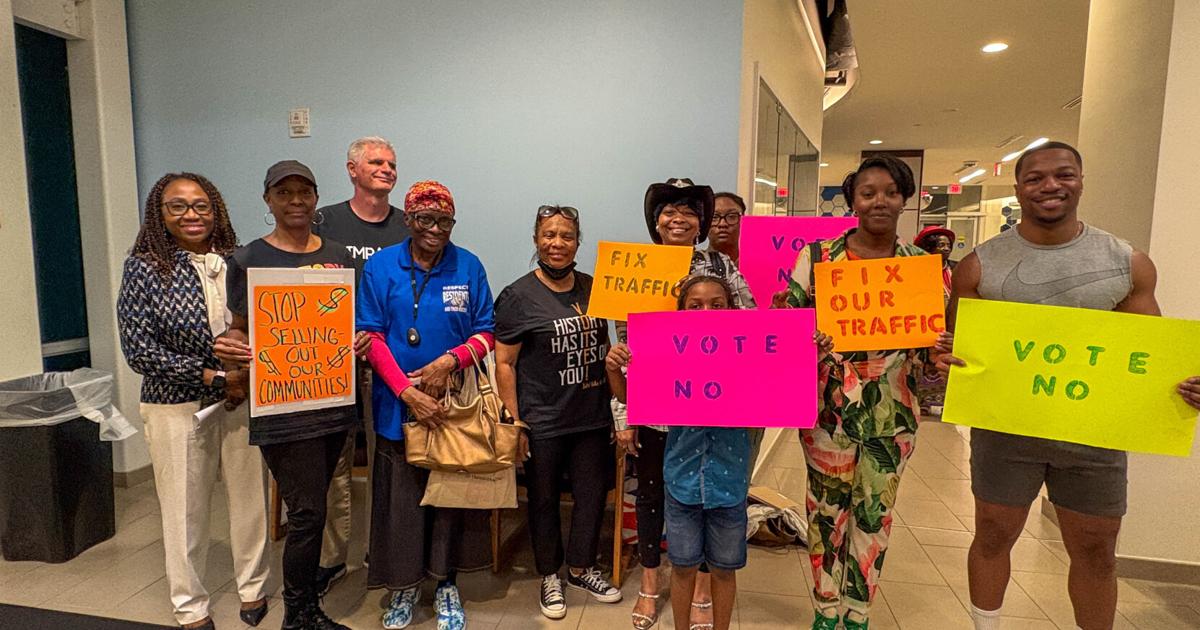
Miami Gardens residents won a major victory last Wednesday after the City Council voted 4-3 against a controversial rezoningrequest tied to El Dorado Furniture, killing a proposal that would have converted a 4.21-acre parcel near Venetian Gardens from single-family residential to heavy industrial.
The ordinance would have allowed the company to expand its warehouse operations southwest of its current location. But after weeks of community organizing, petitions and public comments, a majority of council members decided to block the plan.
Mayor Rodney Harris and Councilwomen Linda Julien and Katrina Wilson, who represent the area, voted in favor of the ordinance. Vice Mayor Robert Stephens III, Councilman Reggie Leon, and Councilwomen Katrina Baskin and Dr. Michelle Powell voted against it.


Residents stand up when Myya Passmore asks them at the podium to show disagreement against the item.
(Amelia Orjuela Da Silva for The Miami Times)
Traffic concerns
The decision followed extensive public comment through which residents raised alarms about traffic, pollution and transparency. City planning staff said the applicant had made several changes since the proposal first came before the council in February.

Residents hold signs raising alarms of pollution and traffic.
(Amelia Orjuela Da Silva for The Miami Times)
Residents and councilmembers had raised concerns about traffic in the Venetian Gardens neighborhood. Myya Passmore, a local organizer and resident since 2019, said she has repeatedly requested safety improvements.

Myya Passmore, organizer and resident of the Venetian Gardens neighborhood.
(Amelia Orjuela Da Silva for The Miami Times)
“Within the last two weeks, we’ve experienced about seven accidents caused by cut-through traffic that comes through the residential area. We’ve seen two hit-and-runs and two cars that hit homes and a gate,” Passmore told The Miami Times.
She added that large trucks making wide turns on Northwest 42nd Avenue already disrupt traffic flow and warned the expansion could worsen congestion.
City staff and the applicant, however, maintained that the expansion would not increase traffic. Planning and zoning director Reginald White said the developer agreed to add a landscaped buffer wall, connect sidewalks in front of the site, relocate commercial vehicle areas away from Northwest 44th Court, and enter into a restrictive covenant limiting the site to warehouse use.
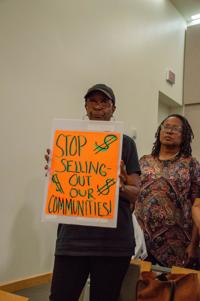
Residents hold signs opposing the rezoning.
(Amelia Orjuela Da Silva for The Miami Times)
White and the applicant pointed to a traffic analysis showing no significant increase in trips. Bill Pfeffer of Bowman Consulting, representing El Dorado, said the study evaluated both warehouse operations and national trip-generation standards.

Bill Pfeffer of Bowman Consulting, representing El Dorado.
(Amelia Orjuela Da Silva for The Miami Times)
“All of the trips generated from this warehouse facility are actually generated from a sale that takes place at a showroom off-site,” Pfeffer said. “The reason we’re expanding this warehouse is to better circulate those shipments internally. The number of trucks entering and leaving the site today will be the number of trucks entering and leaving the site in the future.”
He added that the expansion “would only add seven peak hour trips,” according to the Institute of Transportation Engineers manual, arguing that the project would maintain current traffic because El Dorado would not add driveway access on Northwest 44th Court.
Health concerns
Residents, however, said the traffic analysis was not enough and argued the city should not move forward without a broader look at air quality and existing neighborhood conditions.
“Although we heard from the consultants that allegedly there’s going to be no increased traffic at this location with the rezoning, we can’t say for sure that that’s the case,” said Z Spicer, a resident and Catalyst Miami’s climate justice community organizer.

“This is our health. If you’re not tracking [air quality and traffic], and you’re just giving a nice PowerPoint, how are we really assessing how this will impact us?” -Myya Passmore, resident
(Myya Passmore)
Passmore said the issue goes beyond a single presentation.
“This is our health,” Passmore said. “No traffic study has been done, and it comes off a bit biased because they’re doing their own studies saying what won’t happen. If you’re not tracking [air quality and traffic], and you’re just giving a nice PowerPoint, how are we really assessing how this will impact us?”
Dr. Cheryl Holder, founder and co-chair of Florida Clinicians for Climate Action, urged council members to consider the health consequences of diesel exhaust and industrial encroachment in Black communities.

Dr. Cheryl Holder, founder and co-chair of Florida Clinicians for Climate Action, speaks at the meeting.
(Amelia Orjuela Da Silva for The Miami Times)
“Where you live, work and play is more impactful for your health than your DNA,” Holder said. “Truck diesel exhaust releases fine particulate matter (PM2.5), which gets into children’s lungs, increases the risk of asthma, lung disease, heart disease, and then cancer.”
Residents with existing health conditions echoed those concerns. Lynette Hickenbottom, a 73-year-old resident and two-time cancer survivor, said she lives with the effects of poor air daily.
“I hear a lot of stuff about the traffic analysis, and I heard very little from the people who own the place about the air quality. That is so important,” she said. “I take asthma medications, and this is my survival every day. I must know that it’s below 50 — the air quality — because if it’s above 50, it’s poor air quality.”
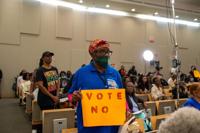
Lynette Hickenbottom, a 73-year-old resident and two-time cancer survivor, holds a sign urging council members to vote no.
(Amelia Orjuela Da Silva for The Miami Times)
Referring to a recent warehouse fire, she added, “We all remember March 6 with the burning of the warehouse, and what it actually affected me, and I live way over that way.”
Applicants and city staff noted that environmental and health studies aren’t required for zoning decisions. However, Passmore cited the city’s Land Development Regulations, emphasizing that potential harms or benefits should not be overlooked just because they are “indirect, intangible or not readily quantifiable,” and argued that officials can still weigh broader impacts.
“Criteria F says you have to care about things you can’t always see, like the air we breathe,” Passmore said. “We are facing a triple threat of emissions from Opa-locka Airport, 826 expressway, M-DCPS bus depot, and the existing industrial and commercial district.”

Lynette Hickenbottom, a 73-year-old resident and two-time cancer survivor with asthma, displays the medicines she takes every day while speaking to the dais.
(Amelia Orjuela Da Silva for The Miami Times)
Dais turns tense
Councilman Leon seized on those concerns and pushed to delay the vote so that the city and the applicant could explore air quality testing.
“What we’re trying to accomplish is that our residents made a concern, and we were elected to take care of our residents,” Leon said. “They brought it to us. It’s our responsibility to let our people breathe.”
Wilson said she did not oppose studying air quality but objected to delaying a business that had followed the city’s rules.
“What I disagree with is penalizing a business that may not be responsible for the air quality issue,” she said. “If we are concerned about our residents and we believe that all of the factors that we’ve just enumerated, then what we need to do is do a comprehensive study to really discuss what this area is subject to, but not at the expense of someone who has complied with the law.”
The exchange escalated when Leon pressed further.
“But these are our residents. Don’t they deserve it?” he said.
Wilson fired back.
“Don’t do that. Don’t put any residents on me, because that’s unacceptable,” she said.
After a brief recess, Leon withdrew the motion to table the item, and the city voted on the ordinance itself.
‘Heart of the city’
Residents credited the outcome to community pressure. Passmore called it “a good start to listening.”
“I don’t know how authentic it is, but I’m gonna take this win today,” she said, thanking council members who voted no.

Resident Keisha Guyton after the vote.
(Amelia Orjuela Da Silva for The Miami Times)
Resident Keisha Guyton said she felt encouraged that officials ultimately sided with residents.
“I feel really good that they voted on the residents because, more importantly, residents are the heart of the city,” Guyton said.
Guyton argued businesses should not be prioritized over the people who live nearby and questioned whether the company had invested in the community. She also expressed disappointment with Wilson’s stance.
“I felt that she was more concerned about giving the corporate more contingencies than thinking about the quality of life of the residents.”
Ultimately, Guyton said the win proved a vital point.
“The power of the people is greater than the people in power,” she said.