
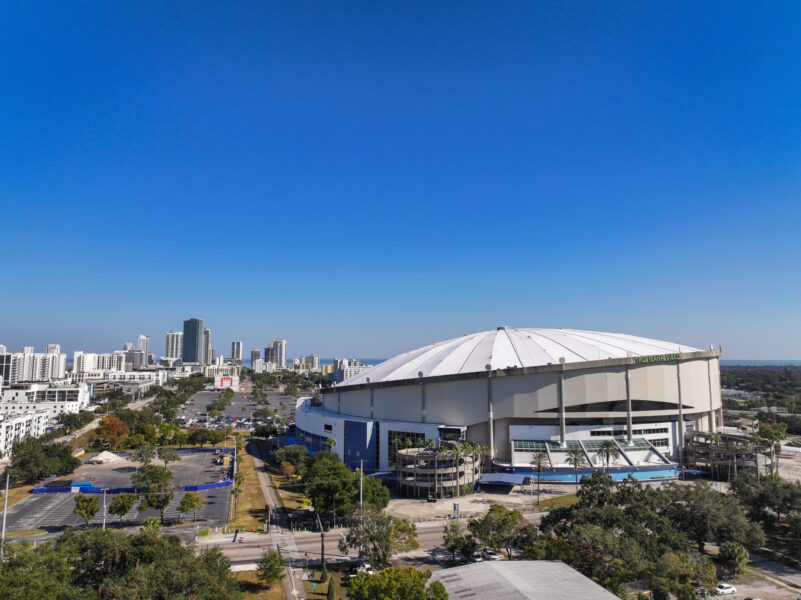
The city has narrowed development proposals for the Tropicana site down to four, which consist of submissions from ARK Ellison Horus, Blake Investment Partners, Foundation Vision Partners and the Pinellas County Housing Authority.
Mayor Kenneth Welch is expected to make a final decision in June, but isn’t unilaterally selecting a proposal. Instead, he’s weighing studies and public input first.
Beginning this April, city staff will begin the first phase of the Urban Land Institute study, which will include an analysis and aggregation of previous studies, community feedback and draw on both prior and new research.
As for the public feedback component, a meeting with shortlisted developers will take place at the Coliseum, giving residents a chance to pose questions about the proposals. Following that meeting, a 30-day input session will be provided for the public to submit feedback.
“We want to make sure [the final development] reflects the needs and wants of residents,” said St. Petersburg Public Information Officer Samantha Bequer. “It’s why we are holding a 30-day stakeholder feedback session.”
Bequer added that both virtual and in-person meetings will be used to gather that input.
This falls under Welch’s JHOP initiative, an acronym for Jointly held Opportunities and Principles, which calls for collaborative development and progress in the city.
District 2 City Council member Brandi Gabbard has also recently made headlines for advocating more community feedback. When asked if that influenced the administration’s decision to extend the process, Bequer said, “No, this isn’t about the input of any council seat,” adding, “This is our standard operating procedure. At the end of day, this is taxpayer money.”
Still, some aspects of how that feedback will be used remain unclear.
Bequer said details on how public input will be formally incorporated into the city’s strengths and weaknesses analysis of proposals have not yet been finalized, but emphasized that no decision will be made until all materials are reviewed.
The Welch administration’s decision for further study and public feedback follows a previous commitment made Feb. 5.
“In response to the request for an additional planning framework in the Council resolution, I will ask my team to explore a process that clarifies what that additional planning would entail, and how that could inform our assessment of the proposals received,” Welch said at the time.
In the same statement, Welch added, “This redevelopment process is ultimately about people and progress. When I was elected mayor, I made a commitment to honor the history and fulfill the promises of the Historic Gas Plant District; and I intend to keep my word.”
As for the strengths and weaknesses analysis, it remains unclear whether that will be released to the public ahead of a final decision, which could necessitate additional public input sessions. The city has not yet committed to that release date.
The role of the Urban Land Institute study also remains undefined. According to Bequer, the study will incorporate previous research tied to the site, though whether it could influence the final selection is not yet known.
For now, what the administration has provided is a timeline in the broad sense.
In May, the Community Benefits Advisory Council Committee Project Committee application portal will open. The CBAC is a nonpartisan board that advises the Mayor, City Council and residents on the implementation of the city’s Community Benefits Agreement program.
CBAC project committee members are expected to be selected during a City Council Committee of the Whole meeting that same month.
In June, Welch will select a proposal, which will then move into formal review by the CBAC and City Council.