
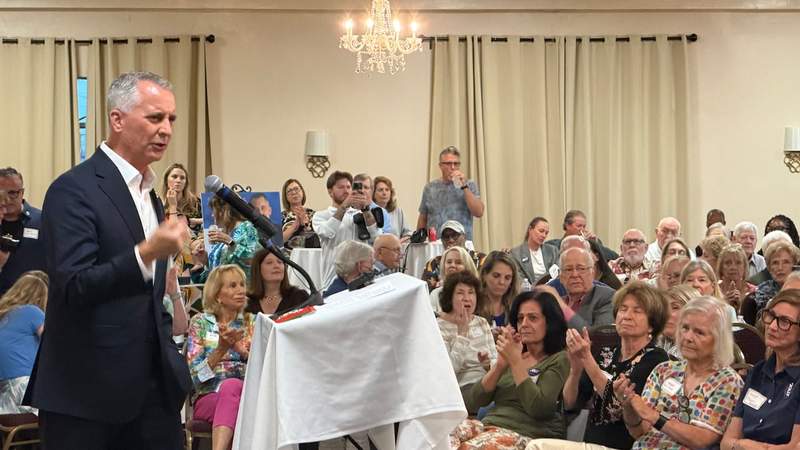
Since David Jolly announced his run for Florida governor last year, he has spoken at more than 200 town hall meetings across Florida.
On Thursday night, his campaign stopped at West Tampa’s famed La Teresita Restaurant, where he riffed for nearly an hour before 350 mostly older voters feeling optimistic after last week’s surprise Democratic victories in two legislative special elections.
Jolly, a former Republican congressman who represented Pinellas County, urged an energetic message that cautioned Democrats, who haven’t won a statewide election in eight years, to keep in mind that Republicans hold a commanding edge in active registered voters.
“We are more enthused than ever to turn out and to win elections, but let’s not presume that we have already won hearts and minds,” Jolly said. “So between now and November, we have to prove ourselves worthy to an emerging political coalition that we have not seen in the country, and certainly as Florida Democrats we have not seen in a very long time.”
Several Democrats afterward said Jolly left them feeling inspired. They will choose between him and another leading Democrat, Orange County Mayor Jerry Demings, in August.
Here are some highlights:
He has to convince Democrats to vote for him in the August primary, but Jolly doesn’t shy away from his GOP roots.
It might be risky: He’s trying to get the nomination from a party that four years ago bet on another former Republican to run for governor and lost big. But Jolly, who registered as a Democrat last year, doesn’t just mention his past and move on. It’s a major theme in his pitch and a variation onformer Republican Gov. Charlie Crist’s“I didn’t leave the party, it left me” explanation for his Democratic conversion.
Jolly told the crowd Thursday that he was the only Republican in the U.S. House in 2015 who voted against a bill authorizing an investigation into Planned Parenthood.
“Change is part of my story,” Jolly said. “And so I speak openly about my change because I celebrate my change in politics. You see, I don’t think the problem in politics is people who change. I think it’s people who won’t change.”
He needed to quit his party, he said, because he was kind of a “Bush 41 Republican” that didn’t mesh with a GOP that continued to lurch to the right.
“I fought the Tea Party and lost. I fought the Freedom Caucus and lost. I fought Trumpism and I lost.,” Jolly said. “I walked away from the fact that the party I signed up for was a party of less government, and then it became the party of no government, and now government’s the enemy. Folks, government is not the enemy. We are the government, and when we attack government, we’re attacking ourselves.”
That moral element to Jolly’s argument resonated with Thursday’s audience.
“I supported Crist, but it felt like he was going through the motions,” said Mickey Castor, an 86-year-old retired social services manager who is also the stepmother ofDemocratic U.S. Rep. Kathy Castor of Tampa. “But David has a real fire in the belly when he’s talking about his values.”
Jolly waited until the end of his speech to note that he had yet to mention President Donald Trump, even on a day when the president fired Tampa’s own Pam Bondias U.S. attorney general.
“I’m not asking people in this race to litigate the president,” Jolly said. “This race is about what (former Democratic governors) Bob Graham and Lawton Chiles used to focus in on: the responsible administration of government. Are we educating your kids? Do you have access to health care? Do you feel secure in your home or in your apartment? Do you feel as though we’re investing properly in the environment and quality of life in the state of Florida?”
Jolly didn’t mention the Republican front-runner in this year’s gubernatorial race, U.S. Rep. Byron Donalds, who polls consistently show is leading Jolly (and Demings) in a head-to-head race and has a war chest that dwarfs anyone else in the race.
If Jolly fired shots at anyone, they were aimed at Florida’s current governor, RepublicanRon DeSantis.
“The problem with this governor is that he thinks he’s the smartest person in the state,” Jolly said. “I know you’re not surprised to learn he’s not. Your next governor is not going to be either.”
Polls show Republicans, Democrats and independents agree that affordability issues are the most pressing. Jolly agrees, he’s just not calling it “affordability.”
“An affordability crisis is whether you can pay your rent this month. An economic crisis is whether you feel comfortable that you’re going to have housing and health care in the next decade,” Jolly said. “We’re a state gripped by an economic crisis and exhausted by culture wars.”
Jolly ticked off a few things he would push forif hewere governor.
Remove hurricane and wind coverage from the private insurance market and finance them through a state catastrophic fund, which he said would cut homeowner’s insurance by 60% to 70%. “My Republican friends in Tallahassee say, ‘That’s socialism,” he said. “I just call it cheaper insurance, folks.”
Provide tax relief for first-time homebuyers so they benefit from the same discounts that other homeowners get through programs like Save Our Homes.
Cap profits for investor-backed utilities to the national average of about 10%, which he said would save hundreds of millions for rate payers.
Expand Medicaid. “Tallahassee is too busy litigating President Obama’s legacy than bringing health care to Florida’s families. And I think it’s wrong.”
Make major investments in public education, including 30% pay raises for teachersthrough tourism taxes.
About 40 minutes into his stump speech, Jolly was cooking as he talked about his ending the culture wars.
“We are going to promote science over ideology. You know what that means? On the first day as your next governor, I get to fire the Surgeon General of the State of Florida.”
Jolly made that same reference to DeSantis appointee Joseph Ladapo earlier this week, and it drew the biggest applause of the night.
As the cheers and clapping died down, Jolly followed with a forceful defense of much of the Democratic agenda that had been successfully lampooned and subverted by Republicans in the last couple of election cycles. That included diversity, equity and inclusion programs, often referred to as DEI.
“My Democratic friends, a lot of us thought, ‘Oh boy. We got in trouble talking about DEI two years ago.’ Maybe, so maybe we did. That doesn’t mean it was wrong.
“To suggest that for political reasons, we should run from the losses of two years ago because we feel like embracing diversity somehow led us in the wrong direction. No, it was leading us in the right direction, and now is the time for us to defend it.”