
WINTER PARK, Fla. — In Winter Park, a local wildlife center is giving injured raptors a second chance at survival.
The Audubon Center for Birds of Prey rescues and rehabilitates hundreds of birds each year, from bald eagles to owls and hawks.
What You Need To Know
The Audubon Center for Birds of Prey rescues and rehabilitates hundreds of injured raptors each year in Winter Park
Many birds arrive hurt by cars, power lines and other human-related causes
Staff and volunteers work daily to treat, train and release birds back into the wild
The nonprofit relies on donations while also educating the public and expanding exhibits like a new owl aviary
MAP: View more Florida on a Tankful locations
Officials at the nonprofit say many of the animals arrive with injuries from cars, power lines or other human-related causes.
The center is not only working to heal birds, but also to educate the public on how to help protect them.
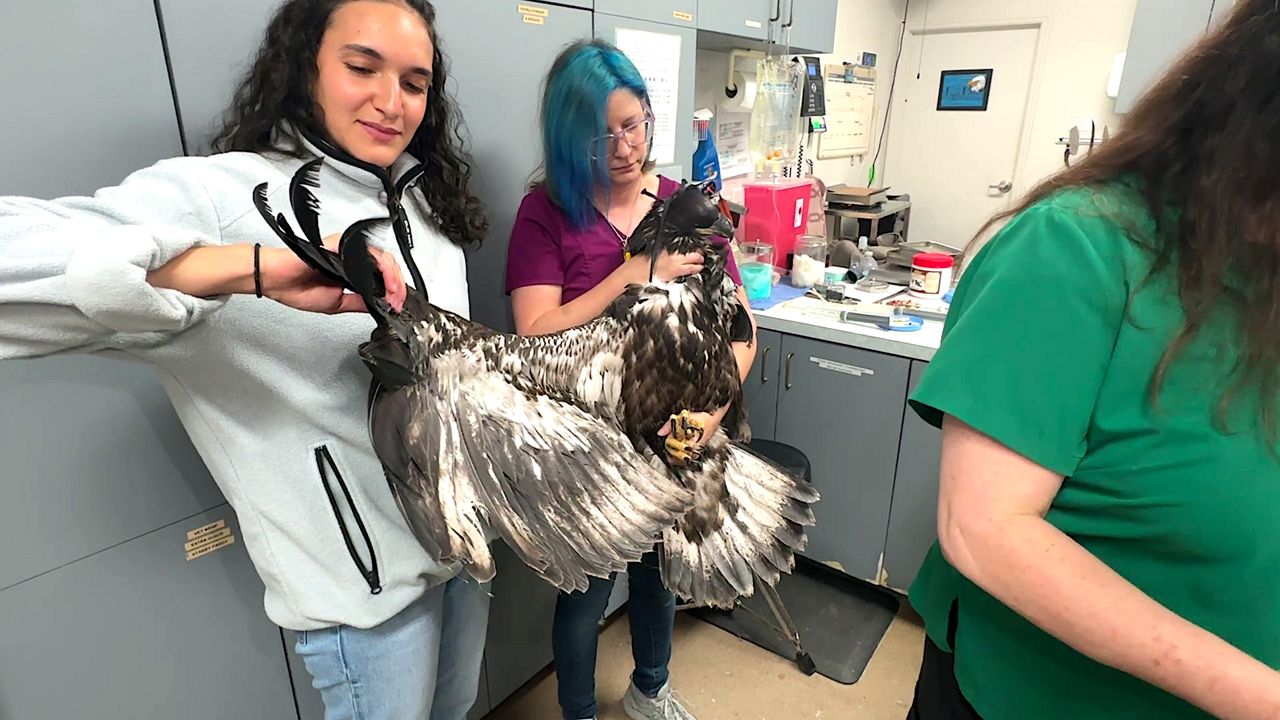
Rescue teams work hands-on with birds of prey daily — and on this day, it’s an immature baby bald eagle that fell out of its nest too early.
“They are really crazy when they’re learning to fly,” said Beth Lott, a raptor specialist at the Audubon Center for Birds of Prey.
This is not unusual for America’s national bird, with about 80 ending up at the center each year. Staff members say they have found ways to help protect the young birds during those early stages.
“These are the little bumpers we put on to protect their risks out there,” Lott said. “Because they will hit some walls just learning to fly.”
It takes a team to save lives. The young eagle is tagged, given fluids and fed before being moved into a temporary habitat where it can build strength and practice flying.
“But they will become magnificent fliers before you know it,” Lott said.
What volunteers know is that injured birds — the center primarily rescues raptors — continue to arrive, one after another.
Some 700 birds come into this center each year, and about 40% of those will be released back into the wild.
“Since 1979, we’ve been able to release over 800 bald eagles,” said Birds of Prey Director Katie Gill-Warner.
With a yearly operating cost of around $1 million, the nonprofit relies heavily on donations.
Many of the injuries they treat are caused by humans, including collisions with buildings, vehicles, gunshots and poisoning. The center is also expanding with the unveiling of a new owl aviary.
“So, it houses great horned owls. Barred owls. There’s three enclosures for the public to view them,” Gill-Warner said.
The facility is open to visitors, giving people a rare chance to see these birds up close.
“Over and over, I hear guests say, ‘I’ve never been this close to an owl. I’ve never been this close to a falcon,’” said longtime volunteer Maggie Haynes.
Some birds can’t be returned to the wild and become permanent residents, serving as ambassadors for education.
“And most of the birds that we get in can get hit by cars and have very bad wing fractures and can’t fly,” said Samantha Little the center’s raptor conservation manager.
And helping the injured is what Birds of Prey is all about.
The Audubon Center for Birds of Prey is open Tuesday through Sunday from 10 a.m. to 4 p.m. The cost is $10.00 per person, while children under 3 get in for free.