
It’s November 2025, and Richard Bravo moves through Sidney & Berne Davis Art Center’s Grand Atrium Gallery like a live wire. He’s clasping hands, gesturing toward canvases, blinking back tears. It’s the opening night for his solo exhibition. Along two walls, towering pop art-inflected portraits of cultural figures—Biggie Smalls, Fidel Castro, Rihanna—pulse in graphic color and declarative strokes. Branded fabrics add contemporary flair to classic portraiture.
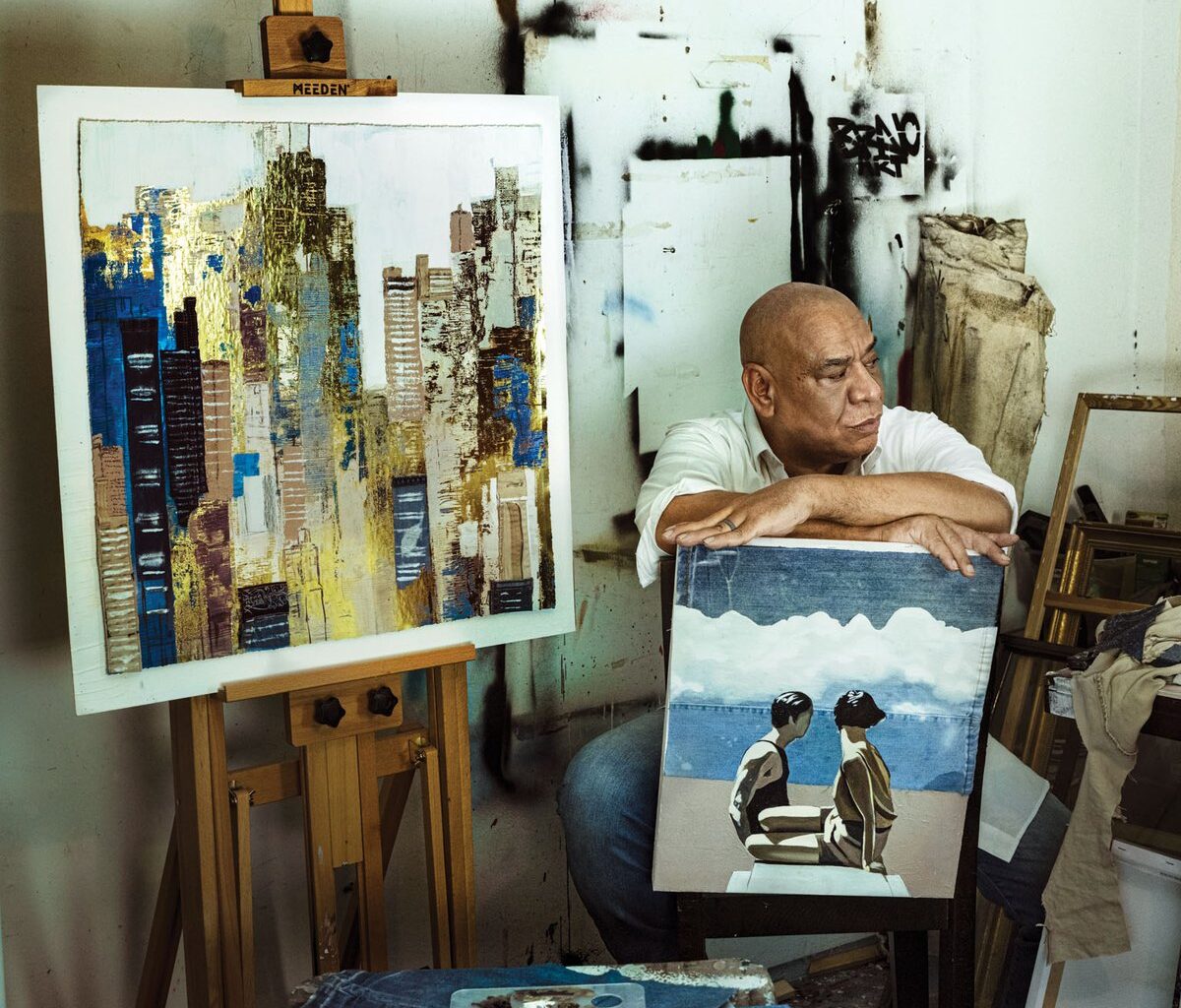
By the third wall, the volume quiets to a hum as the show shifts to Richard’s newer work, the palette softening to chalk and indigo as figures recede and landscapes stretch. A woman draped in a sheet stands with her back to us, facing an open coast. Two swimmers hover in the suspended breath before a dive. Each image is built from reclaimed denim, cut and layered, painted with bleach and oil pigment. Richard completed the collection in less than two months and titled the new series, Art Is in My Jeans.
Over the years, Richard has incorporated fabric in bursts—a torn coat lining or Louis Vuitton scarf stretched as canvas—but this collection takes the textile focus to its extremes. Belt loops, tags and hems become roads, smokestacks, skyscrapers; the utilitarian nature of the medium is not hidden, but honored.
“We throw away denim all the time,” the artist says. After helping his father-in-law downsize by clearing out some of his old clothes, Richard began thinking about denim’s history as a uniform for American railroad workers, miners, factory hands and generations of immigrants who built the country’s infrastructure in heavy-duty cloth. “I started looking at it and saying: ‘That’s the fabric of America,’” Richard says.
The series began with small-scale experiments, testing how bleach could be used on denim to create a watercolor-like effect. The reaction was unpredictable at first, the jeans’ indigo lifting unevenly depending on wear and saturation. To get his desired effect, Richard tested dilution ratios obsessively, bleaching swatches at 75%, then 65%, 55% and 25%, and studying how the color ghosted. As he worked, experimentation bled into creation, with successful fabric tests cut and layered into finished scenes.
In one such piece, Standing on the Edge, layering creates depth. In the foreground, a pant waistline becomes the corner of a rooftop, and vertical slices of light-wash denim rise into a skyline behind it. The piece was the foundation for the larger Sitting on the Edge of the World, which shows a lone figure sitting at the top of a high-rise above a dense cityscape. “[It’s] about rising above the congestion, seeing it from a different perspective, taking advantage of that perspective and knowing that you can take on the world.”
Richard was born in Colombia and raised in Jamaica, Queens, New York, as the son of a printer father and a mother trained in patternmaking. Color theory and precision entered his life early. So did the urban landscape around him—the scale and audacity of street art would later echo in his large-format portraits.
In the 1980s, as gangs tightened their hold on parts of the borough, Richard accumulated misdemeanor graffiti charges. His mother, long the rock of the family, wrote him off. But his father intervened, sending him to live with relatives on Long Island, where teachers steered him toward the Fashion Institute of Technology. There, Richard refined instincts he had taken for granted while scrawling on abandoned walls: intuitive color mixing, speed, spatial vision.
After graduation, Richard became a clothing designer, following his mother into the field. She was proud, but he was miserable. During the 1992 Rodney King police brutality protests, which spread across the nation, Richard called in sick to join demonstrators. A front-page photo captured him separating protesters and police; he lost his job the next day.
Hip-hop culture became both subject and scaffolding. Richard started an arts collective on the West Side, drawing the attention of a record label photographer, who brought him on as a scenic designer. “I did videos for DMX, Shania Twain, 311,” he says. “I got to do the set design for the Wu-Tang Clan’s Enter the Wu-Tang 36 Chambers cover. It was amazing.” He went on to start a band, performing at historic venues like CBGB. Around the turn of the century, he reentered the fashion industry, working out of the 65th floor of the Empire State Building. From that vantage point, the city felt invincible. Then, two planes hit the twin towers.
Weeks passed before the rubble cleared. Deals fell through, start-ups shuttered. The fear and trauma lingered, guiding Richard and his family to the Gulf Coast, where his children’s grandparents would be closer at hand.
“I said, ‘This is so perfect. Look how quiet it is here. There’s no danger. People wave at you,’” Richard remembers. Art moved to the back burner as he found work with an insurance agency and life settled. Then, a friend caught a glimpse of his paintings and introduced the artist to the team behind local arts and poetry collective, Gulf Coast Leisure. “There were all these young artists—it got my energy pumping,” Richard says. Soon, he was exhibiting at SBDAC, doing a residency at Fort Myers’ Space 39 Art Bar, and showing work in New York and Los Angeles. He kept his day job, but by night, his garage studio exploded with creativity.
Over the years, Richard’s style has mingled with the rhythms of life on the Gulf—best seen in Art Is in My Jeans. For every cityscape, there’s a coastal vista, a sweep of sand rendered in mottled bleach. The shift lives in tone, too. His metropolitan bravado has softened. The work—like its artist—reflects a peace, patience and passion that draws viewers in.
Several co-workers at the insurance agency showed up for Richard’s November opening, many of whom didn’t know about his work until the day of the show. Alliance for the Arts invited him out to give a talk about his work and his life. A gallery in Delray offered him permanent space on its walls. And, when he and SBDAC curator Cesar Aguilera were hanging works for November’s exhibit, Richard’s young granddaughter walked into the gallery. “She walked right up to the piece, put her hand in the pocket and said, ‘Oh, wow! This is cool!’” Richard recalls. Everyone else froze, but Richard just laughed: “‘You like it?’” She nods. “‘I had to make sure that it was a pair of pants.’”
“I love that it draws people in,” the artist says, reflecting on the moment. “Whenever someone hesitates and looks around for a guard, I want to be the one to say, ‘That’s fine, you can move forward.’”