
My family’s history with Walt Disney World is neither casual nor recent. I grew up with Disney World as part of family life. My parents are Disney Vacation Club members, and the Bay Lake Tower interest at the center of this dispute was a wedding gift from them. WDW has long been, for us, a place woven through memory, ritual, intergenerational trust, and investment.
That history sharply narrows what Disney and its defenders can plausibly say. This is not a one-off consumer complaint from a family that suddenly discovered Disney once there was a grievance to air.
For many years, my family has relied on Disney’s disability accommodation systems to access Walt Disney World safely and predictably. When a disabled family objects after years of successful participation, that is not opportunism. It is evidence that something real has changed.
According to my Feb. 24 declaration, Disney’s operational changes to the Disability Access Service program and related transportation policies have materially impaired my family’s ability to use that ownership interest safely and predictably.
Nor is this some vague or emotional objection. The alternatives Disney now points to are, for my family, technically and medically unworkable and, in many cases, dangerous.
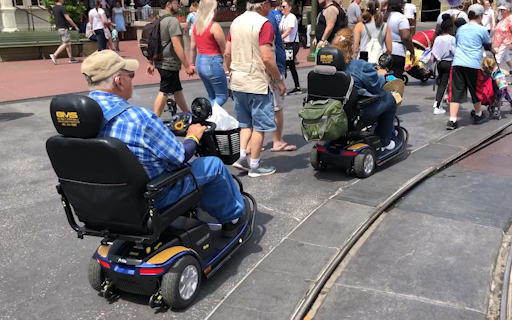
I am a full-time user of a medically necessary power wheelchair. In dense switchback queues, I may be unable to perform a U-turn, reverse once another guest is behind me, or exit quickly against the flow of the line. Once committed to certain queue geometries, I can become physically locked in.
So when Disney points to queue re-entry, return-time systems, or some version of “attempt the queue first” when DAS is denied, it’s not offering my family a fallback. For a guest in a chair like mine, that alternative is physically impossible.
 My family also cannot safely use the parks with the party separation Disney now suggests. I require close caregiver proximity and rapid assistance if something goes wrong. My husband is not optional in that setting. He’s my primary caregiver and emergency responder. My disabled son also cannot safely tolerate the disruption and instability that forced separation and queue re-entry can produce.
What Disney presents as flexibility becomes, for us, a risk multiplier.
There is also a plain crowd-safety problem here. A nearly 400-pound power wheelchair positioned against the flow of a narrow, crowded queue creates a predictable egress bottleneck in an emergency. This is not a preference issue. It is an engineering and emergency-access issue.
DAS cannot be pursued until after non-refundable tickets have already been purchased, and it is not guaranteed even then. That forces my family to absorb substantial financial and medical risk before we can even know whether safe access will exist at all.
Paid alternatives such as Lightning Lane are not a serious answer. The issue is not convenience. It is whether a medically complex family with long-term DVC ownership can safely navigate the parks at all after Disney changed disability access.
This is still not a scorched-earth story. My family’s continued love for Disney is real. Our positive experiences with Disneyland Paris as a disabled family are real. We are returning there in June. A family acting opportunistically does not keep making careful distinctions between the parts of Disney that have served it well and the part it is now challenging.
I used the process. I documented. I preserved evidence. I filed through the proper administrative channels. On Feb. 20, the Florida Commission on Human Relations docketed my discrimination complaint as FCHR No. 2026119734. I elected mediation. No mediation conference occurred before the March 18 deadline, and the matter proceeded to investigation.
Large institutions count on brand loyalty to do defensive work for them and on the public’s habit of treating accommodation disputes as greed rather than structural change.
A disabled family can love Disney and remain loyal enough to keep traveling, keep distinguishing, and keep telling the truth with precision.
And Disney can still mishandle a specific dispute with that family in Florida.
We were loyal. Disney changed the terms of access anyway. That is the betrayal.
Kelsey Maurine Brickl of Brooklyn, N.Y., is the founder and director of Accessible France, an accessible travel consultancy focused on disabled and neurodivergent travelers.