
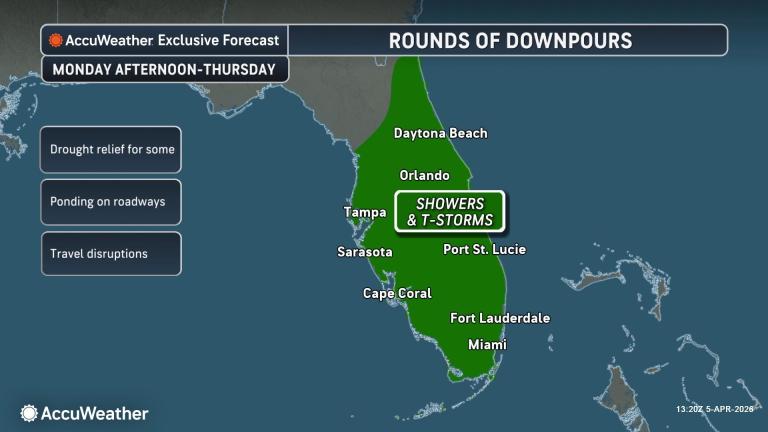
Rain will bring much-needed drought relief to Florida this week, but repeated thunderstorms may lead to localized flooding while strong onshore winds create dangerous surf and rip current risks along Atlantic beaches.
Published Apr 5, 2026 12:24 PM CDT
|
Updated Apr 5, 2026 1:25 PM CDT
Video from Lake Michigan in Indiana shows seagulls flying into strong winds, appearing nearly motionless in midair. AccuWeather’s Ariella Scalese explains why birds seek out these conditions.
Rain is set to return to Florida this week, bringing more than just the usual spotty showers and thunderstorms. The rain will help green up the landscape, reduce wildfire risk and begin to ease the state’s extensive drought.
“Our team of forecasters expects 1-2 inches of rain along the Florida Atlantic coast and across much of South Florida from Monday to Thursday, which will be good news for areas under severe to extreme drought,” said AccuWeather Senior Meteorologist Brett Anderson. “However, some locations could see repeating thunderstorms deliver 4-6 inches of rain, which may lead to flooding in poor drainage areas.”
Some parts of Florida have received only one-quarter to one-third of their average rainfall since Jan. 1. Nearly 80% of Florida is experiencing the two most severe categories of drought, and almost the entire state is affected by at least some level of drought. The state is experiencing its worst drought in 25 years.
The most extreme conditions are in the northern counties, where streams and river levels are very low. The severe drought conditions extend into southern Georgia as well.
Much of the southeastern United States is experiencing conditions ranging from abnormally dry to extreme drought. Since this week’s rain will bypass most areas north of Florida, drought conditions will likely worsen amid dry, breezy weather, increasing the risk of wildfires.
Conditions are expected to remain mostly dry during the 2026 Masters at Augusta National in Georgia.
Conditions will be rough along Atlantic beaches much of this week, with onshore winds averaging 15-30 miles per hour and higher gusts.
Have the app? Unlock AccuWeather Alerts™ with Premium+
“This long-duration onshore wind event will bring rough surf and dangerous rip currents as many people vacation in the state and locals return to the beaches,” Anderson said. “Beach erosion and minor street flooding are possible, especially around high tide, including in Miami. Fortunately, the King tides, the highest astronomical tides of the year, do not occur until the third week of the month.”
More stories of interest:
Want next-level safety, ad-free? Unlock advanced, hyperlocal severe weather alerts when you subscribe to Premium+ on the AccuWeather app. AccuWeather Alerts™ are prompted by our expert meteorologists who monitor and analyze dangerous weather risks 24/7 to keep you and your family safer.