
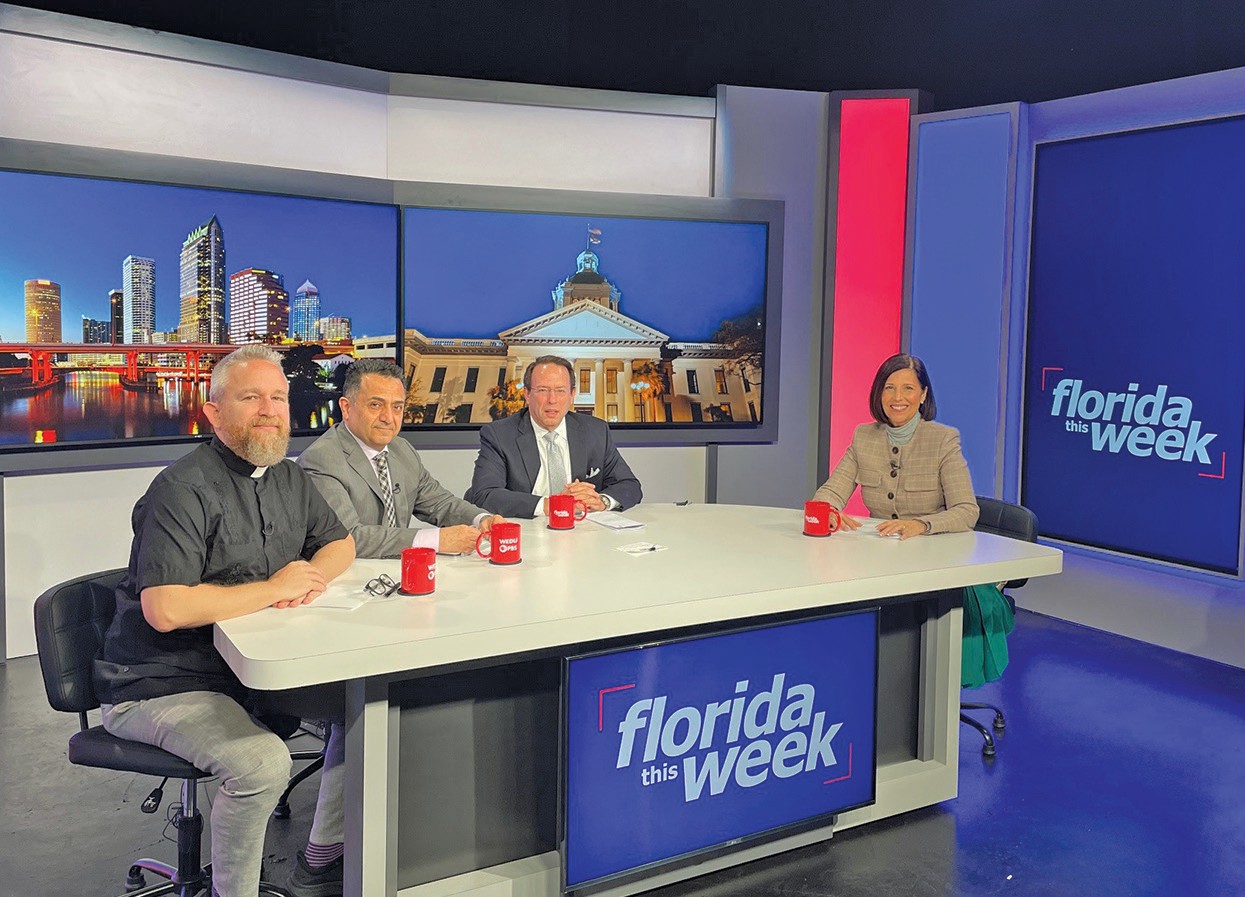

Panelists on a recent episode of WEDU’s “Florida This Week” included guests Rev. Andy Oliver, Amir Ardebily and Jonathan Ellis with host Lissette Campos.
In late March, Tampa Jewish Community Relations Council (JCRC) chair, Jonathan Ellis, appeared on WEDU’s public affairs series “Florida This Week,” a program highlighting local perspectives on current events. Hosted by eight-time Emmy Award winning journalist and former news anchor Lissette Campos, the episode featured Florida-based experts discussing the ripple effects of the war in Iran are being felt in the Tampa Bay area.
Panelists included Tampa Mayor Jane Castor; Lathan Craig Austin, a supply chain expert at Florida International University; Amir Ardebily, an Iranian American business owner representing the Persian American Society of Tampa Bay; and Rev. Andy Oliver, with Allendale United Methodist Church.
The program opened with a brief overview of U.S. Central Command (CENTCOM) at MacDill Air Force Base, established in 1983, which oversees all of the military operations for this conflict. According to CENTCOM’s website, Operation Epic Fury, initiated in February of this year at the direction of the President of the United States, aims to dismantle the Iranian regime’s security apparatus, prioritizing locations that pose an imminent threat.

Campos noted that developments in
Iran are being followed by many in the community, particularly among Iranian Americans, and Mayor Castor what types of reactions to the war her office had been fielding. Mayor Castor emphasized the city’s incredibly diverse population, including significant Iranian, Muslim and Jewish populations and described the community responses as mixed.
“There are individuals that are very supportive and others think this may be the spark that sets off the entire Middle East,” Castor said.
Addressing potential economic impacts, Castor said, “Some of the immediate effects are the increase in oil prices. As we, here in Tampa, and the entire nation, struggle with affordability in a number of different ways, this dramatic increase in gas is impacting our community, our residents, our businesses and the city as well.” She said the city is focused looking at ways the city can be more efficient with the fuel it uses.
Security concerns were also raised during the show and Mayor Castor said that the city has relationships and during times of heightened risk, provides additional patrols for houses of worship without waiting for requests. “We have police officers who serve on the JTTF [Joint Terrorism Task Force]. We do ramp up those security efforts at those locations. We’re always aware of the threat level if any in our community and work collaboratively with the community to prevent any incidents before they occur,” she added.
Ardebily said that Iranians have mixed feelings. “They are very sad but very hopeful for a changing regime. There is hardly any democracy there. Iranians traditionally never celebrate death but celebrate life, and there is so much going on and so many being killed by the regime and now there’s a war, which is never a good thing. There is a huge division.” He added that with the Internet down and the lack of information from the Iranian government, many are fearful, moving from one city to another, and appreciate updates from the U.S. and Israeli governments about areas to avoid.
When asked about the local Jewish community’s reaction, Ellis said, “The Jewish community is not necessarily homogeneous. The general consensus is that while they don’t want to see the U.S. or Israel at war and don’t want to see people dying, the hope is that this war will make the world a safer place. It will be beneficial to the US, Israel and the entire Middle East, stabilizing the Middle East.”
Ellis continued, “Israelis have been living under these types of attacks in major cities and population centers for decades, receiving rockets and rocket fire from Iranian proxies like Hamas, Houthis and Hezbollah. The Israeli public shows that it overwhelming supports for changing the regime in Iran if that is able to happen, more importantly removing the threat to the entire Middle East.”
Ardebily noted, “After 47 years of the Ayatollah’s dictatorship, Iranians are grateful to the Jewish community, Israel, the United States and the US government. You need to get rid of this tyranny otherwise the world will never be in peace.”
Oliver said, “A lot of our talk about this war coming to an end is about the economy. That says something troubling about us, that we are moved by the economy and not human suffering. I think that keeping human life at the center of this conflict is the most important and that is what moves us as a people to want to build better, beloved community.” The 30-minute show began airing on WEDU in late March and is streaming on WEDU.org/floridathisweek.