
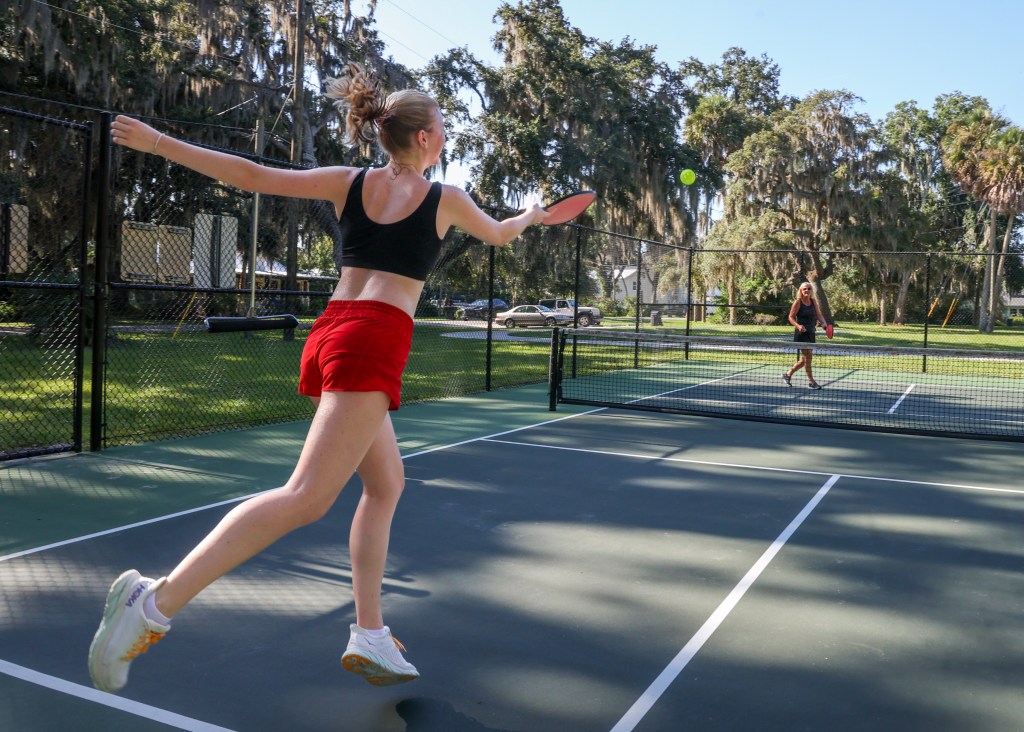
For generations, the charity golf tournament has been a staple of fundraising. Yet now the granddaddy of philanthropic sporting events is being replaced by a sport actually popularized by granddaddies — pickleball.
Yes, the hybrid of tennis, badminton and ping-pong, where the balls make a popping sound that fans love and foes loathe, is pushing old-school golf into the rough. Charities, civic groups and even business execs are trading golf balls for pickleballs, since golf is costly, time-consuming and not for everyone.
Helping lead that trend locally is Family Promise of Greater Orlando with its third annual “Serving Hope Pickleball Tournament” this coming weekend.
Family Promise is a great local charity with a unique approach to helping families address homelessness. Its primary goal is to help families stay in their homes. But for families in immediate need, the group partners with more than a dozen local churches that take in families for a week at a time, four times a year.
These are congregations that take Jesus’ command to welcome the stranger literally, transforming their churches into shelters where congregants voluntarily fill round-the-clock shifts, helping families get back on their feet and into permanent housing. It’s personal and transformative.
We’ll talk more about what Family Promise in a moment. But first, let’s talk pickleball, which ESPN recently described as experiencing “perhaps the most meteoric rise of a once-niche sport that the United States has ever seen.”
It’s a sport with a silly name and some annoyingly passionate fans that’s played a lot like tennis, except on a smaller court with a slower ball.
It’s also oddly contagious. I know because I myself am now somehow a pickler.
Every Tuesday and Friday after work, my neighbors and I drag a net-on-wheels into the cul de sac and start pickling.
Every neighbor has their role. Larry is the organizer, the pickler-in-chief. Sean is our resident semi-pro. Marty’s role is to complain anytime the temperature drops below 80, but also serves as the neighborhood’s generous handyman, known to fix a malfunctioning garage door mid-match.
My role is to be a warm body. My pickling skills are decidedly meh. But you need at least four people to play doubles. And I am, in fact, a person.
So I join Tyler, Lou and Beth Anne in rounding out our group of regulars. Some of us went from non-pickleballers to annoying pickleballers in zero to 60. When Tyler had a birthday, the neighborhood gave him a collective gift that consisted solely of pickleball paraphernalia. You’re welcome, Tyler.
We’re on our third net and sixth year, a tradition that started during COVID when we were all desperate to socialize. We’re not alone. The sport was invented for kids in 1965, but came on gangbusters recently as old farts got excited and then young farts and middle-age farts joined in.
My 23-year-old son and his friends now pickle. My boy and I sometimes pickle together. Using “pickle” as a verb is one of many annoying things about pickleball people.
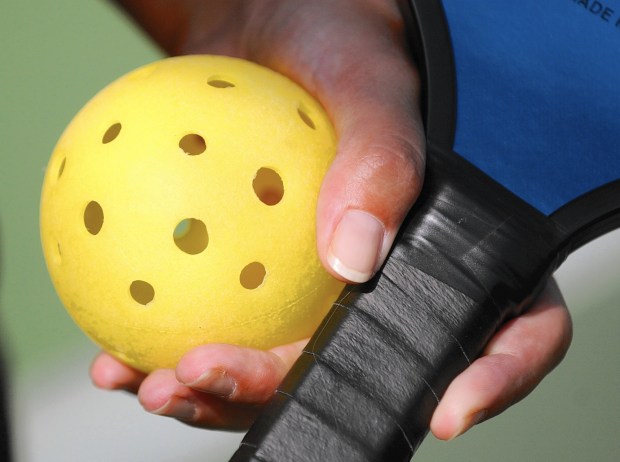 Pickleballs are kind of like wiffle balls with holes that slow down their speed. (Stephen M. Dowell/Orlando Sentinel)
You know who isn’t annoyed by pickleball? Orthopedic practices. Since boomers started trying to recapture their youth by running around a court, injuries have skyrocketed. The American Osteopathic Academy of Orthopedics has started tracking the rise of pickleball-related injuries.
Our cul-de-sac crew has thrown out two backs, sprained at least two ankles and seen a couple cases of road rash. Visitors routinely rotate in. One judge popped in for a visit, pulled a muscle and never came back. I think he held our cul de sac in contempt.
We’ve also seen at least two paddle-on-head clonks … though I think the clonk Larry recently delivered to my noggin may have been an intentional response to a recent column. If so, fair enough.
Kathie Southern, the executive director of Family Promise, sustained an injury herself. “A partial calf tear,” she said sheepishly. A battle scar of pride, Kathie.
The truth is pickleball is usually pretty tame and easy for beginners, which is why Family Promise switched from golf. Even if you’ve never picked up a paddle, everyone is welcome at Saturday’s event at the Picklr complex near Apopka.
And if you’re looking for a reason, this cause is noble. Members of the churches that participate in Family Promise’s “congregational shelter program” volunteer shifts from early morning to overnight. Sometimes they entertain kids while Mom or Dad go job-hunting. Sometimes, they just listen. Always, they make sure families have a safe place to rest their heads.
All told, the program is supported by more than 1,000 volunteers a year with help from more than a dozen churches from the Catholics at St. Margaret Mary in Winter Park to the Methodists at St. Luke’s in South Orlando.
That kind of support is impressive. Just as impressive is that 88% of the families served find permanent housing. That’s the definition of success. The charity served seven families during its first year 25 years ago. Last year, it served 254.
People who see what this group does want to get involved. Last fall, I hosted a fundraising breakfast where attendees donated more than $300,000 after hearing some of the group’s success stories.
But in Central Florida — a community built on the back of low-wage workers — the needs are nonstop. You can volunteer, donate or get your own church involved.
Or you can come play pickleball this weekend. Matches take less time than a couple holes of golf. And it can be amusing to watch septuagenarians humble athletic teens … if you don’t mind the noise anyway.
You can get more information at fporlandofl.org/pickleball, by sending an email to info@familypromiseorlando.org or calling 863-409-6959.