
LARGO — A developer’s bid to clean up a contaminated property on Eighth Avenue Southeast and build 168 apartments under the Live Local Act stirred up hard feelings among city commissioners March 17.
Despite their concerns, commissioners said the environmental benefits of designating the property a Brownfield area outweighed the potential for added traffic and congestion, and they voted 4-2 in favor of the move. Commissioners Michael Smith and Mike DiBrizzi voted against; Vice Mayor Chris Johnson, who ran the meeting in Mayor Woody Brown’s absence, joined Commissioners Curtis Holmes, John Lauser and Donna Holck in voting yes.
When Florida legislators passed the Live Local Act in 2023, it was designed to spur affordable housing development statewide by giving developers tax breaks and other incentives to build in commercial, industrial and mixed-use areas. It also stripped local commissions and councils of the power to block such projects.
In 2025, despite objections from some neighbors and commissioners, a developer used the act to build a 240-unit apartment complex adjacent to Largo Middle School on Eighth Avenue Southeast.
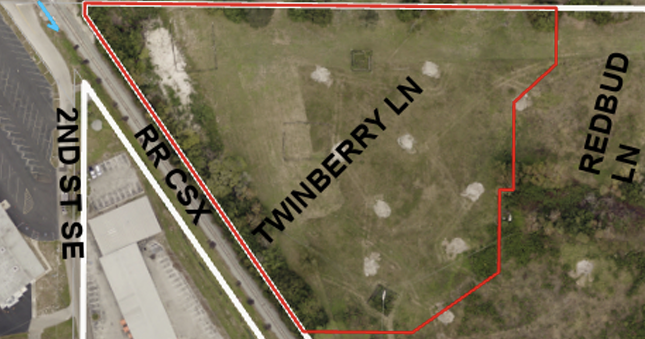
A developer now wants to use it again for a trio of vacant adjoining lots to the northwest of that recently opened complex, known as Caspia. The lots sit adjacent to a railroad line that is the likely source of the contamination, city staff said.
Staff recommended approval of a resolution designating the 5.7-acre site as a Brownfield area — defined by the state as an abandoned, idle or underused industrial or commercial property — which, following an environmental survey and cleanup, would allow a developer to build on the repurposed land.
Assistant Community Development Director Christopher Tillett, a newly installed official, repeatedly stated the Brownfield designation was separate from any potential future development of the site. But commissioners used the opportunity to air their frustrations with the constraints the state has placed on them.
“The Live Local Act took the power from this commission to be the direct representatives to the citizens,” Smith said, noting he voted against the Caspia project. “Now Tallahassee has approved developments to be in areas that are zoned Limited Industrial, which is why the decision was taken away from us with the other development.”
Smith also lamented the lost prospect of possibly leaving part of the area vacant for passive park space.
“And now we’re going to be putting 168 affordable housing units on the area,” he said.
Tillett acknowledged there was a proposed development for the property currently under review, a 168-unit, three-building complex called The Station that would also feature a clubhouse and multiuse path. But he and other staff members repeatedly noted the Brownfield designation was separate from the proposal, which he said “has not been approved yet.”
Lauser summed up the board’s position.
“All of these things are separate,” he said. “But this is our only opportunity to actually weigh in on the plans that are happening at this site.”
Lauser added that the developer “could build without us designating it a Brownfield site. It would just cost more because they’re not going to have the state funds. So, this is our only leverage point.”
Holmes said traffic on Eighth Avenue Southeast has already increased sharply since the Caspia project opened, a situation he said would grow much worse if The Station receives approval.
“That Eighth Avenue Southeast is not designed for the traffic it’s got now,” he said. “And ultimately, it’s going to get considerably worse. You’re going to have gridlock 24 hours a day.”
City Manager John Curp said the primary benefit of the Brownfield designation is getting the site cleaned up. Tillett said the property was found to have “limited soil and groundwater contamination.”
“The benefits of the cleanup outweigh what could happen,” Curp said.
He added that denying the designation “simply adds cost” to The Station, which he said is being designed for residents at or below 80% of the area median income.
“It’s been our goal as a community to provide more affordable housing to that demographic group,” Curp said. “Adding cost to this project reduces the quality of housing that will come on that project.”
He noted that the Live Local Act preempts the city from controlling whether housing goes on the site. “But this instead at least is a contribution to making that housing as good as it could be for our community,” he said.
After further discussion among the board, staff and an attorney for the developer, Johnson said the environmental benefits had won him over.
“The fact that we’re going to get better cleanup with the Brownfield designation than without helps make the decision for me,” he said.