
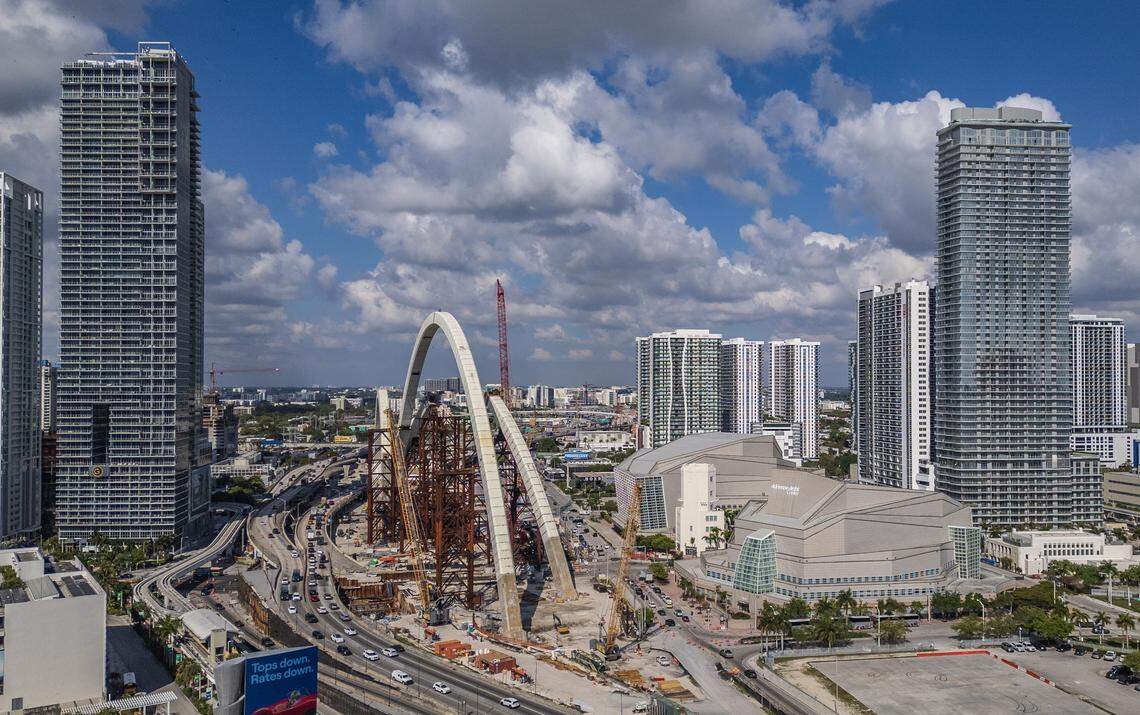
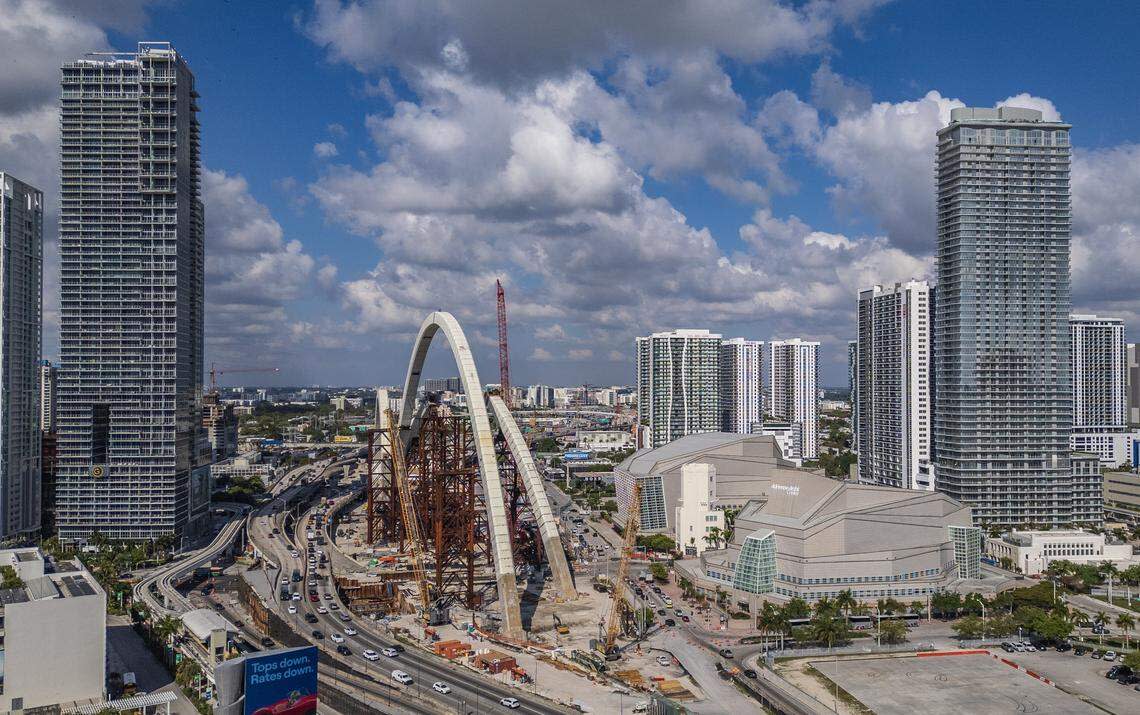
View of the ongoing construction of the arches for the I-395 signature bridge, in front of the Adrienne Arsht Center in downtown Miami, on Thursday, March 26, 2026.
(Pedro Portal/pportal@miamiherald.com)
Reality Check is a Herald series holding those in power to account and shining a light on their decisions. Have a suggestion for a future story? Email our journalists at tips@miamiherald.com.
The chaos starts as soon as you approach either end of Interstate 395, the critical downtown Miami highway link whose insanely complex, seemingly endless reconstruction has become a mirthless joke for the tens of thousands of drivers who are forced daily to navigate its ever-changing twists and turns.
It’s been like that for seven years. And there’s no end in sight to the hazards and aggravation.
There’s a lot to put up with. The traffic backed up to the MacArthur Causeway bridge on one end, and high over the Miami River onto State Road 836 on the other. The suspension-rattling pavement. The shifting lanes that turn the highway into a slalom course. The constant ramp and road closures. The confused drivers darting across three lanes to an exit that was there last month, but has now vanished.
On the ground, unsightly heaps of construction materials, dust and noise, closed sidewalks and side streets at the front door to the Arsht Center for the Performing Arts, the Perez Art Museum Miami and Frost Science Museum.
There has also been a cost in human lives. So far this year, there have been two serious construction accidents, including one last month in which a worker fell to his death on Biscayne Boulevard.
And, astride it all, a set of gigantic concrete bridge arches, reminiscent of a certain fast-food franchise, have been so slow coming off the grill as to markedly augment the Florida Department of Transportation’s reputation for failing to finish any road project on time.
This one’s breaking records. And according to the lawsuits flying between project contractors, engineers and their insurers, those now-infamous arches and the “signature bridge” they’re meant to support may be one big reason why.
Documents filed in those cases outline initial errors in the design of the six arches that, according to the project’s lead contractor, led to 18 months of delay and required a redesign that added significant time, cost and complexity to their construction, pushing back the expected completion date at least five years.
FDOT declined to make someone available for an interview with the Miami Herald and did not respond to written questions about the project — the agency’s consistent practice for years as the unexplained delays mounted.
Absent FDOT transparency, here’s a chronology of postponements, partial explanations provided in brief agency statements, and claims from an extensive court record of lawsuits and counter-suits that help explain some — but not nearly all — of the reasons the project has been delayed so long.
The first anticipated completion date for the new Miami bridge? 2021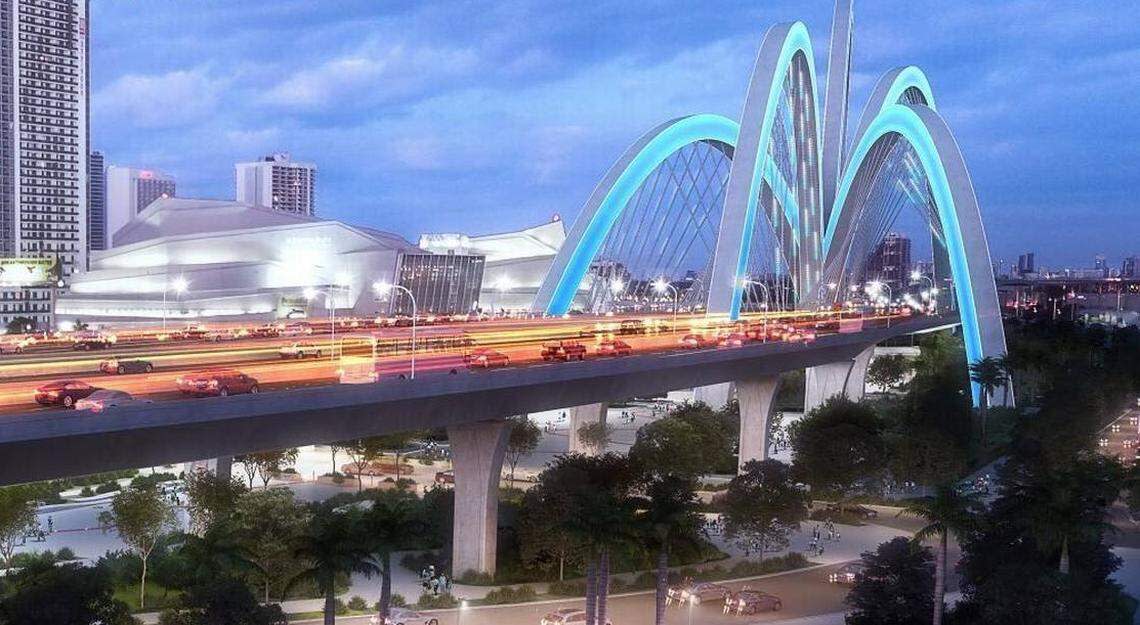
A rendering depicts a reconstructed Interstate 395 overpass and its “signature bridge” arches in downtown Miami, with the Arsht Center to its left.
(Archer Western-The De Moya Group)
It certainly wasn’t supposed to be like this.
When FDOT first picked a contractor in 2017 for the road-engineering quagmire officially known as the I-395/SR 836/I-95 Design-Build Project, the whole thing was supposed to be done in four years — by 2021.
Yes, that’s five years ago.
Now, in the latest update from FDOT, the delivery date has been postponed again, to late 2029. If you’re keeping score at home, that’s eight years behind the original schedule.
Yet FDOT made that latest delay public in the least noticeable way. It simply changed the expected completion date on the project webpage with no statement, no explanation and no acknowledgement of the newest postponement.
At the same time, the posted project cost has crept up — from $802 million originally to $866 million now.
An FDOT spokeswoman, Maria Rosa Higgins Fallon, asked for written questions from the Herald. After more than a week, she had not responded and did not respond to or acknowledge follow-up messages. The same thing happened with the Greater Miami Expressway Authority, or GMX, the agency that manages Miami-Dade’s toll highways and a partner in the project.
In the past, FDOT has blamed delays on bad weather and supply-chain issues prevalent during the COVID-19 pandemic in broad statements that provide no details or acknowledgement of construction issues. In 2023, an agency spokeswoman even ascribed the blame in part to holidays.
But the agency has never fully detailed reasons for delays, even as the completion date was pushed back at least three times since 2021.
By 2021, the first targeted completion date, FDOT had already announced the project finish would be delayed to 2024.
Criticisms of the Miami signature bridge project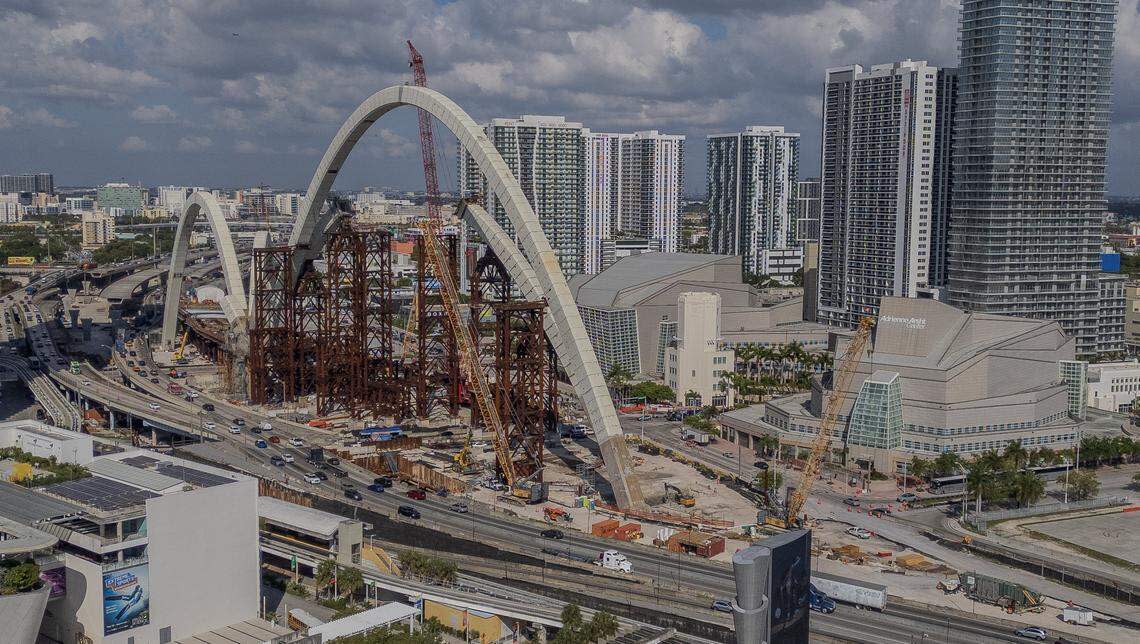
The arches for the Interstate 395 “signature bridge” over Biscayne Boulevard rise between the Arsht Center, to the right, and the Frost Science Museum, bottom left.
(Pedro Portal/pportal@miamiherald.com)
To critics who have complained from the start that the project was a waste of taxpayer money better spent on expanding public transit, the inflated costs and delays are all too predictable. Cathy Dos Santos, executive director of the Miami advocacy group Transit Alliance, called the project “misconceived from the start.”
It’s the consequence, she said, of focusing public resources almost exclusively on cars instead of mass transit that can more efficiently carry far more people, and an overly complicated plan that calls for double-decking State Road 836 over the Miami River.
“Highway widening is already extraordinarily costly and FDOT’s choice to double-deck the project only ballooned the price tag and stacked on delays,” Dos Santos said in an email. “Alternatives have existed since the 1980s, when Metrorail was first proposed: a mass rapid transit connection to Miami Beach. For decades now, there have been projects proposed, straw polls, resident polling all pointing to the same conclusion: transit moves more people than cars.
“Unless we want highways stacked as tall as the downtown skyline, our state transportation agency has to start building transit too.”
The massive road project, decades in planning, has been enveloped in controversy even before getting underway.
In the 1990s, FDOT concluded that I-395, the mile-long elevated highway built in the late 1960s to connect the new Interstate 95 and the MacArthur Causeway, was hazardous and structurally and functionally obsolete. Its solution: tear down the old expressway and replace it.
In collaboration with the agency in charge of Miami-Dade County’s toll highways, then known as MDX, FDOT opted to package the I-395 reconstruction with a far-reaching overhaul of the dysfunctional, often-clogged interchange where the highway meets I-95 and State Road 836, also known as the Dolphin Expressway, into one mega-project.
But when FDOT first announced it was ready to move on the project, then-Miami Mayor Manny Diaz, other public officials and residents balked. They cited the decimation its construction wrought on the historically Black neighborhood of Overtown and areas around Biscayne Boulevard, arguing that building something similar again would perpetuate the damage done to the city.
Diaz and former Miami Mayor Xavier Suarez, soon to be elected to the Miami-Dade County Commission, along with other officials and urban activists, pressed FDOT to consider other options, including replacing I-395 with a surface boulevard, or burying it underground or in an “open-cut” below street level, arguing that an elevated expressway had no place in a resuscitating downtown Miami and the planned new cultural institutions flanking it.
FDOT did not budge — citing cost and engineering complexity as objections to the proposed alternatives — but agreed to super-elevate the highway and significantly reduce its support columns and support embankments to lessen its impact at street level, while providing the land beneath it for the creation of a new 33-acre park that would join sundered pieces of the urban fabric back together. (The Trump administration last year rescinded a $60 million federal grant from a Biden administration program to fund the park.)
The agency also agreed to make the elevated, 1,000-foot segment over Biscayne Boulevard and Northeast Second Avenue into an architecturally distinctive “signature bridge” that could become a symbol of new Miami. When the agency seemed to backtrack, later proposing a purely functional bridge with no design flourishes as an option, city officials sued.
They got what they wanted.
FDOT baked in a requirement for an iconic arched bridge design into its request for bids for a contractor who would be responsible for designing and building the bridge, the new highway and improvements to the I-95 spaghetti bowl, traversed daily by 450,000 vehicles.
Complex bridge design added complications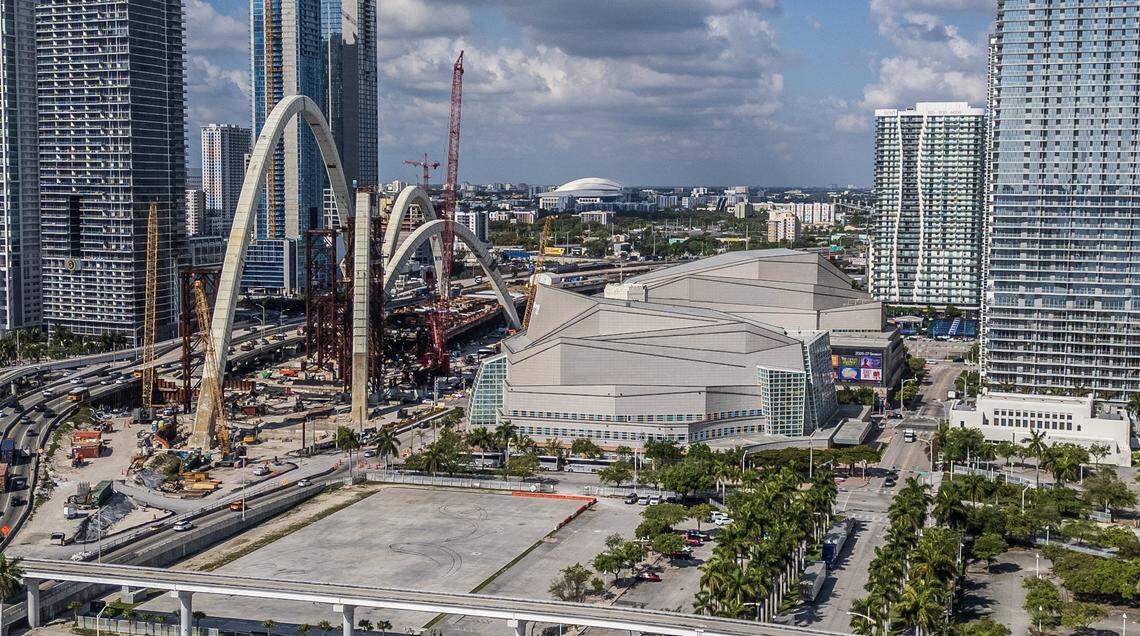
The arches for the Interstate 395 “signature bridge” over Biscayne Boulevard rise in front of Arsht Center, at right, in downtown Miami.
(Pedro Portal/pportal@miamiherald.com)
Initially, the funding included nearly $616 million in federal and state highway money. MDX, which has been replaced by the newer GMX, contributed an additional $186 million from toll revenue for improvements to State Road 836.
Under the design-build approach, the winning bidder — in this case, a joint venture between contractors Archer Western, whose parent company is in Chicago, and Miami’s The de Moya Group — must deliver the project at the budgeted cost. It’s designed to save taxpayers money and put the onus for on-time completion on the contractor, who would absorb the cost of any budget overruns or delays.
The Archer Western bid proposed an even more ambitious blueprint than FDOT requested, in the form of a new double-deck bridge over SR-836. It would send drivers hurtling directly to and from the MacArthur, avoiding the interchange altogether and helping reduce congestion below on I-95, where new ramps and an added lane would improve traffic flow.
The team also submitted a design for a dramatic and ambitious bridge to be suspended by cables from six soaring arches, described by the contractor as a fountain, and anchored to the ground by a massive center pier. The design immediately drew ridicule from some critics who likened the arches to a giant tarantula attacking downtown Miami, or the arches on a McDonald’s outlet.
The second-place bidder, a consortium of MCM Construction of Miami and Figg Bridge Engineers of Tampa, separated from the winner by just a few points in the FDOT scoring system, proposed a significantly simpler design consisting of a bridge suspended from a pair of tall piers, shaped somewhat like ballet dancers. But the MCM plan was dinged in the evaluation for design elements of its piers that were purely decorative.
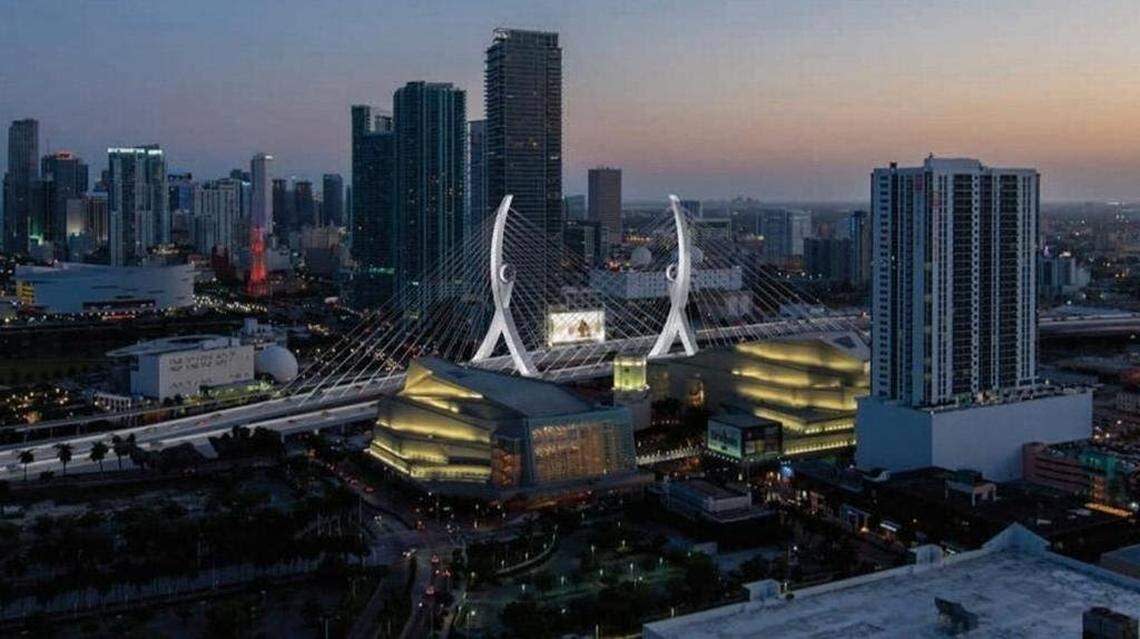
The second-place bidder for FDOT’s Interstate 395 reconstruction project would have featured a simpler design for the “signature bridge” over Biscayne Boulevard, featuring pylons that recall dancers, than the winning proposal for a bridge with six soaring concrete arches by the Archer Western de Moya Group team.
(Miami)
FDOT’s selection, in 2017, triggered a year-long bid challenge and a political tussle between the Archer Western team and the MCM group that hinged in significant measure on which competitor would deliver the most aesthetically pleasing designs for the highway and signature bridge.
MCM alleged FDOT’s scoring and evaluation system was rigged to favor Archer Western and argued the SR-836 double-decking was unnecessary and would add complexity and cost to the project, among other arguments. MCM also challenged Archer Western’s claim that put total construction time at just three years, calling it unrealistic, in contrast to its own given timeline of four years.
The battle ended only because MCM and Figg withdrew their challenge in 2018, after tragedy struck in another project they had teamed up on, a pedestrian bridge over the Tamiami Trail for Florida International University that collapsed while under construction, killing six people and injuring 10 others.
The Archer Western group finally signed an $802 million contract with FDOT in July of 2018. The initial three-year completion window, set to wrap in July 2021, was soon extended to four years.
By then, the Archer Western group was already running into its own problems on the I-395 project — also connected to bridge design.
Those are detailed in lawsuits filed in 2022 by the Archer Western venture in Miami-Dade and South Florida’s federal courts against its engineering partner, Nebraska-based HDR, and the project’s insurers.
According to Archer Western, HDR’s design engineers failed to properly account for wind loads — including hurricane winds — in an initial, partial design for the signature bridge arches that the contractor used to calculate construction costs and time for its bid.
The error was not discovered until four months after the bid was awarded, the lawsuits say, when HDR hired a wind consultant to look over its design. Archer claimed HDR also failed to design a required vibration-damping system and a lighting warning system for aircraft flying overhead.
It then took until mid-2019 for FDOT to approve a redesign, the Archer Western complaints say.
HDR’s error, Archer Western claimed, caused costs to soar. In its initial federal suit in 2022, the Archer Western team claimed $150 million in compensatory damages and said the engineer’s “negligence” set completion of the project back until at least 2025.
HDR filed a counter-claim against Archer but did not contest the claim that its initial design did not fully take wind loads into account. The firm, however, said it was never meant to be a full or completed construction blueprint.
A judge partly dismissed Archer Western’s claim, saying the contractor could not show “gross” negligence by the engineers and ruling that HDR’s liability was limited by the venture’s contracts and insurance policies to $10 million.
The two companies settled in 2024, but Archer Western then sued the project’s insurers in state court, repeating its claims about HDR’s design errors and noting that all other bid competitors had completed wind analysis in their proposals to FDOT.
This time, the Archer Western team claimed increased costs of $400 million due to the engineering miscalculations. Its court pleadings also noted that to settle the federal case, HDR paid Archer Western $12 million, while the joint-venture team had to pay even more to the engineering firm — $30 million for additional services rendered.
Court records show the state lawsuit against the insurers was dismissed, though it’s unclear from the court docket whether any settlement was reached.
Separate litigation, as reported by Miami’s NBC 6 in February, detailed yet another cause for significant delay: In 2020, a plant on the construction site produced defective concrete that was used for three months before anyone noticed. That meant project sections where the spoiled concrete was used, including road segments and support pieces, had to be torn out and redone, adding months of further delay and costing the venture $3.6 million, the station reported.
By 2023, FDOT said the project cost had risen to $840 million, but it’s unclear what accounted for the increase or whether the agency authorized any additional payments to the Archer Western team.
The agency has since then said little as the project was further delayed and the listed cost rose. Requests from the Herald and other news organizations for explanations have been met with general responses that don’t address specific questions, often after weeks of delay in answering.
If Archer Western’s allegations in court are correct, the arch design miscalculations set back completion to 2025.
But FDOT has issued no explanation as to why it’s now saying the project won’t be done until 2029.