
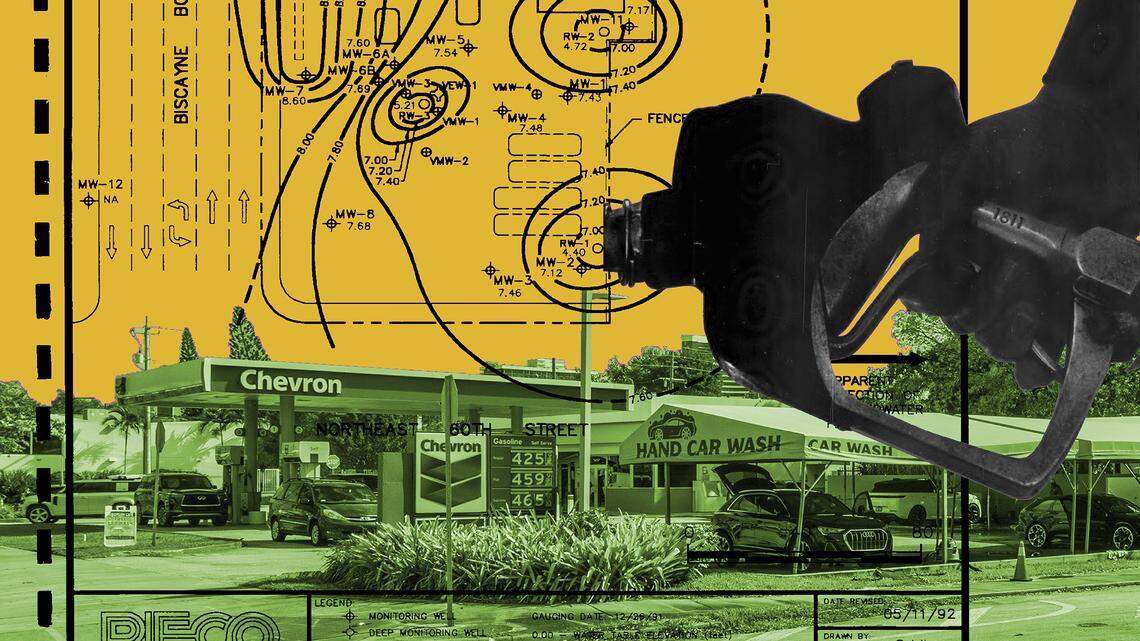
Photo Illustration by Susan Merriam/Miami Herald; Photos: Pedro Portal, National Petroleum News archival imagery; Documents: Florida Department of Environmental Protection
Photo Illustration by Susan Merriam/Miami Herald; Photos: Pedro Portal, National Petroleum News archival imagery; Documents: FDEP
Viewing this story in our app? Click here for a better experience on our website.
Jorge Uribe, a luxury real estate agent, thought it would be an easy sale. The Morningside home sits in a gated community in Miami’s Upper East Side near a prestigious private school, a waterfront park and in one of the country’s hottest housing markets.
Instead, it’s become one of the toughest properties to sell in his career.
Every potential buyer has to be told that a neighboring gas station leaked fuel 40 years ago, which spread to contaminate the groundwater beneath the home.
Even with assurances that the home’s drinking water isn’t affected and that the cleanup costs won’t fall on a future owner, deals keep falling apart. He said he’s lost 10 so far.
“They just walked away and walked away and walked away,” Uribe said. “Now we’re down to 50 percent of the value as it would be if the property was clean.”
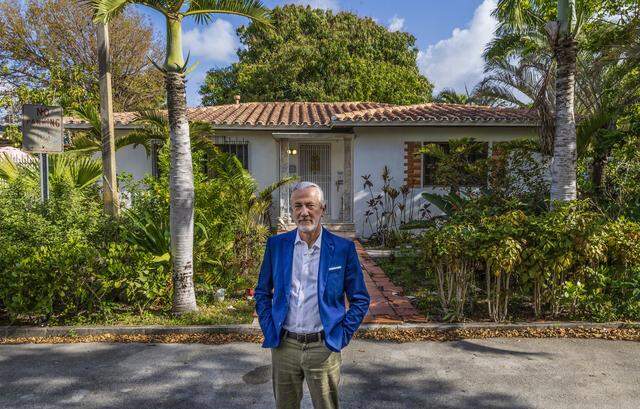 Jorge Uribe, Senior VP of ONE Sotheby’s International Realty, stands in front of a duplex in the Morningside neighborhood that has been on the market for nearly two years. It would have been “flying off the shelf” if not for the contamination, he said. Pedro Portal pportal@miamiherald.com
The property — a 1930s duplex featuring a two-bedroom, one-bath main house with a Spanish barrel tile roof and a towering mango tree, plus two separate efficiencies — is one of many sites affected by gas leak contamination that became endemic during the 1980s. The problem was widespread throughout the county as gas stations used steel underground storage containers that were highly corrosive, especially in coastal communities. State-funded programs to clean up gas spills exist, but, in the case of this property, have proven to be ineffective and slow.
It was listed in 2024 for $1.9 million and should be “flying off the shelf,” Uribe said, given its potential to build four units up to three stories tall on the quarter-acre lot. Plus the house sits in a quiet historically-designated neighborhood along Biscayne Bay, surrounded by Mediterranean Revival-style houses shaded by palms, mahogany and oak trees draped in Spanish moss.
The home was once was owned by Dell Gardo, a Cuban immigrant who purchased it with money he earned performing in nightclubs and on cruise ships. Nearly four decades ago, he met comedian-ventriloquist Patrick Murray on a cruise and took him under his wing, beginning a 39-year friendship.
When Gardo died in 2024, he left the house to Murray with instructions to sell it and distribute the proceeds to family and friends.
But Murray worries about upholding his best friend’s wishes.
As buyers walk away, the price keeps falling. Uribe now has it listed for $950,000. Most interested buyers see the house as a teardown, but get cold feet when they consider the Pandora’s box they might be opening once they start trying to get permits.
And the pollution problem may still be an active issue. In March, the state found evidence of a new leak, which reported contamination levels higher than they’ve been in three decades. The county gave Sunshine Gasoline, the current owner of the Chevron gas station and one of Florida’s largest gas companies, about four months to produce an interim report and nine months to do a full investigation from the discovery in early March.
While the issue of who is to pay is debated, the homeowner is left to wait and suffer.
“Gas stations get a hall pass to pollute,” Uribe said.
Groundwater tests in 1992 reveal gasoline was moving towards the Morningside house.
The tanks and dispenser system were monitored for leaks for decades.
Groundwater monitoring wells installed around the site show that, as recently as January, the groundwater beneath the home remained contaminated.
Some groundwater monitoring wells detected contamination levels higher than at any point since 1991, which the county believes may be due to a new leak.
‘Too big of a problem’
Petroleum leaks were common in the 1980s, when underground storage tanks were typically made of single-walled steel. Along the coast, exposure to saltwater accelerated corrosion and fuel escaped from the rusty gas tanks and leaky pipes into the groundwater.
To some extent, nearly every gas station is polluting the ground beneath it, experts say.
“Most places, it was just too big of a problem to really handle. You couldn’t clean up every site,” said Michael Sukop, Florida International University Earth and Environment professor.
Old Herald clippings from 1986 reported about homeowners toilets and sinks smelling like gas, a 3-year-old getting rashes and fevers from drinking the well water and fear of driers exploding. Hundreds of residents all over the state were forced to use bottled water or hook up to city water supplies, when available.
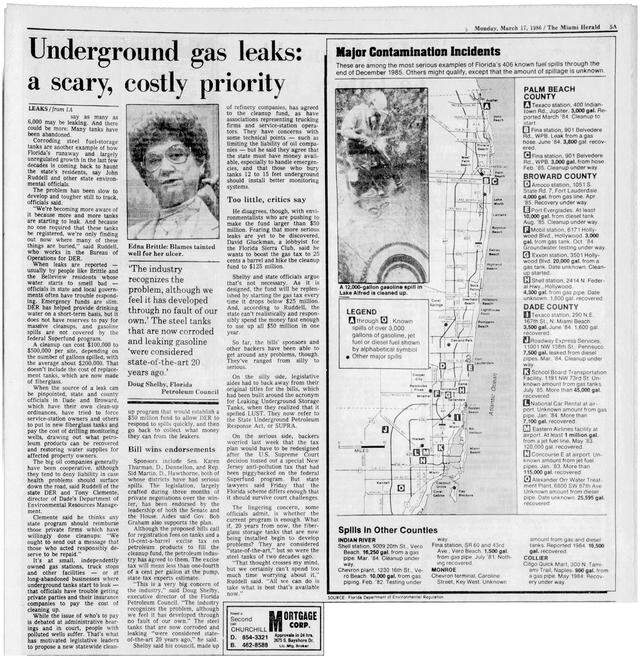 A Miami Herald article from 1986 shows where major contamination incidents occurred in South Florida at the time. A quote from a member of the Florida Petroleum Council at the time said, “The industry recognizes the problem, although we feel it has developed at no fault of our own. The steel tanks that are now leaking and corroded were considered state-of-the-art years ago.” Newspapers.com
The state knew the problem was extensive, but wasn’t sure where the leaks were. Many of the tanks were lost from both memory and records. In some cases, the new owners were not aware that the responsibility of the tanks had been transferred to them.
Even when they did know where they were, it was tricky and time-consuming getting oil companies and service stations to clean up. So the state offered amnesty in 1986 for the polluters to come forward and report their leaky tanks and the state would pay the clean up.
The state’s initiative, called the Early Detection Incentive Program, is funded by a trust fund that can generate over $200 million a year from a tax on gas imports, according to the Florida Department of Environmental Protection.
Miami-Dade County considers the program a success and has used the funds to facilitate clean-ups for 1237 leaks, according to the Miami-Dade Department of Environmental Resources Management (DERM). In the late 1980’s, Miami-Dade had hundreds of reports of new gas and diesel leaks. Last year, there were just eight, DERM reported.
For Murray, the program is moving too slowly — leaving him to bear the burden while gas stations receive publicly funded cleanups.
“We understand the concerns raised regarding the length of time involved in the remediation process at this property,” said Loren Parra, director of DERM, noting the county, “is not permitted to initiate full remediation activities until the State can allocate the necessary funding.”
The Florida Department of Environmental Protection acknowledged the Herald’s request for comment about clean up efforts near the Morningside house, but did not respond after multiple requests.
Over the past decade, the state has spent $54 million on cleanup efforts across the county, according to DERM.
There are currently 1,003 active leaks in Miami-Dade, according to data from DERM. There are 771 active state-funded sites and several programs being tapped to remediate gas leaks in addition to the Early Detection Incentive Program, which currently has 350 sites waiting for state funds to clean up.
“I am quite hopeless and fear the inefficiency of this program will never get my property a clean bill of health,” Murray said.
Early Detection Incentive Program Sites in Miami-Dade
On March 6, DERM and its environmental consultant hired by the state sent a letter to Sunshine, determining that the new leak they found “constitutes violations.”
Robert Fingar, an environmental lawyer representing Sunshine, said Sunshine is working with its own environmental consultants to check the state’s findings.
“There is no confirmation of another leak,” he wrote in an email to the Herald. “There was an issue in February with a component of the tank system, and Sunshine is working with its consultants to investigate.”
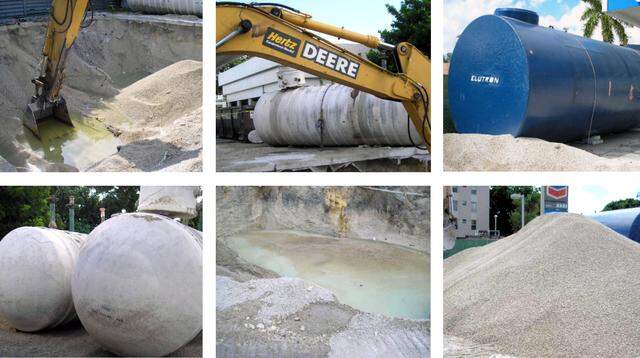 In 2007, four tanks underneath the gas station were replaced with two fiberglass tanks. During the excavation contractors noted free flowing gasoline in the water. Florida Department of Environmental Protection
William Mayorga, an environmental engineer with DERM, said that despite the tank being 14 feet deep in the water table, it’s low-risk because it’s not close to any drinking or irrigation wells. Even so, the contamination still matters because the entire Biscayne Aquifer system is connected. Water – and any pollutants in it – can eventually travel through the aquifer and threaten future drinking supply.
“The Biscayne Aquifer, Miami-Dade County’s primary source of drinking water, depends on aquifer recharge to maintain the water levels and ensure a sustainable supply to our drinking water and the health of our Biscayne Bay and ecosystem,” Mayorga said.
Environmental experts say one gallon of gasoline could make one million gallons of water unsafe to drink.
Some experts warn that, over time, climate change could worsen these leaks across the county in one of the most fragile aquifers in the United States.
Climate change causes groundwater to rise by the coast, acting as a “hidden threat” that exacerbates flooding risk by pushing the groundwater upward as sea levels increase.
Read more: From the sky, the ground, the sea. The three ways South Florida gets flooded
“As the water level rises, and we know it’s rising, albeit slowly, these things can come all the way to the surface at some point, especially if it’s floating product, that’s a really dire circumstance,” Sukop, the FIU professor, said.
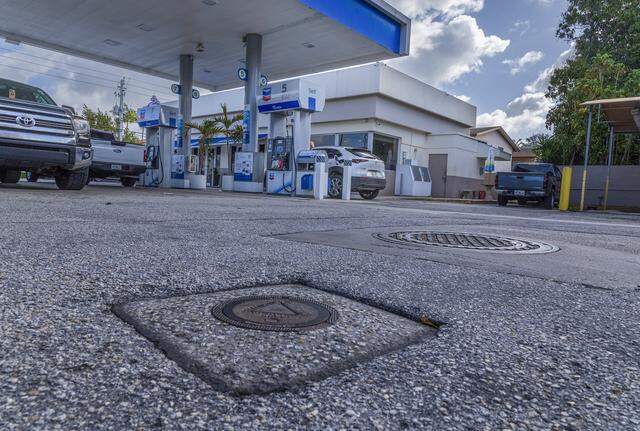 View of a monitoring well manhole cover in the grounds of a Chevron gas station located in the Morningside neighborhood in Miami, on Tuesday, March 31, 2026. Pedro Portal pportal@miamiherald.com Stalled remediation
The state has invested $416,000 into this particular site for monitoring and some clean-up efforts. The Early Detection Incentive Program does not have a cap on how much money it takes to clean a property.
In the late 1990s, contractors spent nearly four years using state funds to address the leak. They installed extraction wells, soil vacuums, pumps and air-water separators and reduced contamination levels to what officials classified as “minimal.” At one point, they were pumping contaminated groundwater at a rate of 61 gallons per minute, sending it through an air-stripping tower to evaporate pollutants.
Then funding halted as the state had to prioritize worse leaks.
When remediation ends too soon, contamination often rebounds, according to DERM officials. Even after years of cleanup, residual gasoline in the groundwater can migrate back into more “transmissive areas” — where it spreads more easily.
That’s what happened here.
In 2007, the gas station owners at the time, Europa Biscayne LLC, installed two new 15,000-gallon double-walled fiberglass tanks. But evidence of the original spill remained. Documents from Department of Environmental Protection noted, and smelled, floating fuel visible beneath the tanks.
By 2017, monitoring wells — narrow pipes drilled into the ground to test groundwater — confirmed that contamination had been migrating off-site.
Around that time, Murray’s late friend Dell allowed county and state consultants to test on his property, where they installed monitoring wells. Other nearby properties, including the Cushman School, denied access for groundwater testing, according to Department of Environmental Protection documents. Representatives from the Cushman School did not respond to requests for comment.
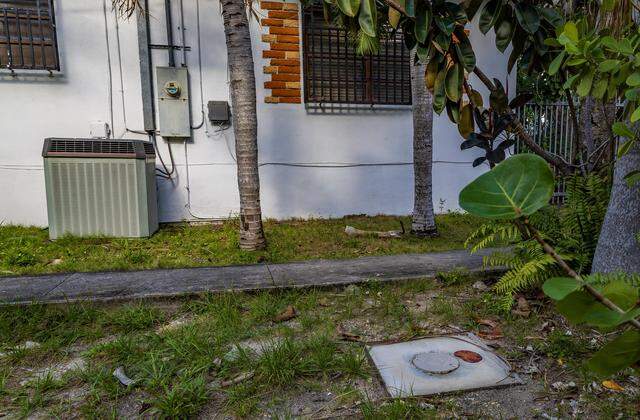 View of a monitoring well manhole cover in the grounds of a residential home located in the Morningside neighborhood in Miami, on Tuesday, March 31, 2026. Pedro Portal pportal@miamiherald.com Letter of ‘comfort’
The county shared with Murray a “letter of comfort” he could give potential buyers to let them know they are not responsible for the cleanup, and that the contamination is not a current risk.
But the letter also disclosed that construction would require close coordination with regulators to avoid spreading contamination — a process that adds time and cost.
“It just slows you down,” Uribe said. “And slow means money – you can’t turn around and construct quickly. Developers will go somewhere else with less bureaucracy.”
If it does somehow spread during construction, the owner could be charged and held responsible for “some portion of the site rehabilitation,” Department of Environmental Protection documents say.
“Buyers want proof that they can get building permits, develop the property and sell the units. This seems impossible with contaminated groundwater on-site,” Murray said.
One buyer backed out after commissioning their own environmental report. Another said they couldn’t afford to tie up capital without certainty.
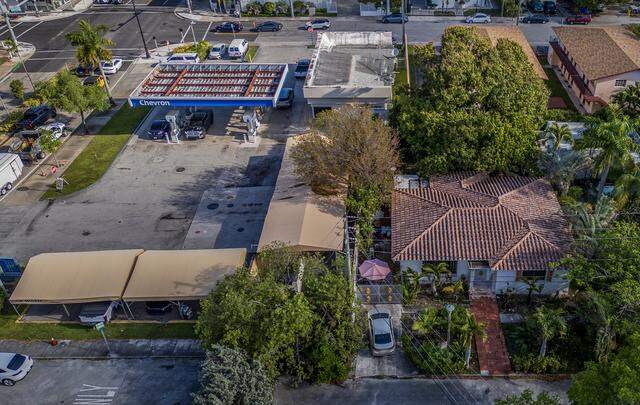 View of a residential house (far right) located next to a Chevron gas station (far left) both properties located in the Morningside neighborhood in Miami, on Tuesday, March 31, 2026. Pedro Portal pportal@miamiherald.com
“We don’t have discretionary capital we could park here,” he wrote to Murray in an email shared with the Herald.
He went on, “There’s also a down gradient slope, which could result in more areas of the subject property being affected before it gets better. Tough to gauge how long it would take to have the site clear and I don’t have the capital willing to spend further dollars without absolute certainty of a clean site.”
They asked several lawyers what their legal options might be, but Murray couldn’t afford the legal fees.
But one environmental attorney they consulted did offer to take the home off their hands for $250,000, Murray said.
Murray and Uribe considered holding the property for a few more years, hoping conditions would improve. But the family relying on the sale is getting older, so they kept it on the market.
There are signs of movement. This month, another buyer made an offer. Murray accepted.
The buyer recently finished the inspections, but Murray isn’t holding his breath.
“It’s still very much up in the air,” Murray said. “But I’m praying it goes through.”
Ashley Miznazi is a climate change reporter for the Miami Herald funded by the Lynn and Louis Wolfson II Family Foundation and MSC Cruises in partnership with Journalism Funding Partners.
Methodology
Credits Ashley Miznazi | Climate Change Reporter Susan Merriam | Data Journalist Pedro Portal | Photo Journalist Amy Reyes | Editor

Miami Herald
Ashley Miznazi is a climate change reporter for the Miami Herald funded by the Lynn and Louis Wolfson II Family Foundation and MSC Cruises in partnership with Journalism Funding Partners.