
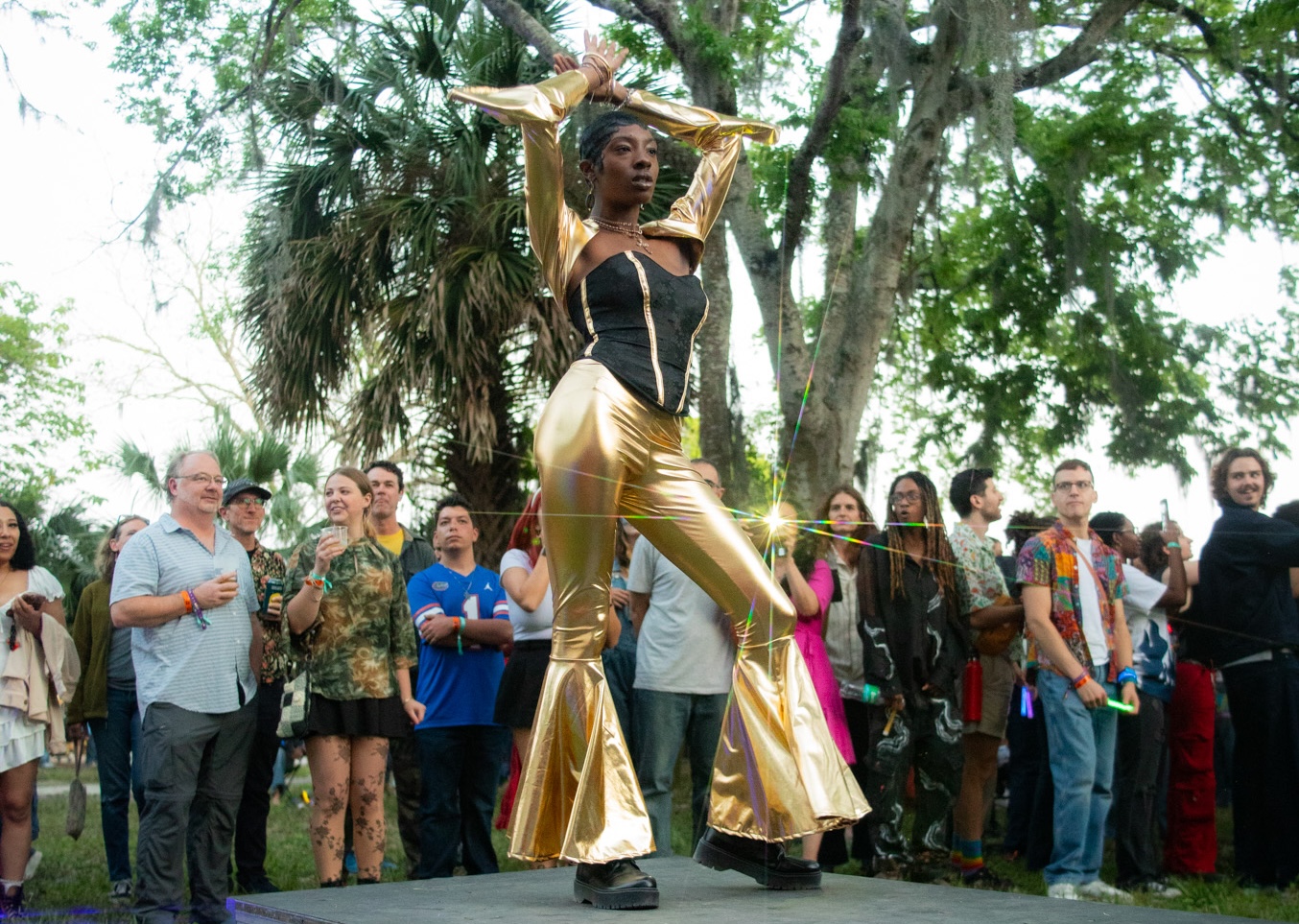
More than one set of stars aligned when Laila Fakhoury and Jahi Khalfani first met in a 2018 University of Florida astronomy class.
For one thing, both felt a calling toward community building in their adopted home of Gainesville: Fakhoury — a Palestinian woman whose roots inform her belief that it is “our duty to support our friends, our family, our neighbors, and uplift those around us” — worked as a program coordinator at Ocala’s Marion Correctional Institution and as a consultant and counselor at a crisis and suicide intervention center. Khalfani, meanwhile, had run nonprofit tech centers as well as after-school tutoring and financial literacy sessions. They both longed to merge their social justice work with the art, music, and cultural scenes around them.
The pair soon thereafter established Dion Dia Records as a cultural, intersectional beachhead. “We just kind of found ourselves feeling very alone,” Fakhoury tells New Times. “We didn’t have a lot of space to express ourselves, so we just decided to create that space and carve it out ourselves.” Dion Dia didn’t stop at releasing hip-hop and R&B records by local enlightened acts such as Casey Jones II and FARO; the label quickly expanded to silent discos, networking events, and live shows. It brought social good programs to end-of-life patients in the palliative care wing of the hospital and to people serving life sentences in the prison. “The first event had about a hundred people,” Fakhoury says. “The next time there were 200. Then 300. And it kept growing and growing.”
In 2023, Fakhoury and Khalfani expanded their vision to include the Big: Arts & Culture Festival, a boundary-obliterating visual/sonic/experiential smorgasbord set to take over a wide swath of downtown Gainesville this April 10 to 12. The festival’s fourth iteration will span three outdoor stages and five venues, featuring headliners Earl Sweatshirt, The Alchemist, Zack Fox & UWAY, Pink Siifu, and dozens more. Offstage, there will be a “full schedule of circus and aerialist performances, a film screening experience from Miami’s Subtropic Film Festival, visual art installations, live painting and screen printing, fashion shows featuring Florida designers and models, a car show, panel discussions on art and activism, [and] interactive workshops.” Oh, and a parade — just for good measure.
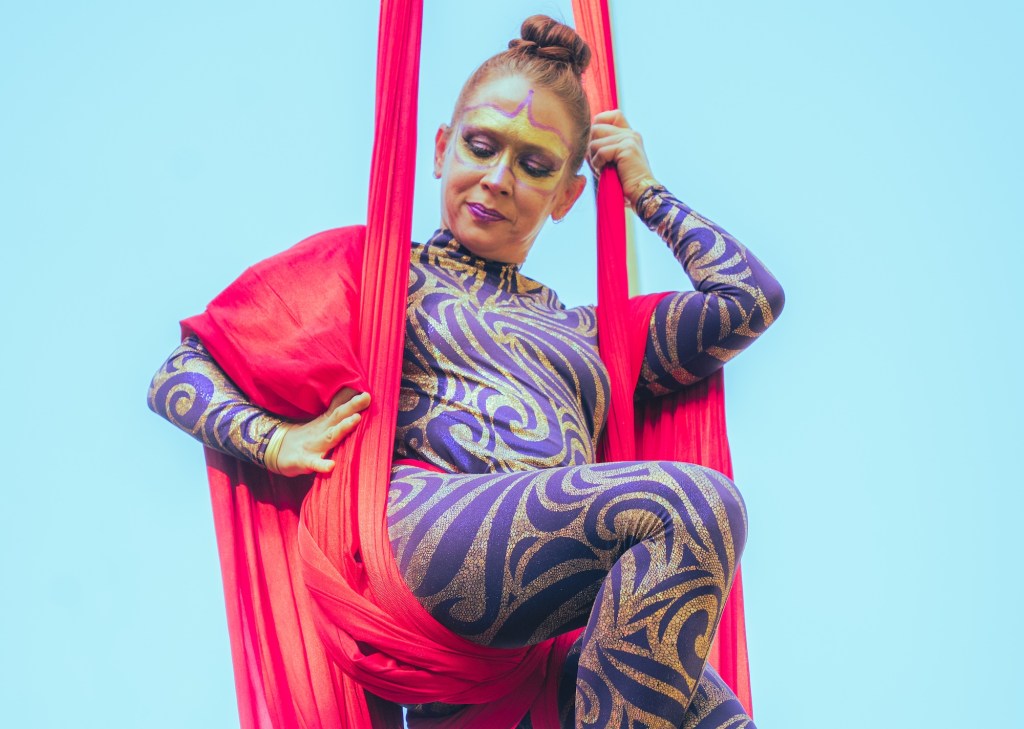 Aerialists are just some of the many performers you’ll see at Gainesville’s Big Festival.
Big in some ways represents a revival and expansion of Gainesville’s already storied musical and cultural history, which encompasses acts ranging from Tom Petty, Less Than Jake, and Hot Water Music to Discount, Bo Diddley, and Fueled By Ramen, the emo-mainstreaming label formed by future Interscope CEO John Jannik in his University of Florida dorm room. “That’s the Gainesville vibe — it’s a very creative community,” Fakhoury says. “It’s very accessible, open, welcoming. It’s forgiving, too. We call it a playground because it really is somewhere that you can experiment and explore. We didn’t necessarily have a framework for Big, we just knew that Gainesville would be open to that kind of energy.”
That vibe has not stayed confined to Gainesville, though, with an ever-growing contingent of Miami movers, shakes, and art makers making the yearly trek to add what Khalfani calls “wild Miami flavor” to the Big gumbo.
“We’ve been there ever since its inception — haven’t missed a year!” John Caignet, founder of Miami’s legendary station/cultural hub Jolt Radio (which livestreams the festival and connects it with Miami artists), says. “We’ve always valued community greatly here at Jolt, and when Jahi and Laila reached out to us, we knew they were on to something…big.” He laughs. “No pun intended! I mean “big” in the sense that they put their community first, and that was the beginning of a great friendship and relationship with the festival. Every year we pack our bags in April and head to Gainesville knowing that we’re gonna have a blast, do the radio thing, and, of course, spin some records.”
“We’re excited to be a part of Big because we truly believe in the folks organizing it,” adds Tyriq, of Miami pop band 5loko. “We see this specific year of the festival as a major historical moment in the Florida music scene. The number of Florida-based indie, alternative, and hip-hop acts on the lineup is unreal, and the general curation is top-notch…The amount of engagement that Big has been able to generate naturally is extremely impressive.”
Big is about more than platforming rising and thoughtful established acts; it’s about establishing a space in which the barrier between observer and participant is considerably more porous. The fashion show, for example, encourages attendees to model for the first time. The live painting and screen printing are similarly open. The vast majority of the media team are shooting a show or festival for the first time.
“We really want to have a reputation as a festival that is an incubator for new talent as much as it is a showcase for established talent,” Khalfani says. “We are deliberately steering it as far away from elitism as we can get. We want Big to be a place where people can discover and try new things and walk away with a new air of confidence in their ability to create within their own lives. The whole purpose is to bring people together.”
It’s working: More than half this year’s ticketholders are coming from outside of Alachua County, and half of that group is coming from out of state. (With the little spare time they have, Big organizers are compiling a Guide to Gainesville for visitors, full of recommendations for food, yoga, scenic bike rides, and more.) Last year, the county ran the one-day festival through its economic impact calculator and estimated it created more than $700,000 in economic impact.
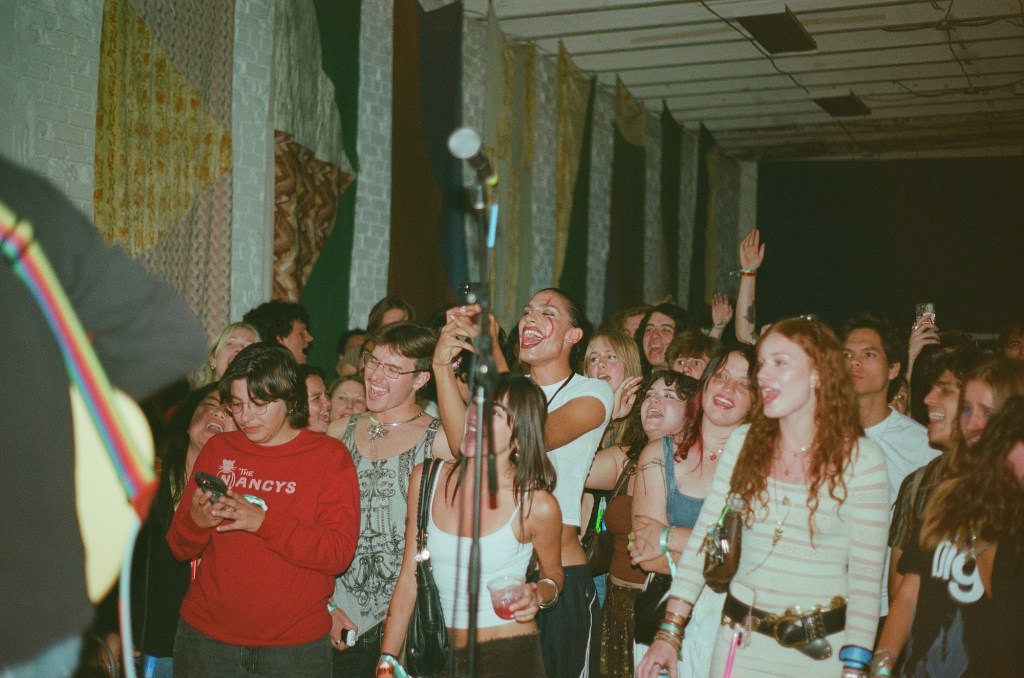 Audiences are also participants in the performances at Big.
“What working on Big has shown me is that if we all come together, if we bridge all of the different community groups in Gainesville and throughout Florida, there’s endless potential to create real, positive alternative ways of living,” says Khalfani, who, along with Fakhoury, has learned how to do everything from booking artists, production staff, and security to filing permits, graphic design, and putting up fencing. “How the music industry works — and, really, the way the majority of industries we all are in work — is so archaic and top-down and extractive in so many ways. It’s anti-human. So, for us, to be more human-centered as opposed to capital-centered is hopefully a path to stabilize this ecosystem.”
Raquel Lily, singer and guitarist of Miami indie band Buko Boys, is quick to add a hear, hear!
“We’re stoked to see Florida finally being put on the map for something that isn’t a ‘Florida Man does X’ headline,” Lily says. “It’s empowering to get highlighted for something that we’ve put in so many hours of work for. We’re excited that the time is finally coming — and are extremely grateful for the opportunity.”
Fakhoury mirrors those warm sentiments. “Honestly, I get emotional thinking about how this little dream has not only become real but exceeded all our expectations in terms of impact on others,” she says. “Seeing other people validate and affirm that dream by wanting to put their own labor, love, and creativity into it has been the most surreal and fulfilling part of all this.”