
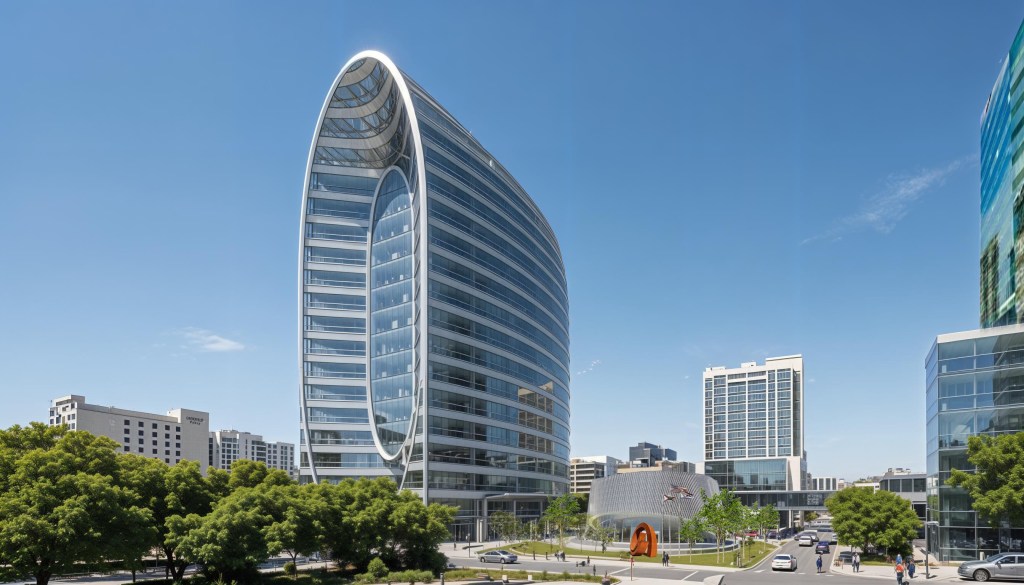
The fine print of paying for a new Fort Lauderdale City Hall is emerging, and it’s troubling.
It’s happening too quietly with too little transparency, raising new questions. The city is taking on a massive, long-term financial obligation at a time of anxiety over what will happen to property taxes and a looming multi-year budget deficit.
Residents deserve reassurances that this grandiose project won’t break the bank. What they got this week was the opposite. The mayor and commissioners spent much of an hour studying the costs — some for the first time, such as possibly cutting city services to pay for it.
City of Fort Lauderdale
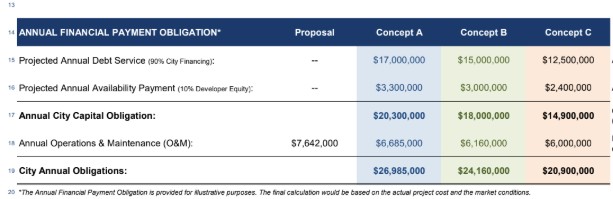
A city document shows the city would pay $24.2 million a year to operate, maintain and pay debt on a new City Hall, on top of projected design and construction costs of $268 million (subject to change), city documents show.
Controversial from the start
It came at a workshop-style meeting where no votes are taken. The topic was not on the agenda, but it’s a good thing that it came up, because the public has a clearer view of things.
Everyone in Fort Lauderdale has a stake in this. The building will last 40 to 50 years or longer. It could mean higher taxes, fewer services or both.
A city staff document shows pared-down design and construction costs of $268 million, plus projected costs of $24 million a year to operate and maintain the building and pay debt.
Do a little math: Over 30 years, that $24 million operating expense comes to $720 million.
This project was already highly controversial. When the developer’s initial proposal surfaced last fall with a stark, vertical ship’s-hull design, a backlash followed. Residents criticized the cost and design (though both remain in flux), and city leaders agreed to shrink the size to lower the cost.
On a split 3-to-2 commission, the project is favored by Mayor Dean Trantalis and commissioners Steve Glassman and Pamela Beasley-Pittman.
Two others, Ben Sorensen and John Herbst, support less costly options such as buying the temporary city hall at Tower 101, downtown, for $86 million, or relocating some workers to another site. The boxy 1960s-era former City Hall was ruined by a historic flood in 2023 and demolished.
Sorensen has tried repeatedly, without success, to have the city consider buying Tower 101, which the city leases for about $5 million a year.
Under Sorensen’s questioning, City Manager Rickelle Williams publicly acknowledged that paying for the projected costs of a new City Hall will impact other services.
“We would make recommendations to the City Commission as to what could be cut from our budget,” Williams told commissioners. “It would be an exercise that would likely cause us to rethink the way we operate and provide services.”
Put it to the people
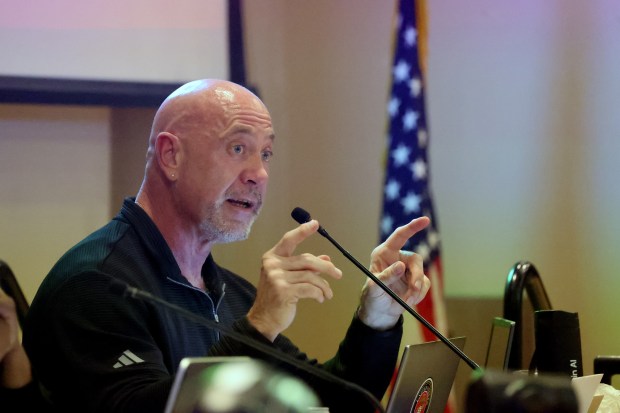 Fort Lauderdale City Commissioner John Herbst.
In a memo to commissioners, Williams said the project should be financed by the city, which would cost $88 million less than if the developer financed it because of lower borrowing costs.
Her April 2 memo suggested unspecified “city-issued special obligation bonds” to pay for it. That would mean dedicating a specific stream of city revenue other than property taxes for 30 years.
Herbst, an accountant and former city auditor, said City Hall should be paid for with property tax dollars through a general obligation bond.
He said financing it that way would not be affected by a mandated cut in property taxes, but it would require a referendum — a vote of the people.
“We need to make sure that we put this to a vote of the residents,” Herbst said.
Shutting out the people
Nobody took Herbst up on the idea, and the reason is obvious.
A citywide referendum on an expensive City Hall could fail, and that would be a huge political embarrassment to its three supporters. But it is the right step, and we urge the commission to consider it.
At their next meeting on April 21, commissioners will be asked to approve an initial agreement with the developer to move the project forward, despite these unanswered questions. The public would be better served by a lengthy public discussion of financial implications.
Herbst and Sorensen should keep pushing for less costly options, and residents should convey their support. Write to bsorensen@fortlauderdale.gov and jherbst@fortlauderdale.gov.
District 3 Commissioner Beasley-Pittman represents many economically distressed areas where residents would most feel the pinch of higher taxes or fewer services. We urge her to reconsider her earlier vote and to join her skeptical colleagues.
This is an enormously ambitious project that will affect Fort Lauderdale’s finances for many years to come — and the public deserves to be heard.
The Sun Sentinel Editorial Board consists of Opinion Editor Steve Bousquet, Deputy Opinion Editor Dan Sweeney, editorial writers Pat Beall and Martin Dyckman, and Executive Editor Gretchen Day-Bryant. To contact us, email at letters@sun-sentinel.com.