
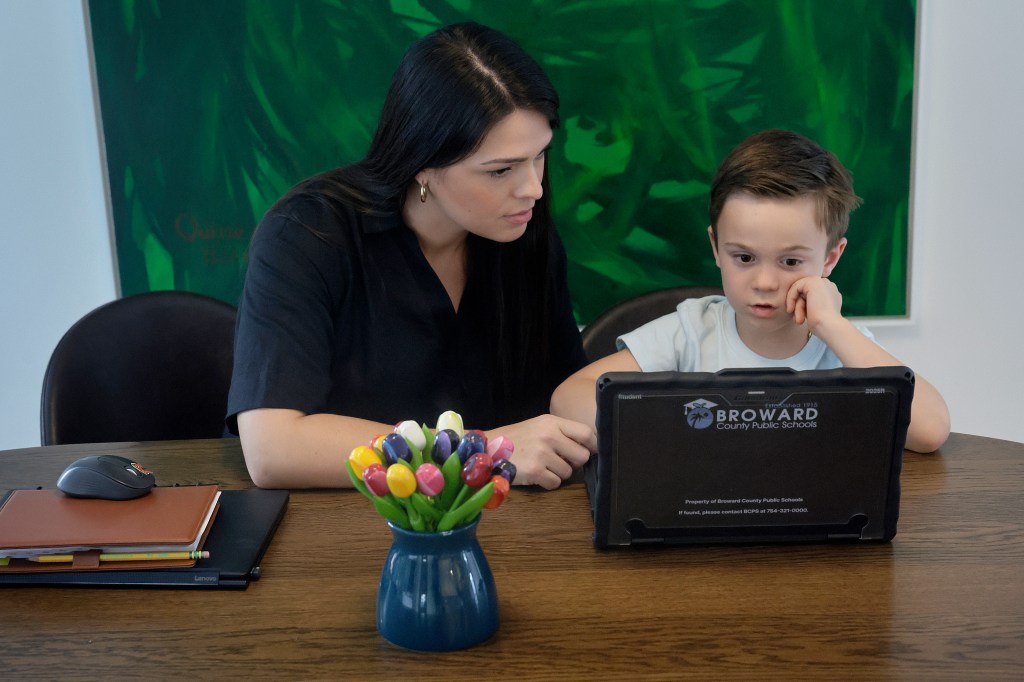
Months after Broward schools launched a program to ensure every student has a take-home laptop, the school district is now tackling a possible downside: excessive screen time.
The School Board voted on Tuesday to try to get a handle on how much time students spend in front of devices. Board members approved a measure that will allow parents to receive details about how much time students are spending on district-issued devices and what types of activities they are doing on them.
District officials will say they will be able to use existing software programs to make this data available. The data is expected to be available for next school year.
“This for me is the first step in a series of actions that I think we as a board can take to protect public education and the way our children learn in our schools,” School Board Chairwoman Sarah Leonardi told the board on Tuesday. “And for me too, this was a request that I heard over and over again from parents. They want a way to monitor screen time.”
Leonardi said the idea came after holding several focus groups with parents and students. She plans more discussions and expects more recommendations in the future. She said the idea is not for parents to demand that teachers quit using technology, but that they can have the information if they want to take steps themselves to reduce their child’s screen time outside of school. And she said this effort will provide data the district can use to make changes later.
The move comes at a time of national discussion of what kind of effect screen time, be it from tablets, phones, laptops or televisions, have on children’s academic, behavior and social skills. A recent study co-authored by Florida Atlantic University researchers found that pre-school and kindergarten-aged children who average at least 10 to 30 minutes of solitary screen time per day showed poor communication, low productive vocabulary and later adjustment problems.
“I see it when I go into my schools, and quite frankly, I see it in my house the effect that these constant computers and iPads can have on our young kids, especially our K-3 kids,” School Board member Adam Cervera said at Tuesday’s meeting. “Sometimes it turns them into zombies, and it just puts them in this funk that quite frankly is a little scary.”
Landyn Spellberg, a senior at Western High at Davie and the student representative to the School Board, told the South Florida Sun Sentinel that he supports the effort.
“The Board’s recent action to enhance capture of screen time will increase transparency for students and families, while helping to ground conversations about technology use in facts,” he said.
The Broward School District has taken various approaches to technology use in the past two years. In 2024, the School Board voted to ban most cellphone use for all students from morning bell to dismissal but agreed at the start of this school year to relax it for high school students at the start of this school year, allowing them to use their phones during lunch.
This year, the school district also started an initiative to give take-home laptops to every student who needed one, with officials saying much of today’s learning is done using technology, and students need the devices to complete homework, research and supplemental instruction.
Leonardi said she recognizes some may see a disconnect between the district’s efforts to simultaneously try to reduce and expand access to technology.
“We’re spending tens of millions of dollars on expanding access to technology while I continue to read that that’s not necessarily great for kids,” Leonardi told the Sun Sentinel. “But one thing I heard over and over again from parents and students is you have us do all this work with technology for school. We need reliable access to technology.”
Leonardi said her effort to reduce screen time “is a much longer-term goal. … In the short term, kids did need access to laptops.”
But Plantation parent Brooke Bordy questions whether young kids need to spend so much time on computers. Her son, Brooks, is a kindergarten student in the district. She said Brooks is required to spend time on a district-issued laptop completing exercises using i-Ready, a program the district uses to monitor students’ proficiency in reading and math.
“At the beginning of the year, he was excited for i-Ready because it was a novelty. It’s kind of cute. It’s gamified. They are characters and you kind of go on a journey,” she told the Sun Sentinel.
But the novelty has worn off, she said, “and now it’s a fight to do it with him. Whereas he doesn’t mind doing the paperwork.”
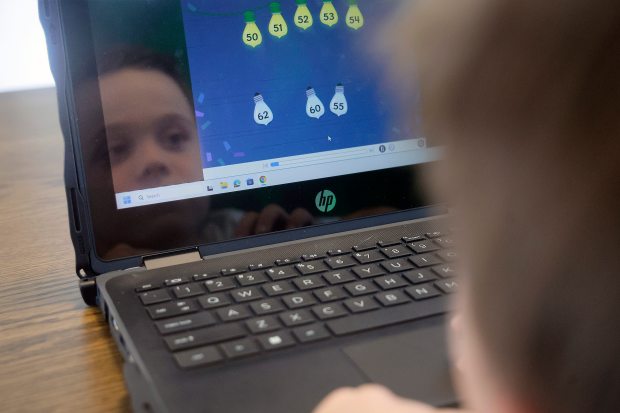 Brooks Bordy works on his school-issued laptop at home on Thursday, April 9, 2026. Months after Broward County Public Schools equipped every student with a personal device, the district is considering whether to rein in technology use due to concerns over excessive screen time. (Mike Stocker/South Florida Sun Sentinel)
Bordy said the district requires 45 minutes of reading and 45 minutes in math per week on i-Ready. But Bordy, a leader in a parent group called the District Advisory Council, said it’s not always clear to parents how much of that work is being done at school. So she said it’s a great idea to let parents know how much screen time children are getting on district devices.
Leonardi said she’s not sure computers are needed for kindergarten students and that may be something the district reviews in the future.
“Kids do need to learn typing skills, and I think they do need to have some very basic life skills in terms of understanding how to use a computer,” she said. “I don’t think that needs to happen in kindergarten but like when you get into fourth and fifth grade, they should have some interaction with that.”
Fabian Cone, the district’s chief academic officer, told the Sun Sentinel that there are benefits to issuing devices to young children, particularly those from disadvantaged homes.
“It boils down to equity because there are students who enter into our district who are not reading on grade level, so teachers are assigning supplemental instruction, resources, homework, projects,” Cone said. “In some cases, parents may not be available to assist in certain particular concepts or standards.”
Brett Laursen, a professor of psychology at FAU, argues that if young children do spend time with devices, it should be supervised. He co-authored a study with researchers at Aarhus University in Denmark that tests the hypothesis that unsupervised, solitary screen time during early childhood increases the likelihood of language and social and emotional problems later.
Laursen told the Sun Sentinel that computerized educational materials can be effective for older children.
“But when we’re talking about young children, 5 and under range, their language acquisition comes almost exclusively from interacting with live people,” he said. “They don’t learn language from screens.”
Problems with vocabulary and communication skills were most common among children whose parents reported that their children spent large amounts of time in solitary screen time exposure, he said.
“The opportunity costs of solitary screen time can be particularly steep for vulnerable youth. Children have a finite number of free time hours in a day,” said Laursen. “Every hour a child spends alone with a device is an hour they aren’t engaged in social interactions that boost language skills. It is an hour not spent practicing the social and emotional skills required to build friendships. Screens don’t demand compromise, sharing or dialogue — the exact skills that children with communication difficulties need to practice.”
Laursen said he doesn’t have the same concerns about supervised screen time since it now becomes a social activity when it’s supervised.
“Supervised screen time involves parents interacting with children while they watch. ‘Oh, look at that. What do you think about that? Can you do that?’” he said. “Now children are getting the feedback that they need in order to bolster their language skills.”