
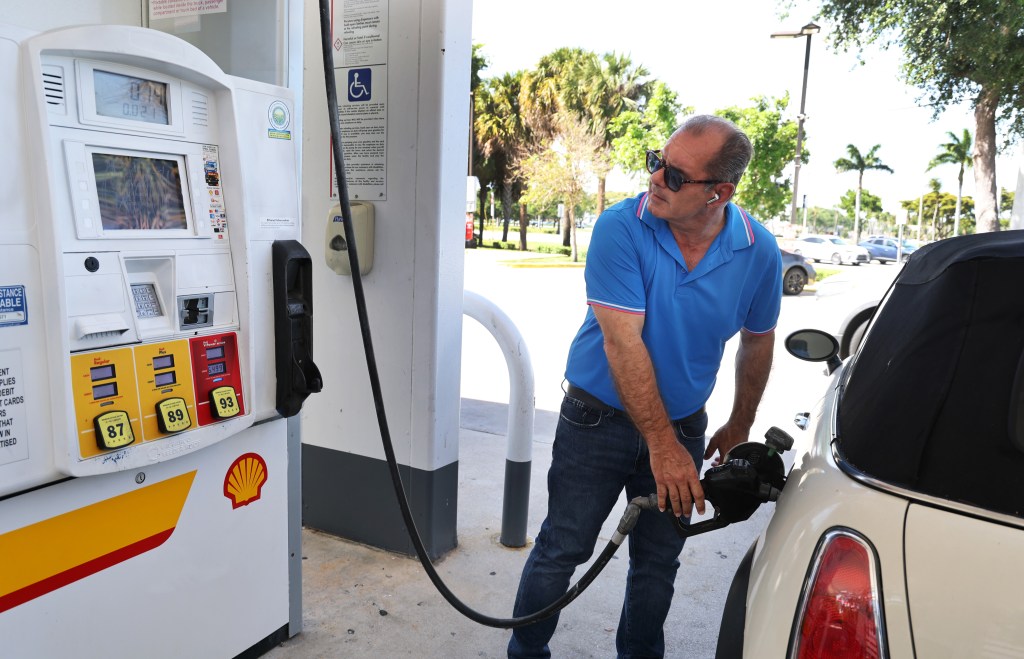
If there is a price point that will become a barrier to travel, it seemingly has yet to be reached as the uncertainties of a weeks-long war with Iran remain in play in the form of $4 to $5 gasoline and record jet fuel prices for the airlines.
At a Marathon station in Lauderdale-by-the-Sea at the corner of State Road A1A and East Commercial Boulevard, the posted price for a gallon of regular unleaded gasoline was $4.99 on Thursday.
“They fill up, they don’t complain, tourists and locals alike,” said store clerk Saleem Jadoon. He noted the lofty price point can be found along the beaches from Miami-Dade to Palm Beach counties.
But he conceded that when it came time for him to fill up his vehicle, he journeyed westward to a Wawa station where he paid $4.19 a gallon. That was in the range Thursday at most stations surveyed from western to eastern Broward County along Cypress Creek Road and Commercial Boulevard, where prices at stations started around $3.99 and reached $4.99 in Lauderdale-by-the-Sea.
In Palm Beach County, prices exceeding $5 a gallon were seen in Boca Raton.
The stakes for the region’s travel and hospitality industries couldn’t be higher. The war broke out in late February, and despite a ceasefire declaration, has continued with air attacks hitting population centers in multiple oil-producing Middle Eastern nations.
Hostilities broke out during the venerable Spring Break season in South Florida, as snowbirds vacationed from the north, students arrived for mid-semester breathers, and cities prepared for large-scale events such as the Ultra festival in downtown Miami, the Tortugas festival this weekend on Fort Lauderdale Beach, the FIFA soccer tournament at Hard Rock Stadium, the annual air show over Fort Lauderdale and the highly anticipated IPW conference, a five-day event expected to draw thousands of travel industry professionals at the Broward County Convention Center.
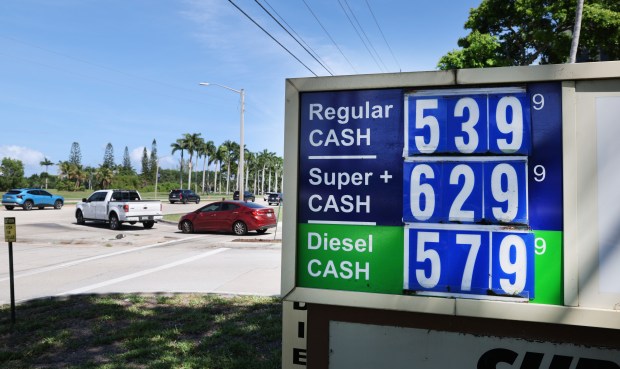 The price of regular gas is posted at $5.39 at a Shell station on Glades Road in Boca Raton on April 6. (Carline Jean/South Florida Sun Sentinel)
Although hotel bookings are holding up, visitors attending any of the events likely will be paying more to travel here.
Shortly after the conflict broke out, airlines were not shy about pointing out the prospects for war-driven pricing and the likelihood of surcharges and other higher fees to offset rising energy costs.
“The war in the Middle East has driven an unprecedented spike in jet fuel, with prices roughly double what they were earlier in the year,” Delta Air Lines CEO Ed Bastian told industry analysts during an earnings call Thursday, according to a transcript provided by the airline. “In this environment, our focus is on what we can control: running a reliable operation, taking care of our people and customers, and protecting our margins and cash flow. As part of that, we are meaningfully reducing capacity in the current quarter with a downward bias until we see the fuel situation improve. At the same time, we’re moving quickly to recapture higher fuel prices.”
In early March, discounter Spirit Airlines, which is based in Dania Beach and is reorganizing under Chapter 11 bankruptcy protection, said fuel pricing and supply issues could well impact its financial recovery.
“The Debtors’ operating results are significantly impacted by changes in the price and availability of aircraft fuel,” the Dania Beach-based airline’s parent firm, Spirit Aviation Holdings, said in a recent disclosure statement filed with the bankruptcy court. “Periods of high volatility in jet fuel costs, increased jet fuel prices, and significant disruptions in the supply of jet fuel could have a material adverse impact on the Company’s business, financial condition, and operating results.”
The outlook was prescient. On Friday, the U.S. Energy Information Agency noted a sharp downward slide in supply since the war began.
“Crude and oil product flows through the Strait of Hormuz have plunged from around 20 million barrels per day before the war to a trickle currently,” the agency said on its website. “With traffic largely halted, limited capacity to bypass the crucial waterway, and storage filling up, Gulf countries have cut total oil production by more than 11 [million barrels per day]. In the absence of a rapid resumption of shipping flows, supply losses are set to increase.”
Joe Cavaretta/South Florida Sun Sentinel
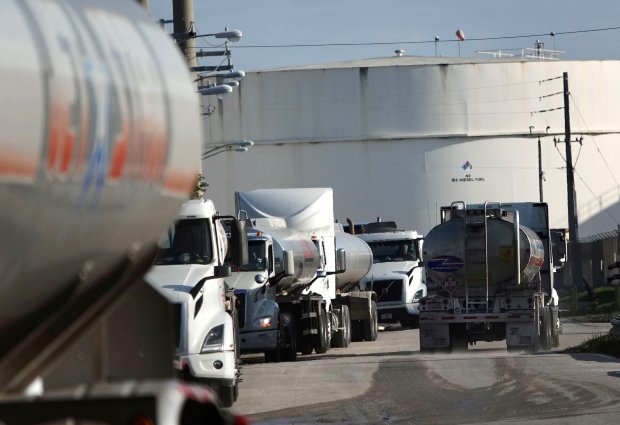
Gasoline tanker trucks wait in line for fuel at Port Everglades in 2023. The Broward County port is a major way station for gasoline and jet fuel deliveries imported to South Florida from mostly Gulf Coast sources. (Joe Cavaretta/South Florida Sun Sentinel file)
South Florida does not receive its gasoline and other oil products from the Mideast. It arrives from the U.S. Gulf Coast at Broward County’s Port Everglades. More than 93% of the region’s refined petroleum comes from Texas, Louisiana and Alabama. Jet fuel is shipped to airports via pipeline while gasoline heads for filling stations via tanker trucks.
But analysts indicate that Asian nations that typically rely on Middle East sources for their oil — sources that are now bottled up by the war — are shopping elsewhere including the Gulf Coast for petroleum products.
Dr. David Menachof, associate professor of operations and supply management at Florida Atlantic University’s College of Business, said that with the majority of local supplies coming from the Gulf of Mexico, no one sees any major interruptions in South Florida at this time.
“What is happening is the price of product on those ships is just going with market rates,” Menachof said.
“At the actual gas station pumps, those changes are happening literally in response to crude oil prices going up, which affects the refined product prices down the road,” he added. “Even though we don’t get our oil from the Persian Gulf, it’s a global market.”
“Now there is additional demand for product coming out of the U.S. Gulf and every other part of the world producing oil,” Menachof said.
Regardless of the origin, the war’s upshot for U.S. consumers is an array of surcharges by transportation firms such as airlines and delivery firms.
Steven Senne/AP
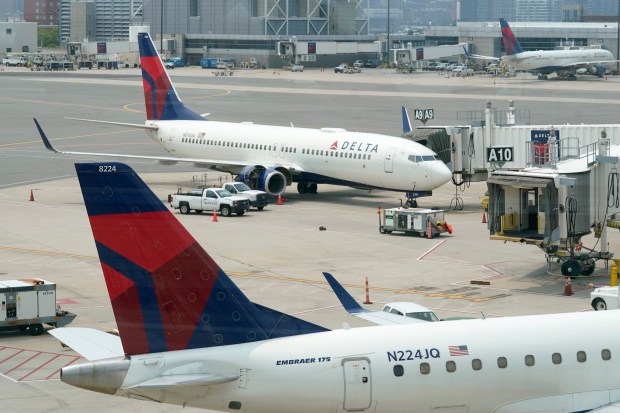
Delta Air Lines passenger jets are shown at Fort Lauderdale-Hollywood International Airport. Top airline management has vowed to recoup additional fuel costs driven up by the Iran war by passing them along to passengers in the form of higher fares and fees. (Steven Senne/AP file)
Blossoming fees
Passenger airlines serving Fort Lauderdale-Hollywood International and Palm Beach International airports are tacking on fees for baggage.
Delta Air Lines boosted fees effective this past Wednesday, with charges for the first bag rising from $35 to $45; the second from $45 to $55; and the third jumping from $150 to $200.
JetBlue Airways added $4 for the first bag to $39 for off-peak flying and tacked on $9 to $49 for peak travel times.
Southwest Airlines announced increases of $10 starting Thursday. The new charges are $45 for the first bag and $55 for the second, applied to most fares.
Major delivery firms have ramped various charges that started in March and are continuing into this month:
FedEx announced a 26.5% fuel surcharge for packages and air freight effective this past Monday.
Amazon is imposing a 3.5% “fuel and logistics‑related surcharge” for third-party sellers in the U.S. and Canada starting April 17.
UPS, starting in early March, imposed a domestic air surcharge that has risen to nearly 10%, international air surcharges that are above 10% and a domestic ground surcharge that now exceeds more than 5%.
Demand still aloft — thus far
Yet, travel and lodging industry executives insist that demand has remained strong despite the daily diets of war news, a continued Iranian blockade of the Strait of Hormuz, the critical outlet for tankers loaded with petroleum products, and a tenuous outlook for resolving the crisis at the negotiating table.
Earlier this month, Visit Lauderdale, the destination promotion agency for Broward County, proclaimed March a banner year.
“Hotels across Greater Fort Lauderdale reported strong performance during the month of March, with occupancy reaching 85%, an increase of 6% compared to March 2025,” the organization said in a statement. “Hotel demand rose 9% year over year, while the average daily rate … reached $240.49, reflecting continued traveler interest in the destination’s beaches, extensive waterways, thriving culinary scene, cultural attractions and cruise departures from Port Everglades.”
“March underscores the ongoing demand for Greater Fort Lauderdale and the impact tourism has across our community,” Stacy Ritter, president and CEO, said in a statement. “This performance reflects the intentional work of our team and the strategic efforts driving awareness and visitation to the destination.”
The statement did not mention the war and Ritter was not immediately available for comment.
At the Atlantic Hotel & Spa on State Road A1A across from Fort Lauderdale beach, Amy Faulkner, director of sales and marketing, said clients are maintaining their booking commitments.
“Knock on wood, I’m not seeing any cancellations,” she said. “I have three rooms left for Tortugas. We were sold out for Easter. I have seven groups coming in. I’m pretty much sold out for April.”
Sean Snaith, an economist and forecast director at the University of Central Florida, said Orlando-area tourism has shown a strength similar to South Florida, and any negative visitor responses to the Iran war will show up in data later this year.
“The bed tax data here in Central Florida has held up and is growing year over year,” he said.
“A lot of people plan vacations and travel significantly in advance. Some of this resilience may be a function of a good part of the trips were already paid for,” Snaith added. “The question is whether people planning now for the summer and later in the year for the holidays — will they start to get skittish?”
Delta, which reported major year-over-year gains in profits and revenues for its first quarter ended March 31, is optimistic.
“Looking at the current environment, demand remains strong,” Ed Bastian, the Delta CEO, told the analysts.
“The acceleration we saw in March is carrying forward into the June quarter,” he said. “Over the last month, cash sales, which are the clearest indicator of demand, are up double-digits, with strength across the booking curve, geographies and products. Our consumers are continuing to prioritize experiences, with travel among the top spending categories.”