
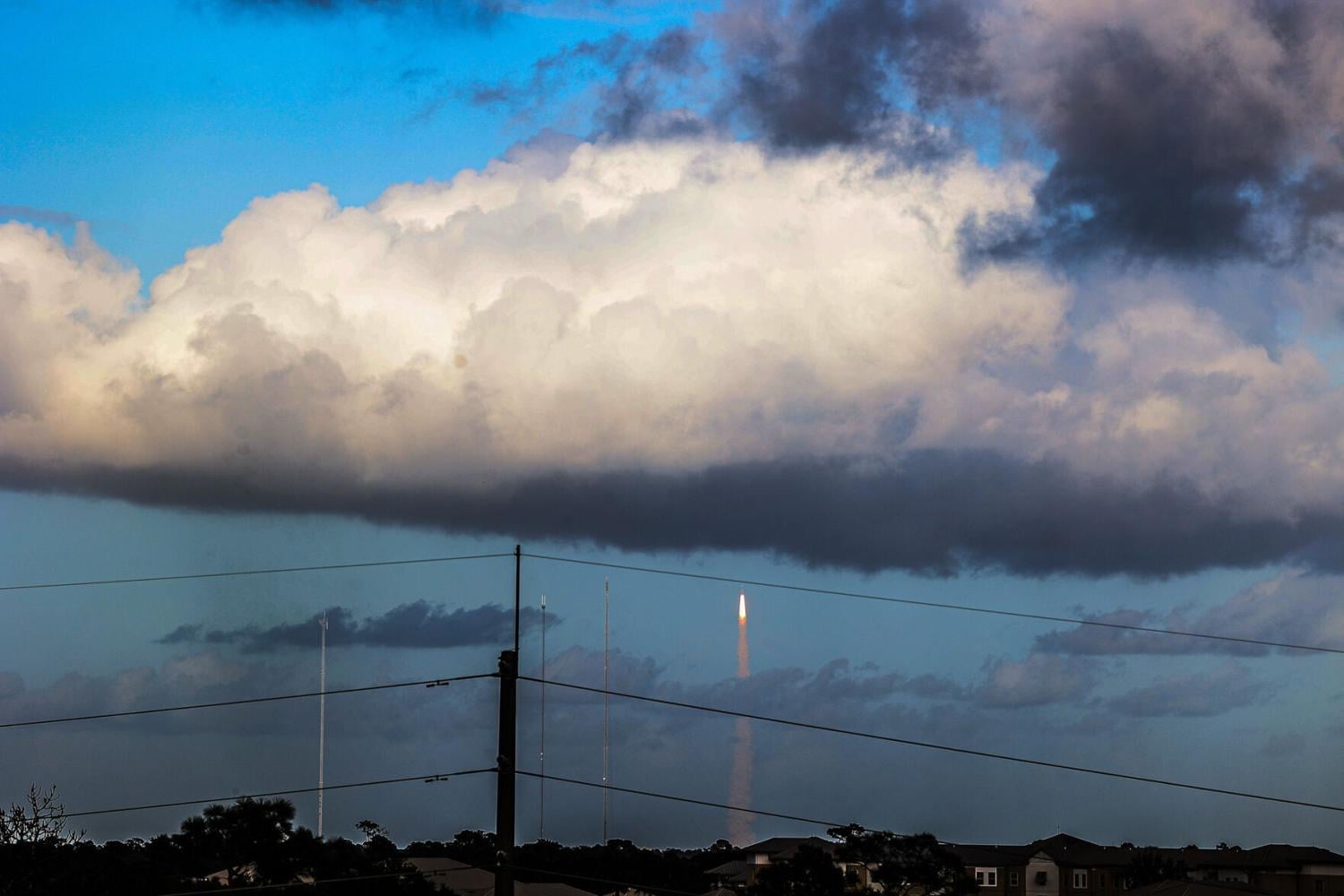

The Artemis II rocket peaks over the skyline of the UCF area at 6:35 p.m. on April 1. Observers on campus experienced around a 10-second delay due to the distance from the Kennedy Space Center.
Juno Le
The Artemis II astronauts completed the first human voyage to the moon in over 50 years, exciting UCF students and faculty alike.
Artemis II launched on April 1 at 6:35 p.m. from Kennedy Space Center, around 30 miles away from UCF. The crew splashed down off the coast of San Diego Friday night, arriving safely from their almost 10-day voyage around the far side of the moon.
During the summer of 2024, senior computer engineering major Megan Danh worked on the Graphical User Interface of an Artemis II launch simulation. Danh watched the spacecraft launch at Cape Canaveral in person.
“I definitely got a bit emotional,” Danh said. “[The launch] gave me goosebumps. I feel like we see this level of passion from artists and creatives more commonly in the mainstream media, but to see an organization of engineers who materialized this mission out of curiosity, science and ambition, it’s definitely inspirational in a whole different way for a young engineer like me.”
During their lunar flyby observation period, the Artemis II crew captured this image at 3:41 p.m. EDT, showing the rings of the Orientale basin. Centered in the image is Carroll, the crater named after Commander Reid Wiseman’s late wife.
Courtesy of NASA
Between the interviews and hand-picked wake-up songs the Artemis crew shared with the world, the astronauts were hard at work conducting scientific research. The spacecraft looped around the far side of the moon, carrying the crew to the furthest point any human has traveled, according to NASA.
They visually surveyed the craters and watched a few micrometeorites hit the surface.
During that survey, they identified and named two craters. One was named “Integrity” after the Orion spacecraft, and the other “Carroll” after Commander Reid Wiseman’s late wife, according to NASA.
Dr. Philip Metzger is a research professor at the Florida Space Institute, a UCF-sponsored off-campus facility dedicated to space research, development and education. Metzger’s work focuses on planetary physics, as well as lunar and asteroid soil.
“It’s the first time that we’ve had humans orbiting the moon from a far enough distance to see the entire moon,” Metzger said. “There’s a historical, humanitarian meaningfulness about that. They’re also demonstrating the ability to get photographs and to observe the moon as we go around using new techniques.”
A major goal of the mission was to study the effects of deep space on the human body and mind. Sleep pattern, immune system response and the effects of radiation and microgravity were all on the agenda.
Dr. Emmanuel Urquieta, associate professor and vice chair of aerospace medicine at UCF, said that the human body is impacted by space almost immediately. He said almost all systems are impacted, including cardiovascular, muscular and skeletal. The effects of deep space are much harsher, lacking Earth’s magnetic field that astronauts in low-Earth orbit enjoy, Urquieta said.
The psychological challenges of space can weigh on astronauts. It’s a large hurdle that must be overcome before long-term human forays into deep space, Urquieta said.
“Astronauts operate in isolated, confined, high-stakes environments where every task is critical, allowing little room for mistakes,” Urquieta said. “Even in low-Earth orbit, this can lead to stress from sleep issues, workload, confinement, and separation from loved ones.”
Urquieta is most looking forward to the AVATAR investigation, an organ-on-a-chip study measuring deep-space’s impact on human cells.
“This approach is exciting because it brings us closer to developing a more predictive and personalized model of space medicine,” Urquieta said. “Instead of just describing the general effects on the average astronaut, we could eventually predict how a specific individual might respond and customize countermeasures accordingly.”
The Artemis II crew consists of commander Reid Wiseman, pilot Victor Glover, mission specialist Christina Koch, and mission specialist Jeremy Hansen. It’s a major milestone in terms of diversity. Artemis II carried the first woman, Black person and non-American around the moon.
Lorelei LaRue, freshman emerging media major, tuned into the NASA livestream of Artemis II for more than 100 hours throughout the astronauts’ trip around the moon.
“I was especially inspired and felt deep admiration seeing someone like me on this journey,” LaRue said. “Knowing that a woman was on that rocket and heading towards the moon for the first time, I cried happy tears. Koch is a role model of mine and has inspired me to work in the space industry and follow my passions.”
LaRue said she plans to pursue a career that supports human spaceflight.
Koch spent the most time in space among the crew, logging 328 consecutive days aboard the International Space Station. Her total time in space is only about five hours fewer than the rest of the crew combined.
The Robotics Club of Central Florida stands on a dock at Sand Point Park in Titusville, Fla., on April 1. The club held a watch party social for the launch of Artemis II.
Courtesy of Lily Rieckhoff
Lily Rieckhoff, freshman criminal justice major, is a self-proclaimed space nerd and has been watching Artemis II developments closely.
“Being able to see women enter an industry that used to be near-impossible to get anywhere close to has been such a special experience, and a huge inspiration for young women everywhere,” Rieckhoff said.
Rieckhoff is the marketing officer for the Robotics Club of Central Florida, which held a watch party of the Artemis II launch at Sand Point Park in Titusville.
“Robotics serves a key part in modern space exploration, so that was something that I think is special for a lot of students in the robotics club,” Rieckhoff said.
UCF was founded to provide new talent to the budding space industry in Cape Canaveral, and about 30% of Kennedy Space Center employees graduated from UCF, according to the UCF college tour series. Dubbed “SpaceU,” UCF is a national hub for training space talent, according to the UCF website.
David Fein, sophomore aerospace engineering major, poses in front of the smoke trail after the Artemis II launch near Titusville, Fla., on April 1. His necklace contains a lunar meteorite fragment.
Courtesy of David Fein
“I feel that UCF is positioned perfectly to have a major role as humanity goes beyond planet Earth,” Metzger said. “With all of our focus on space, we’re ready to provide the workforce for the coming decades. We expect to see gigantic growth in the space industry, and we need to have a university that can provide that workforce to support it.”
Sophomore aerospace engineering major David Fein has always had a fascination with space. Fein said watching the launch felt like entering an Apollo-era documentary.
“The prospect of humanity venturing into, documenting, and eventually colonizing the final frontier has been an endless source of inspiration for me,” Fein said. “Personally witnessing the Artemis II launch has only strengthened my resolve to contribute to humanity’s expansion among the stars.”
NASA’s Artemis missions aim to return humans to the moon and build a foundation for a human mission to Mars. The Artemis III mission is currently planned for 2027 and will test Blue Origin or SpaceX’s lunar landers.