
For 56 years, the lessons of Earth Day have boiled down to this: First, environmental progress happens through each of us, and not ultimately because of government actions, large-group efforts, or corporate enterprises.
“It comes down to how we think as consumers,” says Jennifer O’Brien, executive director of Resource Depot in West Palm Beach (www.resourcedepot.org). Resource Depot is self-described as “a resource wonderland and learning center where materials are revived, repurposed and redistributed to those committed to creative exploration.”
A nonprofit organization, Resource Depot champions “environmental sustainability and creativity through reuse and education programs.”
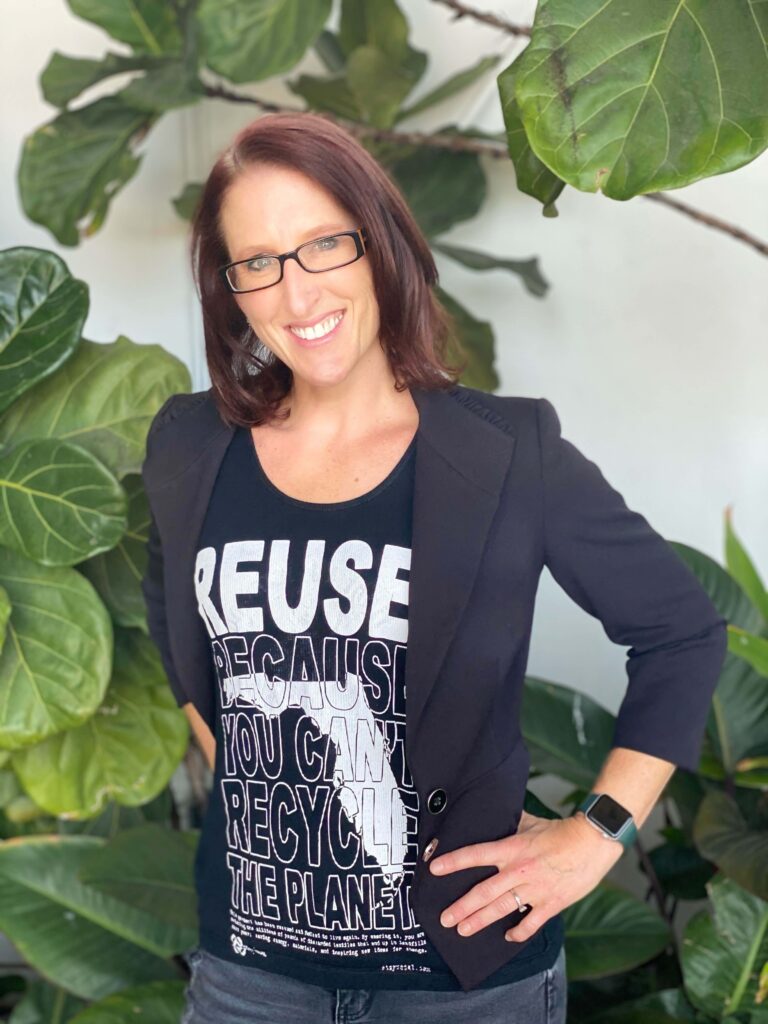
Jennifer O’Brien, executive director of Resource Depot. Her T-shirt says, REUSE because you can’t recycle the planet. -RESOURCE DEPOT / COURTESY PHOTO
Reuse of what? Of anything that might end up in the waste stream, when a thoughtful little effort could keep it in service.
And that takes willing, creative-minded people. Earth Day’s 2026 theme, “Our Power, Our Planet,” points to a notion long shared by Resource Depot and many others: “Environmental progress doesn’t depend on any single administration or election.”
Many people recognize that truth on Earth Day, which is why its organizers call it “the world’s largest civic observance.”
From toilet paper tubes to old U-Haul trailers — from uses as small as seed planters or objets d’art to comfortable homes — each of us can help resist and reduce the waste stream generated by individuals and communities if we find new ways to use common objects, O’Brien explains.
To do that, “Resource Depot redistributes discarded items to teachers, artists, families, and other nonprofits; hosts workshops and community events; and collaborates with educators.”
Escape the waste
There’s a second lesson, too, borne out by 56 years of experience and hugely increasing volumes of waste in America and abroad: “We are all in this together,” says Alex Eaves, founder of Escape the Waste (www.escapethewaste.com), an “edutainment” company as he describes it, based in Massachusetts. He has worked with O’Brien and Resource Depot in the past to help educate and entertain Floridians.
“This will sound like the most hippy-dippy thing out there, but picture anything you like to do,” he said.
“Now, picture doing it without a planet. You can’t get a Lamborghini without a planet. You can’t go hunting without a planet. It has to be part of everyone’s thought process.”
It doesn’t matter whether you’re left or right, a Republican or a Democrat, a capitalist or an environmentalist, a conformist or a nonconformist; what you do, what you use and consume, affects everybody else, Eaves contends.
His words are simple, but his complex thinking and disciplined living in response to the question of how we acquire and consume led to his career — an extension of his life — as a teacher of reuse. Like O’Brien, he teaches people how to resist the growing waste stream in America by offering them positive solutions they can live with.
An author and documentarian, Eaves met O’Brien at a conference, after which she asked him to come introduce his second documentary from 2022, “The Box Truck Film: Building a Reuseful Home,” at a Resource Depot event.

Resource Depot in West Palm Beach champions environmental sustainability and creativity through reuse and education programs. -COURTESY PHOTO
His first film, “REUSE! Because You Can’t Recycle the Planet” (2015), brought him awards and acclaim. The second led to his current life on the road, teaching.
In the film, Eaves documents his work journey in turning an old, 17-foot U-Haul into his 96-square-foot tiny home. It seems to have everything, including complete bathroom facilities.
How does he do that?, a reporter asked.
“There is a completely waterproof bathroom in the truck with a composting toilet. When I shower, the toilet lifts out. Check out the film, and you can see it all (www.boxtruckfilm.com).
Why live in a truck, drive to Florida, and tell people about it?
Saving resources and trying not to be a hypocrite, he says.
It started 22 years ago, when he was still working in the music industry, touring with bands from small to famous (Huey Lewis and the News, on one occasion) as a member of the support staff.
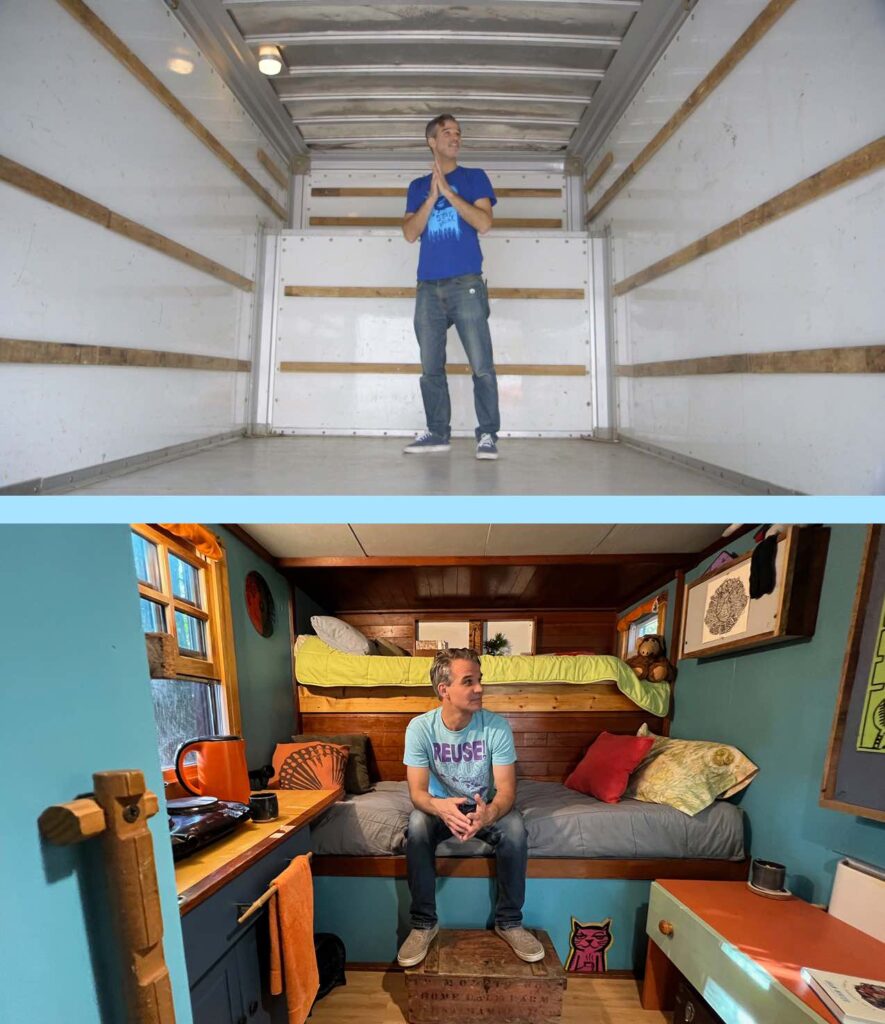
Alex Eaves turned this empty 17-foot U-Haul into a comfortable 98-square-foot home. Everything in it is reused. -ALEX EAVES / COURTESY PHOTO
There was so much waste in clothes, posters, stickers — everything, he recalls.
Then one day, “I realized what happens when T-shirts get printed incorrectly — they get destroyed. Shredded.”
He comes from parents who collected everything and started countless projects they didn’t finish. (His dad was a Vietnam veteran with severe PTSD, so there were sometimes good reasons he couldn’t finish projects.)
The waste on the tours, especially of those T-shirts, bothered him, he says, and so did the notion of not being able to fix the problem.
“It blew my mind — as a lifelong problem solver, I need to put this problem together with a solution — a reuse T-shirt idea. So, I sold them for my brand at concerts.”
He began to think about the world differently, he acknowledges.
“Waste was everywhere, and in every decision I made on a daily basis, I could choose to make a little waste or not make a little more waste.”
His life had taken a new turn. He started a skateboard company, Stay Vocal, producing reused boards, and then he moved to a reused garment brand and T-shirt company, expanding it to teach without being a hypocrite.
“I figured if I was going around teaching this, I had to live it,” he says. “So since about 2007 I haven’t used disposable coffee cups, I don’t get paper towels, I haven’t used a disposable shopping bag, blah, blah, blah.”
Eventually, he teamed up with his friend, Derek Diedricksen, to find a home and go the truck route.
“It made complete sense to me since I always used to dream, while sitting in the back of a tour bus, ‘imagine if you could put a couch in here.’”
But the value of reuse is probably more than just an old couch transplanted into the back of a bus or truck for people like him and O’Brien, especially people whose parents grew up in the Great Depression or during World War I, and taught them the value of reuse.
In those days, apparently, the federal Office of Price Administration, which was established to control and direct prices, rents and rationing so that wartime inflation wouldn’t spiral, borrowed a slogan — an old Yankee ditty, some called it — that went like this: “Use it up, wear it out, make it do or do without.”
That’s not recycling, that’s reusing, and it’s as American as apple pie, it seems.
As for recycling, Eaves says, “it’s more wish-cycling. Are the trucks going to take it somewhere? The numbers on plastic recycling suggest it’s an unfortunate joke.”
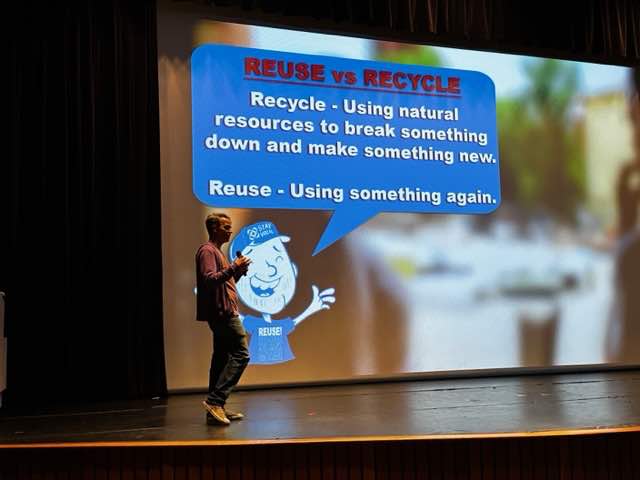
Alex Eaves explaining the difference between recycle and reuse. -COURTESY PHOTO
But living out of a truck and wearing or using things he won’t throw away brings him a variety of satisfactions, not just spare living and money saving.
“The amount of resources saved with this truck is astronomical,” he notes. “When the truck is parked, I’m running all my heat and electricity on one standard outlet.”
That’s reuse at its best, perhaps. But what about gas consumption? And how’s the mileage on the truck?
“I just say, ‘Bad,’” he replied. “No way around it.”
Eaves and O’Brien share the same ethos, she said: Recycling isn’t enough. “In recycling, you break down things to make something new,” she explained. “In reusing, you restore something and use it again.”
His purpose, says Eaves, is “to educate people of all ages about the importance of reusing when it comes to helping our shared planet and preventing wasted personal resources, opportunities, time and money.”
For him, O’Brien and many others, the waste stream is an enemy of sorts.
“Some things are not designed or manufactured to last,” says O’Brien, a collage artist who uses many common everyday items in her art.
“But many things people throw away can be reused. Creative thinking is important,” she adds.
“We don’t have to guess when we decide to reuse a cup. We’re seeing it in action,” Eaves says. “It’s just a no-brainer.”
The big do-good picture
Across Florida — in quietly growing numbers, it seems — sellers and buyers alike are finding ways to resist the waste stream not just by recycling, but by reusing. Some outfits point their reuse efforts at the unfortunate: the ReUse Store in Charlotte County, for example (carefl.org/donate/reuse-store). There, “The ReUse of usable items, instead of them going into the landfill, directly assists victims of domestic violence, sexual assault and other violent crimes.” They ask for donations of household goods, gently used clothing, toys, books, tools, craft items and furniture.
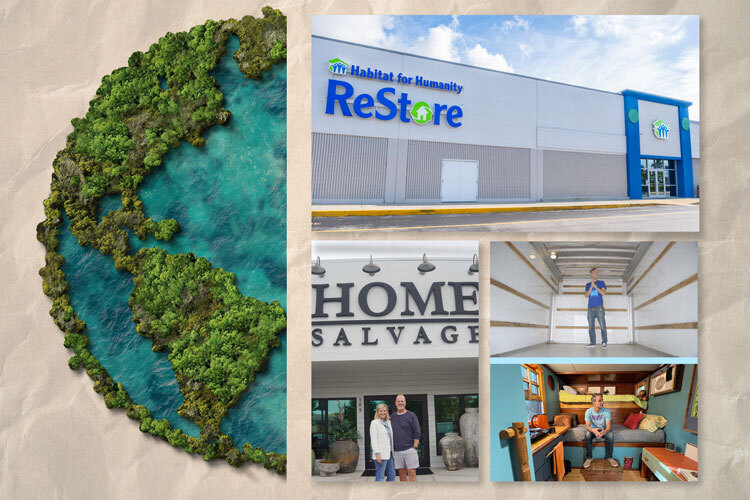
Habitat for Humanity ReStores exist in each county, selling new and used furniture, appliances, home accessories, building materials and more at “a fraction of the retail price.” In Charlotte, for example, they’re open in Englewood, Murdock, Punta Gorda and Port Charlotte.
Habitat for Humanity ReStore off of McGregor Blvd., Fort Myers. -DAVID WISHTISCHIN / FLORIDA WEEKLY
And sometimes there are specialty stores you wouldn’t anticipate, such as Play It Again Sports in Fort Myers.
For those discarding used but serviceable sports gear for football, baseball, tennis, golf and basketball, among others, or searching for weight sets or weights, field hockey or lacrosse gear and the like, this store keeps some marvelous gear out of the waste stream.
In terms of consumer appetites, it’s not always an easy path.
“We started out full consignment, aiming to reuse and repurpose everything we sold, but we had to turn into a furniture store,” said Jim Langeloh. He and his wife, Tina Langeloh, own and operate Home and Salvage in Naples.
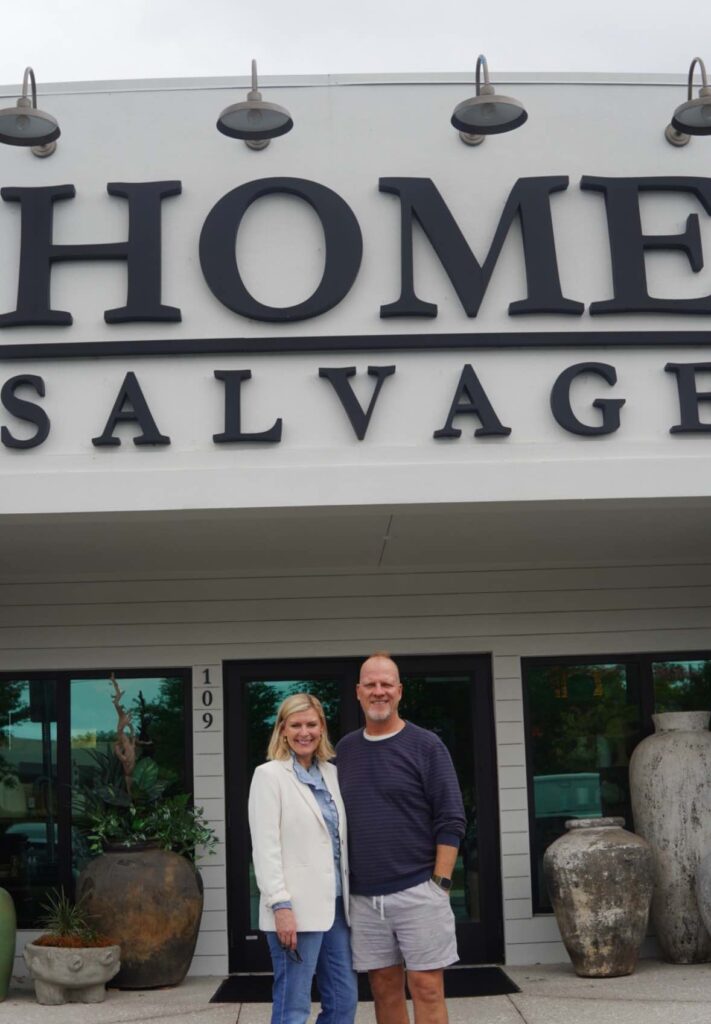
Tina and Jim Langeloh stand in front of their Naples store, Home and Salvage, where they reuse objects rather than discard them whenever they can. -HOME AND SALVAGE / COURTESY PHOTO
Native Michiganders, Jim’s father was a retired antiques dealer, an old term for people who reuse rather than discard objects of living, perhaps.
“He would bring down old doors and windows and shutters and so on, but there was no market down here. Nothing was old.”
Jim and Tina carry on that tradition when they can.
“We’re a small business, and we’re still having fun,” he says. “You have to go where the market takes you, but if we can find old things and bring them to market, we’re doing what we should be doing.
“I think the younger generation is aware of reusing and saving. I think, on the whole, they’re mindful of the Earth. But what does it say when you just demolish stuff?”
He still owns an old cabin in Michigan, built in 1886. A lot of people recommended he take it down, but he hasn’t. And won’t.
“It has good bones,” he said. So, it’ll be reused to serve the occupants of a different century, as well as it served those of the 19th and 20th centuries.
And in Naples, “our building was built in 1970, and when we purchased it six years ago, I can’t tell you how many developers said, ‘Just knock it down,’” he said.
“Naples is my home, and I love it, but unless you go to those cottage streets downtown, we seem to be in a fight to preserve and reuse that’s hard to win in the long term.”
In Palm Beach, by contrast, “you have these cottages built in 1930, and they have great bones. People restore them and maintain them, and they’re just as good-looking now, or better, than when they were new.”
And one more thing: “Do I like my answer?” Jim asks. “No.”
Meanwhile, back at the reused U-Haul packed with reused materials, Alex Eaves points to his T-shirts.
“Every single T-shirt in this truck has saved 713 gallons of water — that’s what it takes to make a T-shirt,” he says. “That’s enough for one or two humans to drink water for an entire year.”
So instead of disappearing into the waste stream, they’ve come back, many sporting these words, often visible on the clothing Jennifer O’Brien wears: “REUSE! Because you can’t recycle the planet.”
And now, perhaps, Alex Eaves is making his late father, Kenneth, proud. After his dad died, Alex and the family cleared out an old house packed with things destined for reuse that never quite got there.
They found people and places where the items could be used; they sold some; and Alex put others back into action himself.
“I have started wearing his uniform shirts when I do speaking engagements, and I have his Vietnam hangers,” he says.
“And I use his map case. Maps were held inside it from the helicopter
he was in as a machine gunner. My whole thing is positive solutions.
“The Vietnam War was a terrible thing, and it caused terrible problems for my family and the nation. But I’m reusing my father’s map case to teach reuse, and that’s a positive thing.”
Reusing, in general, is a positive solution, Eaves insists, on Earth Day or any other day.