
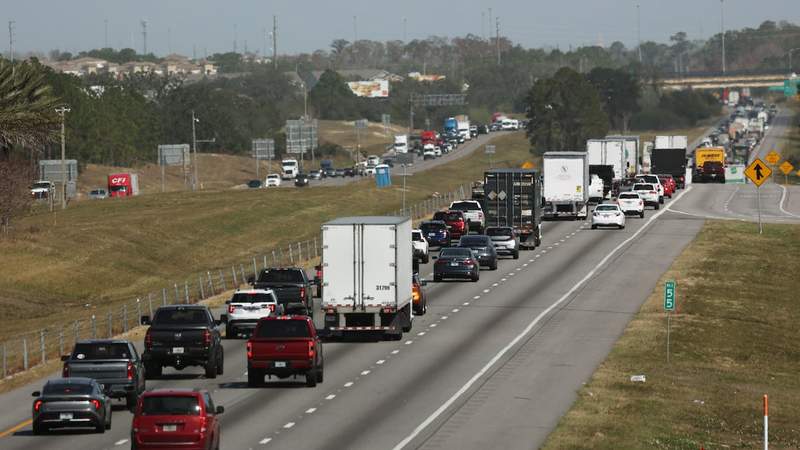
Three data points this month illustrate Florida’s challenge with efficiently moving tens of millions of residents and visitors around the state.
First, Floridians received the latest billion-dollar reminder that roads don’t come cheap.
The state highway department said last week that an upgrade of a section of Interstate 4 would be finished in the summer of 2031, at a price tag of $2.5 billion.
The 14-mile stretch between Polk and Osceola counties on the way to Orlando averages up to 160,000 vehicles per day. The project includes two express lanes in each direction, the latest solution to reduce routine backups.
The announcement came with the familiar pledge of “congestion relief.”
But relief for how long? In a growing state, adding lanes tends to induce more demand. When I-4 expanded from two to three lanes, the new capacity temporarily reduced travel times. More vehicles soon erased those gains.
So here we are, paying $2.5 billion to improve a relatively short stretch of one major road, an amount that could cover Tampa’s annual budget, with enough left to award every Hillsborough sheriff’s deputy a $315,000 bonus.
Keep the $2.5 billion in mind when the next elected official pooh-poohs the cost of alternative transit options like rail or rapid buses. You could also remind them that the feds once offered $2.4 billion ($3.6 billion in today’s dollars) to build high-speed rail along the I-4 corridor from Orlando to Tampa. But in 2011, then-Gov. Rick Scott scuttled the deal, calling the proposed rail line a “boondoggle.”
That decision isn’t aging well: Brightline’s high-speed train now runs from Miami to Orlando, while the state pours billions more into expanding the interstate between Tampa and Orlando. The rail line would not have paid for itself, but neither does the interstate. The $2.5 billion project is just the latest example.
Meanwhile, the demand the expanded interstate aims to address is only growing.
A lot more driving
Americans are driving more than ever. The latest information from the federal highway agency showed that the total miles driven in February was the highest in the nation’s history, based on a 12-month rolling average. A growing population means more drivers, which leads to more miles driven, at least in a country that hasn’t embraced alternatives as readily as many other countries.
The same numbers aren’t out yet for Florida, but the latest state data show Floridians drove 115 million more miles daily than a decade earlier. Commute times have risen in the state, as has the share of drivers who spend at least an hour commuting to work.
All seven of our local counties — Pinellas, Pasco, Hillsborough, Hernando, Polk, Manatee and Sarasota — have longer average commute times than a decade ago. Only Pasco and Pinellas have a lower share of drivers spending at least an hour commuting to work.
All of the road building and improvements — much of it badly needed — hasn’t kept the numbers from getting worse.
What’s fueling all those extra miles? Surprisingly, it’s partly the people who stopped going to the office.
Not commuting; driving more
The COVID pandemic prompted a massive shift toward remote work, a change still felt today. About 5.6% of Florida’s workforce worked at home a decade ago, according to the U.S. Census Bureau. Now, it’s about 15.5%. That’s down from the years right after the pandemic, but it’s still a huge increase.
The surprising part: Not commuting doesn’t always mean less driving. Several studies show people who work from home often drive more, even if they commute less.
Traditional commuters more often combine errands, appointments and other stops into their drive to and from work, making the overall trips more efficient.
In contrast, telecommuters more often make separate trips for errands, school drop-offs or work-related meetings. They also tend to live farther from work, so they drive more miles when trips to the office or client meetings are necessary.
As the pandemic moves further into the past, remote work is expected to decline, which could alleviate some of the pressure on our roads. But any decline is unlikely to compensate for the 2 million to 5 million additional residents the state expects by 2040.
More people will mean more pressure on a transportation system that already strains to keep up.