
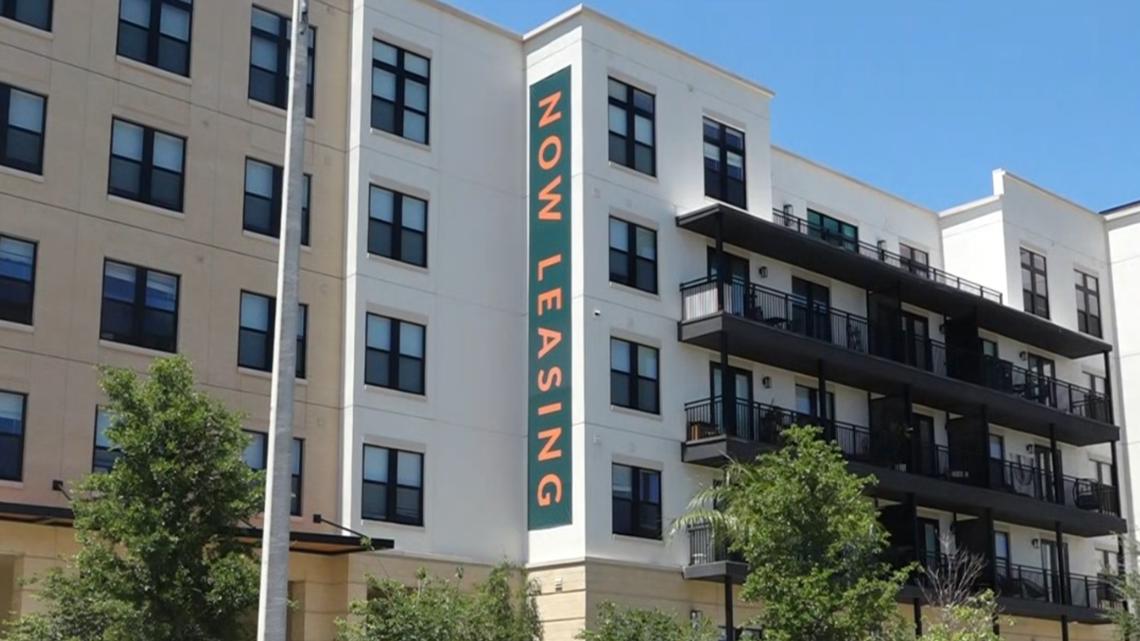
ConsumerAffairs ranks Florida as the worst state in the country to rent an apartment, pointing to a combination of high rental costs and limited tenant protections.
TAMPA, Fla. — A new national study is underscoring what many Florida renters already feel each month — the cost of housing is taking a growing bite out of their income.
ConsumerAffairs now ranks Florida as the worst state in the country to rent an apartment, pointing to a combination of high rental costs and limited tenant protections.

This story continues below.
Economists say the issue is not just how much rent costs, but also how much of a renter’s paycheck it consumes.
“What we really should be concerned about is not necessarily the price itself, but how much of my income that price is taking up,” said Michael Snipes, an economics professor at the University of South Florida.
The study found many Floridians are spending close to — or more than — a third of their income on rent, exceeding what is typically considered affordable.
According to the financial website WalletHub, those percentages are hitting several Florida cities hard.
In Miami, for example, it’s about 33.77% of a person’s income; in Orlando it’s 28.98%; in Tampa it’s 27.04%; in St. Petersburg it’s 26.54% and in Jacksonville it’s 25.16%.
At the same time, Florida also offers fewer tenant protections than many other states, with no limits on application fees, no statewide controls on rent increases and fewer safeguards against eviction.
Snipes adds that market forces alone may not be enough to solve the issue.
“And I think unfortunately, that might have to happen in Florida. There might have to be some sort of government solution via subsidies or some sort of zoning regulation, something like this,” Snipes said.
Despite the high costs, the study shows Florida is not facing a shortage of apartments. In fact, the state has one of the highest vacancy rates in the nation.
But experts say what’s available often doesn’t match what renters can afford.
“It does matter what type of housing gets built,” Snipes said.
Much of the new construction in recent years has focused on higher-end developments, leaving a gap in workforce and affordable housing.
Snipes says closing that gap will likely require changes to how housing is built — and incentivized.
“There has to be some sort of way to incentivize builders to build apartment buildings or duplexes or something like that,” Snipes said.
Until then, economists warn many Florida renters will continue to feel the squeeze as housing costs outpace income growth.