
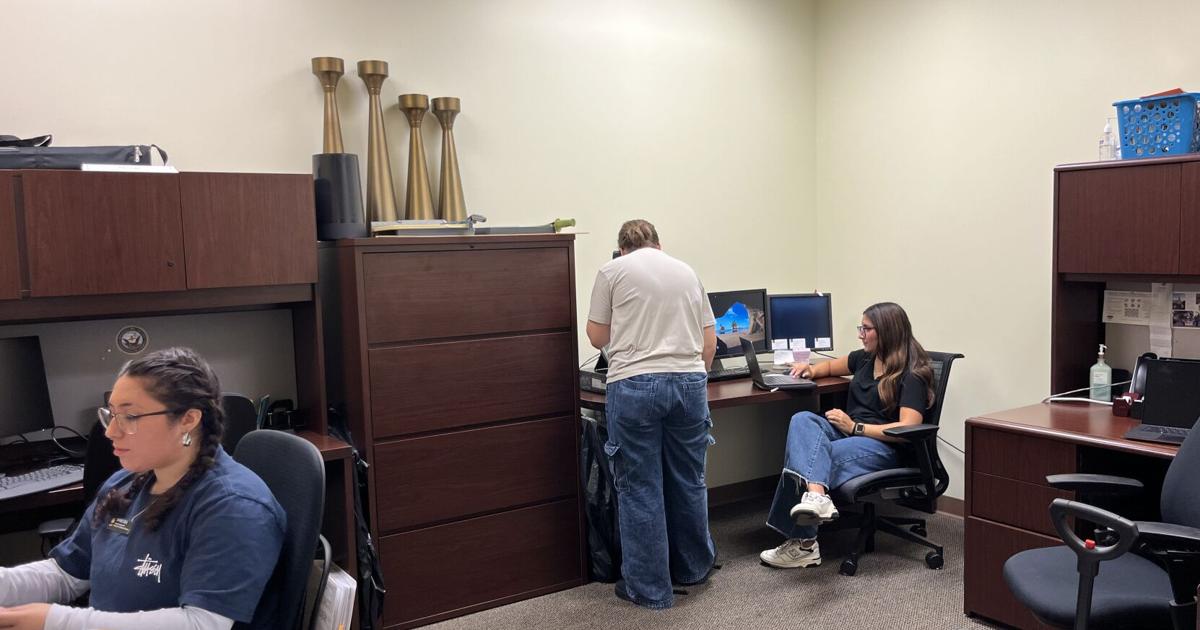

Program Specialists at UCF’s Military and Veteran Success Center Vanessa Roldan (left), Abigail Kost (middle) and Victoria Reed (right) work on tasks to assist the office near the Addition Financial Arena on Wednesday morning.
Lola Fontanez
Following the Oct. 1 government shutdown prompted by a lapse in federal funding, multiple agencies began implementing contingency plans, including the GI Bill call centers that support students receiving VA and military education benefits.
While the shutdown primarily affects national agencies, its impact is also felt on college campuses. At UCF, the Military and Veteran Success Center is facing challenges as the VA call center ceases services.
The Department of Veterans Affairs’ contingency plan allows benefits related to education, housing and pensions to continue. However, the hotline assisting with payment issues is not operating.
Lead school certifying official at UCF MVSC, Matt Winstel, noted that students may face delays or uncertainty regarding their payments due to the shutdown. He also emphasizes that UCF MVSC, the university and the Greater Orlando veteran community are working together to support students.
“The first thing we did was reach out to UCF Cares,” Winstel said. “If a student’s certifications have not been processed through the VA and they’re experiencing financial difficulties, UCF Cares says ‘send them our way.’”
A system change prior to the semester now requires students to certify their enrollment in order to receive funds. Director of UCF MVSC, Michael Kepner, said that delays are most likely when students fail to complete this verification.
“The only time someone doesn’t get paid is if a student hasn’t verified their enrollment,” Kepner said. “They may hit a pay stop because they didn’t complete the steps they were supposed to, and there’s no one to call to fix that, so there might be a delay in their processing.”
Maddox Birr, a junior mechanical engineering major, is largely dependent on his benefits for rent and tuition.
“I applied for my benefits before the semester started. It’s now October, and I have yet to receive confirmation of my paperwork even being processed,” Birr said. “I’ve called them twice now, but they’ve only been able to tell me that my certification is ‘in process,’ which I’ve never heard before.”
The MVSC office has three main certifying officials that handle benefits, social support and academic services for more than 2,000 military or military-connected students on campus. They frequently engage with students, but have limited control over the national funding that students rely on.
“There’s only certain things that our office can do. Some of the problems that we would normally raise up to the call center, whether it’s the student side or our side, those problems are just going to sit there until someone comes to work,” Kepner said. “What we do is keep a backlog of those problems, so that when the government reopens those questions are addressed in a timely fashion.”
Although the office is continuing partnerships with other organizations to support students, this does not always alleviate the rapid effects of payment delays.
“I rely on Chapter 35, which pays me $1,500 a month for my rent. I also use the Children and Spouses of Deceased or Disabled Veterans Scholarship, which pays for my tuition,” Birr said. “My tuition this semester was $4,000, so waiting on that is crippling my bank account, paying everything out of pocket.”
Kepner said that MVSC has reached out to local veteran and military support organizations such as Mission United, Camaraderie Foundation, the American Legion and Transition House. The office also works closely with the Bursar’s Office, Housing and Residency Life, and the Registrar’s Office to ensure student support.
Kepner and Winstel noted that if the shutdown continues into the next payment and registration period in early November, more information and resources will be shared. Students are encouraged to seek help if needed.
“The most important thing now that every military student should know is: if you have a question or concern, or just don’t know, come see us and we will guide you in the right direction,” Kepner said.
The certifying officials had one echoing piece of advice for students who receive military benefits.
“Certify early. On the 10th of November, our operations are going to open up for the spring semester, so starting then, anybody already signed up for classes can give us their information,” Winstel said. “That way we can have it processed long before holiday break, so when we come back, students start classes knowing their information is updated.”
The last government shutdown lasted 34 days under the Trump administration in 2018, the longest in U.S. history.
“It’s even more important now. They’re talking about this on the hill, a seven-week clean resolution, but that doesn’t mean we’re not going to shut down again in 42 days,” Kepner said. “If you certify early, the earlier we can get that process done and the safer you are.”