
Lawmakers reject a push to withdraw U.S. troops from Iran war, and voters groups work to educate people on the Save Act.

The House rejected a resolution Thursday requiring President Donald Trump to withdraw U.S. forces from the war with Iran unless Congress authorizes military action. It was the latest such vote that fell short of passage as Republicans largely continue to support Trump’s operation.
Democrats voiced concern that the United States is becoming further entrenched in another lengthy conflict in the Middle East. They promised to keep raising the issue through more war powers votes in the coming weeks.
The 213-214 vote came one day after a similar effort failed in the Senate. The U.S. and Israel struck Iran on Feb. 28, and a fragile ceasefire is now in its second week.
Democrats overwhelmingly supported the attempt to rein in Trump’s use of military force.
“We’re standing at the edge of a cliff and Congress must act before the president pushes off,” said New York Rep. Gregory Meeks, the ranking Democrat on the House Committee on Foreign Affairs. “Every day we delay, we inch closer to a conflict with no exit ramp.”
Republicans tried to cast the effort as hypocritical.
Florida Rep. Brian Mast, the committee chairman, said Congress never voted on a war powers resolution when the U.S. attacked Iranian-backed Houthis in Yemen in 2024 while Democrat Joe Biden was president.
“When Joe Biden was responding to merchant marine vessels being attacked, it was OK. No war power needed. It went on for about a year,” Mast said. “President Trump responds — war power, war power, war power. … That’s the hypocrisy.”
Under the War Powers Act of 1973, Congress must declare war or authorize use of force within 60 days — a deadline in the Iran war that will arrive at the end of April. The law provides for a potential 30-day extension, but lawmakers have made clear that they want the Republican administration to soon lay out a plan for the war’s end.
While the House vote failed, it gave Democrats an opportunity to highlight some of the most negative effects of the war: the billions of dollars spent, the death of at least 13 service members, the soaring gas prices and fissures with long-standing allies who do not support Trump’s actions.
“Gas prices at home are up to $7 in my home state, and families are hurting,” said Rep. Pramila Jayapal, D-Wash. “Another 10,000 U.S. troops are being sent in to join 50,000 already stationed in the Middle East with absolutely no strategy, no plan and no exit.”
Republicans defended Trump as taking decisive action against an Iranian government that has long terrorized the Middle East and its own people.
“President Donald Trump has sent a message that those who threaten the United States and our partners will be ultimately held accountable,” said Rep. Joe Wilson, R-S.C.
In Thursday’s vote, Rep. Thomas Massie of Kentucky was the only Republican to cross party lines and vote for removing U.S. forces from the war. Rep. Jared Golden of Maine was the only Democrat to vote against the measure.
The first House vote to curb Trump’s miliary action with Iran failed in early March, 212-219.
Earlier this month, Gov. Ron DeSantis signed the Election Integrity Bill, also known as Florida’s version of the “SAVE Act.” The governor said the measure helps strengthen the security, transparency and reliability of the state’s election system.
Voter registration groups like the League of Women Voters are working to educate voters on the changes. The organization says its main focus is making sure people understand the new requirements, which include proving U.S. citizenship using a REAL ID or a birth certificate. DeSantis has said these steps are intended to bring more integrity to the voting process and weed out fraud.
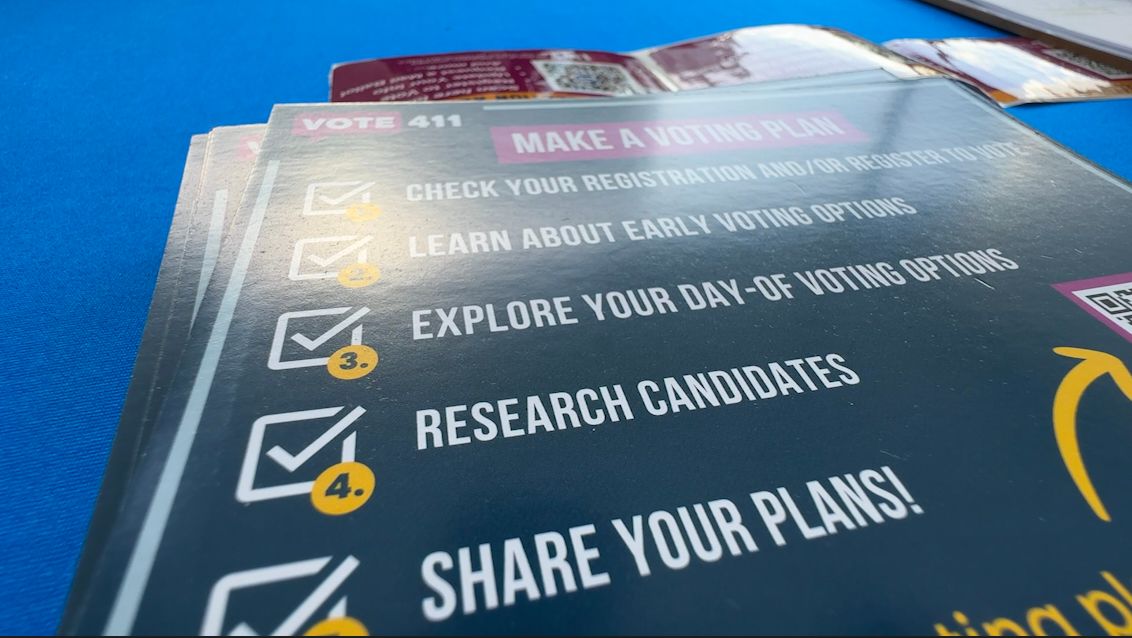
At a tabling event in St. Petersburg, the League of Women Voters of St. Pete shared information about the new law. Heidi Davis, the group’s voter services co-chair, said they receive many questions about what forms of identification will be sufficient.
“We get a lot of questions about is their driver’s license going to be sufficient — is their state ID OK, do I have to get a passport,” Davis said.
Davis represents the league at community events across the Bay area, where volunteers answer questions about the changes and help people ensure their voter registration is up to date. The deadline to update their registration is Jan. 1.
Davis expressed concern that the new requirements could discourage some people from voting, particularly those who may not have the financial resources to obtain identification.
“My biggest concern is that it will just discourage people from voting because people may not have the funds to buy the ID,” she said. “For instance, a state ID, which is the cheapest of the IDs, is $25. We don’t want people to not be able to vote because they don’t have the resources or they are confused.”
The Florida SAVE Act requires verification of U.S. citizenship using REAL ID data, although it is already illegal for non-citizens to vote. The law also establishes a process to identify and remove ineligible voters from voter rolls. Voters must provide documentation to confirm eligibility, such as an up-to-date driver’s license or birth certificate.
“This bill protects and expands integrity in our voter registration process by requiring the verification of U.S. citizenship when you are doing your voter registration,” DeSantis said. “Our constitution in the state of Florida says only American citizens are allowed to vote in our elections, and we need to make sure that is the law.”
Davis noted that some groups, including students and senior citizens, could be affected by the changes in ID requirements.
“Student ID will not count any longer as a photo ID to show up at the polls and vote, so they will be impacted,” Davis said. “Senior citizens who have given up their driver’s licenses are going to be impacted, so we want to make sure those people focus on getting the documentation, their birth certificate, and get to (the Florida Department of Highway Safety and) motor vehicles, get that taken care of. Get your paperwork; get it now; don’t wait.”
She added that confusion remains a concern but emphasized two key messages.
“We have two messages right now — one, it doesn’t affect this year, and two, do not panic. If we can just get those two messages across, it’s a win for us,” Davis said.
The changes brought by the law will not take effect until after this year’s midterm elections. The bill was signed April 1, and federal lawsuits were filed the same day challenging the legislation. Groups suing the state have raised concerns that the law could push out eligible voters and may violate multiple constitutional amendments.