
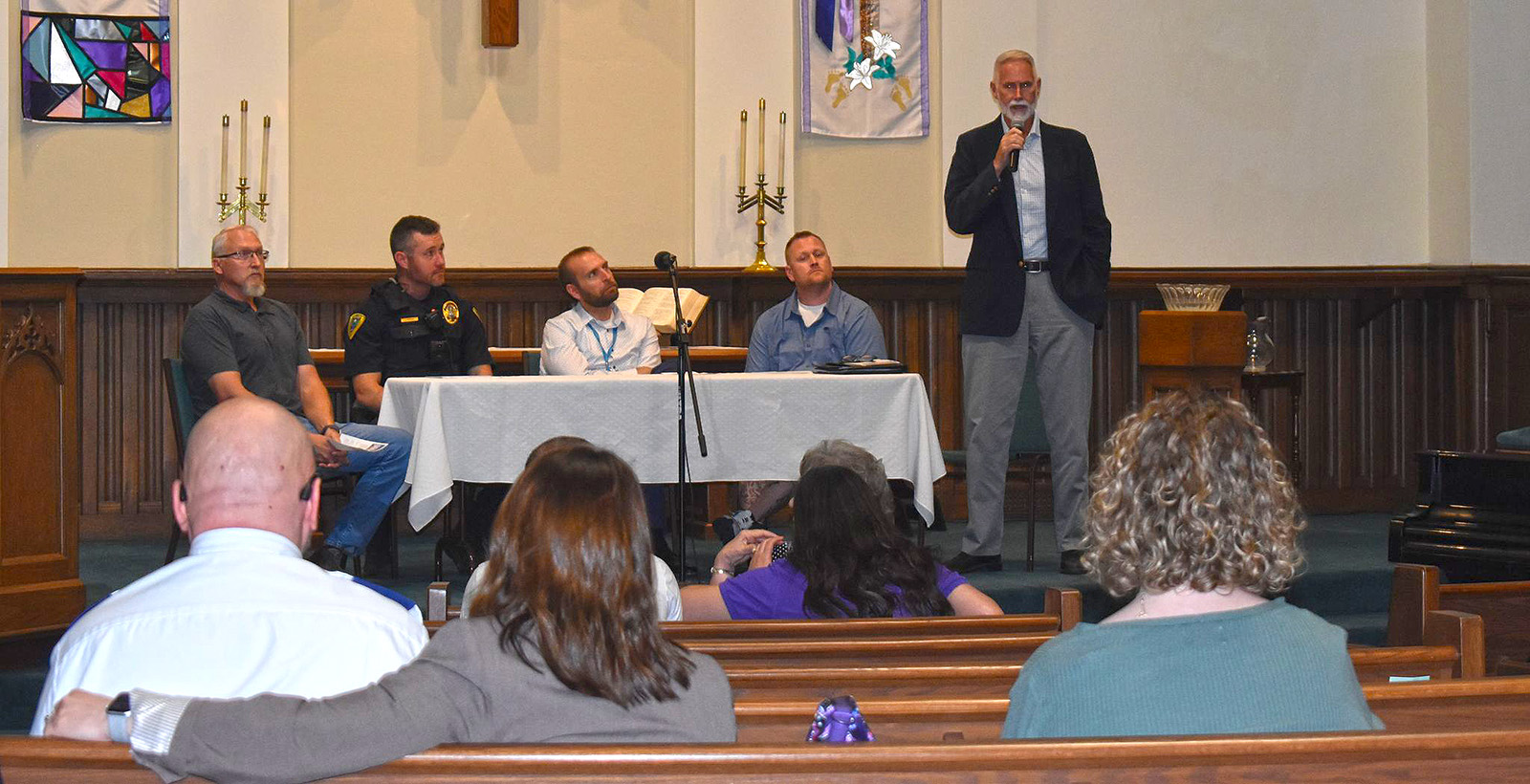
With the issue of homelessness becoming more and more widely discussed in Jacksonville, a group of area churches convened to talk about how the community can help.
Jacksonville Area Conference of Churches convened its “Focus on Unhoused” meeting Wednesday at First Presbyterian Church. The meeting was the second gathering the conference had put on regarding homelessness, the first taking place in January at Spirit of Faith Soup Kitchen.
During the meeting, five panelists representing local government, law enforcement, faith leadership and treatment programs discussed what currently was being done to help the city’s homeless population and what guests could do to lend their assistance.
Among the panelists was Alderman Joe Lockman, who touched on a ban on public camping that the city implemented at its Jan. 26 meeting. Those found sleeping on public property or in a car parked overnight on city property will be penalized with fines starting at $25. The ban has been met with pushback and skepticism from residents, including questions of how they would pay.
People who are unable to pay the fines may perform volunteer work at “minimum wage rates” to work off the fees, Lockman said. The fines themselves were recommended by social service agencies to provide some kind of “accountability” for those individuals, he said. The ban is aimed at keeping people safe, he said.
“My concern was that people were sleeping five inches away from the street and cars and other people,” Lockman said. “It just wasn’t good. In my own head, I couldn’t wrap my head around allowing that to happen.”
Lockman also noted that a census on the city’s homeless population is expected to get underway sometime in the summer.
Several panelists shared their own experiences with homelessness and addiction, including Derek Davis, a representative for Jacksonville’s local Narcotics Anonymous group, New Beginnings. Davis said that the two issues were more intertwined than most people realized. In his own experience, addiction cost him stability and made life purely about survival, he said.
Homelessness is more than a housing issue, he said; many people experiencing homelessness have regular lives beforehand, but had something happen to them that made them “unravel” without a support system.
“How do you get a job when you don’t have an address?” Davis said. “How do you stay clean when you’re surrounded by chaos? How do you rebuild when you feel invisible?”
Several panelists made suggestions for what groups and residents in the city could do to help its homeless population. John Hutton, pastor of Go Church at 767 S. West St., said that the average person could help just by providing basic necessities, such as warm clothes and tarps in the colder months of the year. Matthew 25 Thrift Shop, which Hutton’s wife and co-pastor runs, provides showers and haircuts to those in need.
However, Hutton also stressed that homelessness is not a one-size-fits-all problem.
“Here’s the problem: there’s not ‘a’ solution,” he said. “If you take every homeless person, that’s how many solutions there are.”