
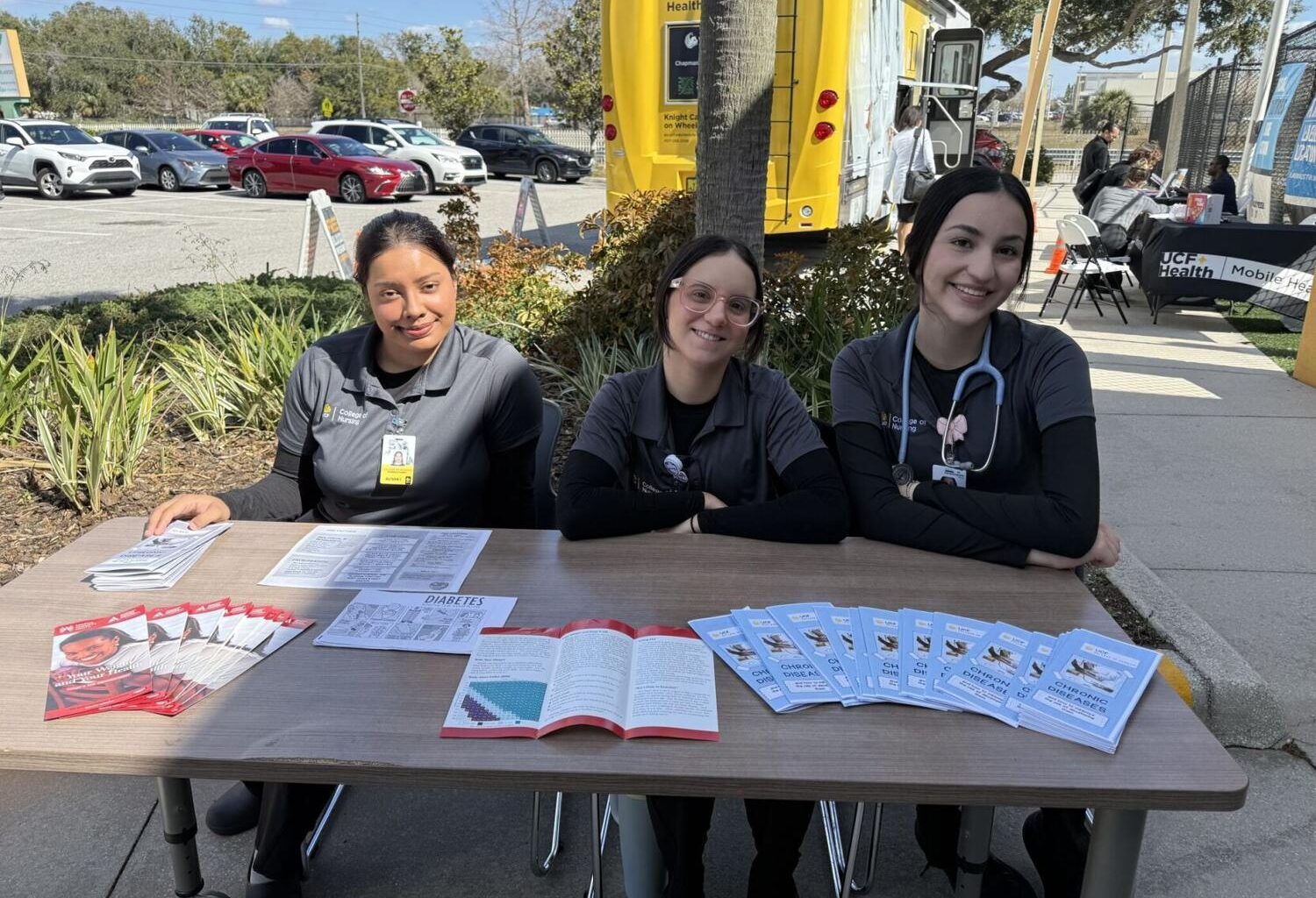

Senior nursing students Alisha Inshanally, Gabriela Coquieri and Genesis Castillo (from left) spreading awareness about chronic disease prevention with the College of Medicine Mobile Health Clinic at the South Orlando YMCA in February. During their public health nursing clinical rotation, they worked directly with Orlando communities to provide accessible healthcare and education.
Courtesy of Gabriela Coquieri
In a sterile, fluorescent hospital hall, a single nurse rushes from patient to patient, juggling more than they safely should.
For many nurses across Florida, this isn’t an exception; it is their reality.
Florida faced a shortage of approximately 19,840 registered nurses in 2022, according to the Florida Center for Nursing. That shortage is expected to reach 37,000 RNs by 2035.
UCF’s College of Nursing, with an accelerated bachelor’s in nursing program that ranks sixth in the nation, works to prepare nurses for the field and fill that gap.
In fall 2025, 2,568 undergraduate nursing students were enrolled — the highest enrollment the college has had in the past five years.
UCF also produces the most nursing graduates of all Florida state colleges, with 25% of all nursing bachelor’s graduates in the state being Knights in 2023-24.
Yet the shortages don’t stop in Florida — they are an issue nationwide. Federal projections show the need is only accelerating.
The Bureau of Labor Statistics projects employment for registered nurses across the nation to grow by 5% from 2024 to 2034, which is faster than the average for all occupations.
In the Sunshine State, an aging population intensifies the issue.
Florida has the third-highest concentration of seniors in the United States, with 21.74% of the population being seniors as of 2023. That leads to more assisted living communities and nursing homes, which require more nurses.
Despite Florida’s growing demand for nurses, wages remain relatively low.
Florida ranks No. 31 in the United States for RN salary, with an average of $42 an hour, according to Nurse.org. That’s $30 less than California, which has the highest average RN salary of $72.
Aspiring nurses say they are noticing this. LanAnh Tran, second-year nursing student, said that many people want to be nurses but question the career because of the wages and the harmful environment.
“I think that’s the biggest hinder with nurses as well,” Tran said. “They’re not able to support themselves.”
Some nursing students, like Gabriela Coquieri, senior nursing student, plan to work in another state after graduation.
“I want to go to Georgia,” Coquieri said. “The pay is better, and I just like it more.”
The problem goes beyond getting more nurses to enter the field. Nurses not only need to enter the field, but also need to be retained.
According to the Florida Hospital Association, 32.1% of registered nurses stay in their place of employment for less than a year, and 35.1% stay for 1-2 years.
A chart from the Florida Hospital Association depicting the average duration before departure of different nursing positions. According to the chart, a majority of nurses do not stay longer than two years, leading to high nurse turnover.
Courtesy of Florida Hospital Association
On the other side of the nation’s coast, a similar nursing shortage is felt, according to Nurse.org.
Nathan Evans, associate vice chancellor of academic affairs for California State University, spoke at the Working for Change: Solving the Nursing Shortage forum, hosted by The Chronicle of Higher Education.
Evans said different institutions must collaborate to standardize their academic pathways and work with employers to inform curricula, ultimately opening more opportunities for students.
Like Florida, California is also struggling with high nurse turnover.
“Production of nurses was close to sufficient, but turnover and retention remain major challenges,” said Dr. Kenyatta Lovett, a principal for Education Strategy Group, a higher-education consulting firm.
Working conditions and strain on nurses are exacerbating the problem.
The American Association of Colleges of Nursing said one major contributing factor impacting the nursing shortage is insufficient staffing, raising the stress level of nurses, reducing job satisfaction, and driving many nurses to leave the profession.
Coquieri said if she were an ICU nurse, she could feasibly take care of one or two patients to care for them properly.
“They’re giving me five,” Coquieri said. “How am I supposed to take care of them safely?”
Lack of nursing school faculty is another major factor the American Association of Colleges of Nursing attributes to nursing shortages.
“Some nurses don’t even get lunch breaks,” said Genesis Castillo, senior nursing student. “They just don’t have time.”
A Florida bill intended to crack down on low-performing schools failed to pass in March, according to the Orlando Sentinel.
The bill was meant to push back against the deregulation of nursing schools in 2009, in light of an FBI investigation that charged over a dozen Florida nursing school operators with selling fake degrees.
UCF’s nursing program has 79 faculty members as of fall 2025, including Dr. Fayshonda Cooks, a registered nurse and lecturer for the College of Nursing.
Cooks said the College of Nursing partners with the community to prepare nurses for real-world care, working with local health centers, city and county programs, and health departments across Central Florida.
“We make sure that the students are not just exposed…but getting an opportunity to have experience,” Cooks said.
The Orlando Sentinel reported that Florida has one of the worst passage rates in the nation on the National Council Licensure Exam, which determines whether nursing graduates can safely practice. Around 82% of test-takers score high enough to obtain their license. The national average is 87%.
However, more than 90% of nursing students at UCF pass the National Council Licensure Exam.
Solving the shortage isn’t only about passing exams and filling positions; patient care is at the forefront of UCF’s nursing curriculum.
“One of the things that I like to tell students is caring to care,” Cooks said. “And knowing that people are people before they are patients.”