
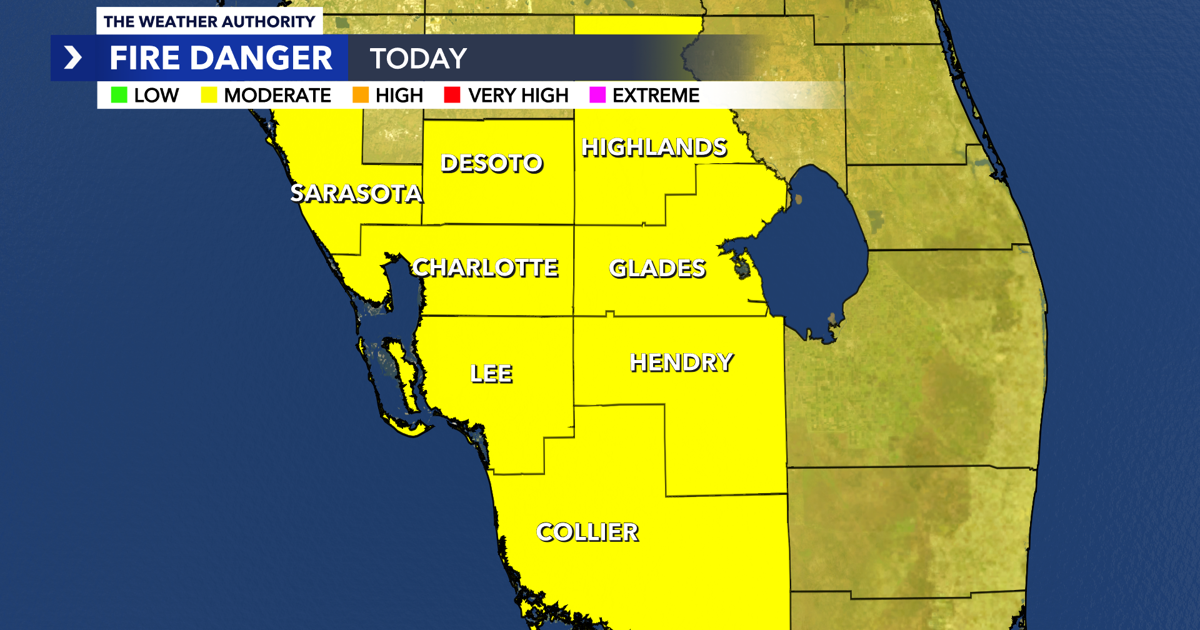
SOUTHWEST FLORIDA, (WINK) — At WINK News The Weather Authority, we closely monitor fire conditions across Southwest Florida, especially this time of year, when heat and dry stretches can quickly change the landscape.
Based on the latest data, the region is currently at a moderate fire danger level, with soil conditions ranging from dry to locally moist. This means the risk is not extreme, but it is also not negligible.
A moderate rating does not mean fires are unlikely. It means they can start under the right conditions and may require a response if they do. That’s why Weather Authority meteorologists work closely with the Florida Forest Service to monitor conditions and clearly communicate the risks to you.
Florida uses the Wildland Fire Danger Index (FDI) to determine daily fire risk. This index estimates how likely a fire is to start and how difficult it could be to control. It relies on two primary factors: the Energy Release Component and relative humidity.
The Energy Release Component (ERC) measures how much fuel is available to burn and how intensely a fire could behave. It accounts for both live and dead vegetation and reflects drying trends over the past week. Because it evaluates multiple days rather than just one, it does not fluctuate dramatically day to day. When ERC values rise, it signals that vegetation is drying out and becoming more capable of sustaining a stronger fire.
Relative humidity plays a different role. It measures how much moisture is in the air compared to how much the air could hold at a given temperature. Lower humidity allows fuels like grass, brush, and trees to dry more quickly, making ignition easier. However, low humidity alone does not automatically create high fire danger—it becomes more significant when combined with dry fuels.
This interaction is why both ERC and humidity are used together. For example, after a soaking rain, vegetation may remain too wet to burn effectively even if the humidity drops the next day. In that case, fire danger stays lower because the available fuel is not ready to support fire growth. The FDI is designed to reflect this balance, providing a more accurate day-to-day assessment.
Another important factor is soil dryness, often measured by the Keetch-Byram Drought Index (KBDI).

This index tracks how much moisture is stored in the ground and in organic layers, like leaf litter. It ranges from 0 (fully saturated soil) to 800 (extreme drought). The number rises during dry periods and falls when meaningful rainfall occurs.
At the moment, Southwest Florida is in extreme drought, but that designation by the U.S. Geological Survey doesn’t tell the entire story.
Soil moisture is still present in parts of the region, which is helping prevent fire danger from rising further. Measuring dryness across Florida is not simple. Rainfall is often uneven, driven by scattered thunderstorms that can bring heavy rain to one location while leaving another completely dry. To account for this, the National Weather Service provides radar-based estimates, which are combined with ground observations to create a more accurate picture of rainfall and drought conditions.
The takeaway is that Southwest Florida is in a relatively stable position today, but not a risk-free one. Moderate fire danger means conditions are dry enough in places to allow fires to ignite and spread under the right circumstances. With continued warmth and limited rainfall, that risk can increase quickly.
We will continue working closely with the Florida Forest Service to monitor changes and keep you informed.