
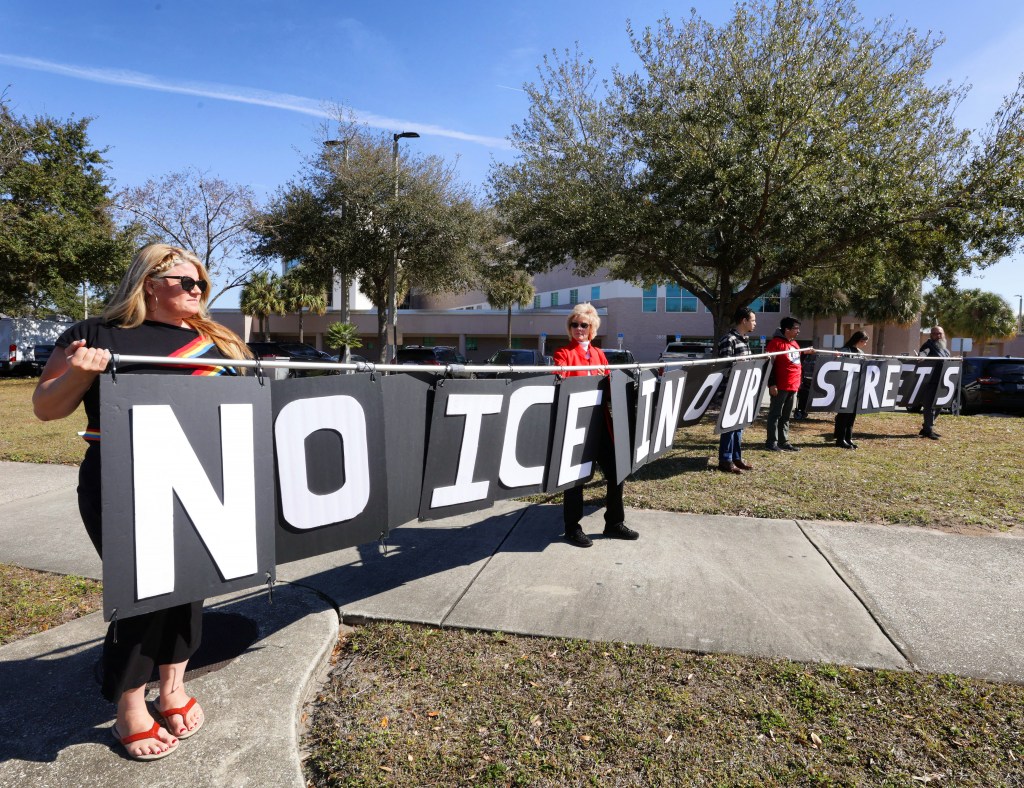
Orange County leaders may make a big change to the county’s deal with Immigration and Customs Enforcement next week — one that would potentially keep fewer immigrant detainees in local custody for a shorter period of time.
Some county commissioners are signaling they’ve lost patience with key terms in the controversial current agreement, which essentially establishes the Orange County jail as a regional detention center — and does so at great expense, since the federal government refuses to pay what the county contends it costs to house the apprehended immigrants.
“Why are our taxpayers paying for detainees that came out of other counties?” asked Commissioner Kelly Martinez Semrad, who is trying to convince her colleagues to back a new form of agreement that, she says, “stops that from happening.”
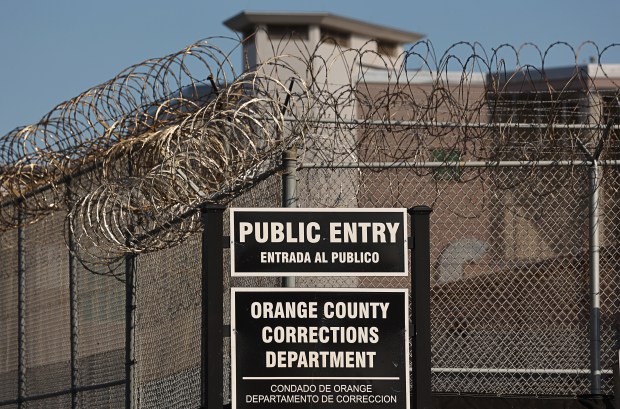 Signs outside the Orange County Jail and Booking and Release Center, on Friday, January 31, 2025.
(Ricardo Ramirez Buxeda/ Orlando Sentinel)
For months, the county has sought to renegotiate how much it’s reimbursed by the feds to house inmates and immigration detainees. The decades-old Intergovernmental Services Agreement, or IGSA, between Orange County and the federal government currently pays the county $88 per day per immigrant, but county officials contend the actual cost to house each immigrant is $180 per day.
However, the most recent offer by the U.S. Marshals Service would only increase the reimbursement to $125 per day – a 42% hike, but still short of closing the claimed deficit. Pinellas County, meanwhile, negotiated an increase in its reimbursement from $118 per day to $138 per day, according to a county briefing sheet.
That gap has led Orange County to consider insisting upon a separate, different agreement with ICE, known as a Basic Ordering Agreement or BOA, an option which appeared to draw the most attention at an advance meeting of four commissioners on Thursday. The formal, full-board discussion of the issue comes Tuesday.
Under a BOA, ICE would be allowed to detain at the Orange jail only those immigrants who are facing criminal charges and who were apprehended within the county’s boundaries. And federal authorities would only be able to stow them at the jail for up to 48 hours after charges are resolved.
Under the current IGSA, the feds have placed detainees facing solely immigration violations and no criminal charges in the jail.
The current IGSA also allows ICE to bring people arrested in neighboring counties to Orange County’s 33rd Street Facility, and hold them there for up to 72 hours after any criminal charges are resolved. County attorneys have also said they can’t release somebody at that point without a court order, potentially keeping immigrants in custody longer.
A BOA reimburses local jails at a different rate than the IGSA. Jails with such an agreement are paid $200 total per detainee for a 48-hour stay — $50 from the feds and $150 by the state. But Semrad said the BOA still would greatly reduce the number of immigrants detained there and thus reduce the deficit faced by the county.
“We should be moving to a BOA agreement, where we’re only taking in Orange County detainees – not other counties – and we’re only holding them for 48 hours. We should be moving into a model where we’re still coming out at a loss, but it’s a lower cost,” Semrad said.
If a BOA had been in place last year, 111 people arrested in Orange County in October on local charges and facing an immigration hold would have been eligible to be housed at the jail . At a reimbursement of $100 per day through the BOA, county taxpayers would have been on the hook for $17,760 — the cost of the unreimbursed expense to house those immigrants for the number of days each was there, according to data compiled by Semrad’s office.
Under the existing IGSA, 550 people were detained in October at a cost of $180 per day. After being reimbursed by the feds at the $125 rate, county taxpayers were on the hook for about $91,000, the data shows.
While BOAs generally allow for a detainee to be released 48 hours after a charge is resolved, they also have language that allows ICE to restart the 48-hour clock by filing a form. Under the current IGSA, the county is considered a 72-hour detention facility.
The issue was hashed out by four of the county’s six commissioners Thursday at a publicly noticed “sunshine meeting,” hosted by Semrad and attended by Commissioners Mayra Uribe, Mike Scott and Maribel Gomez-Cordero. Both Scott and Gomez-Cordero also seemed interested in the idea of the narrower agreement with ICE, but they said Friday they wanted to wait until next week before making a decision.
A fifth commissioner, Nicole Wilson, has said she supports removing ICE from the county IGSA — while keeping it in place for other federal agencies — but she wasn’t committed to then signing a separate BOA with ICE, even though state law requires a county to have some form of detention agreement.
Uribe, a candidate for county mayor later this year, agrees with Semrad’s position. She said the shorter stays mandated by the BOA were appealing, as they would ensure a person isn’t detained indefinitely and also limit the county’s expense.
“The longer a detainee is under our corrections division, the more services are provided,” she said. “The medical services, the medication, all of those things that is making that cost so much more than what the federal government is compensating us.”