
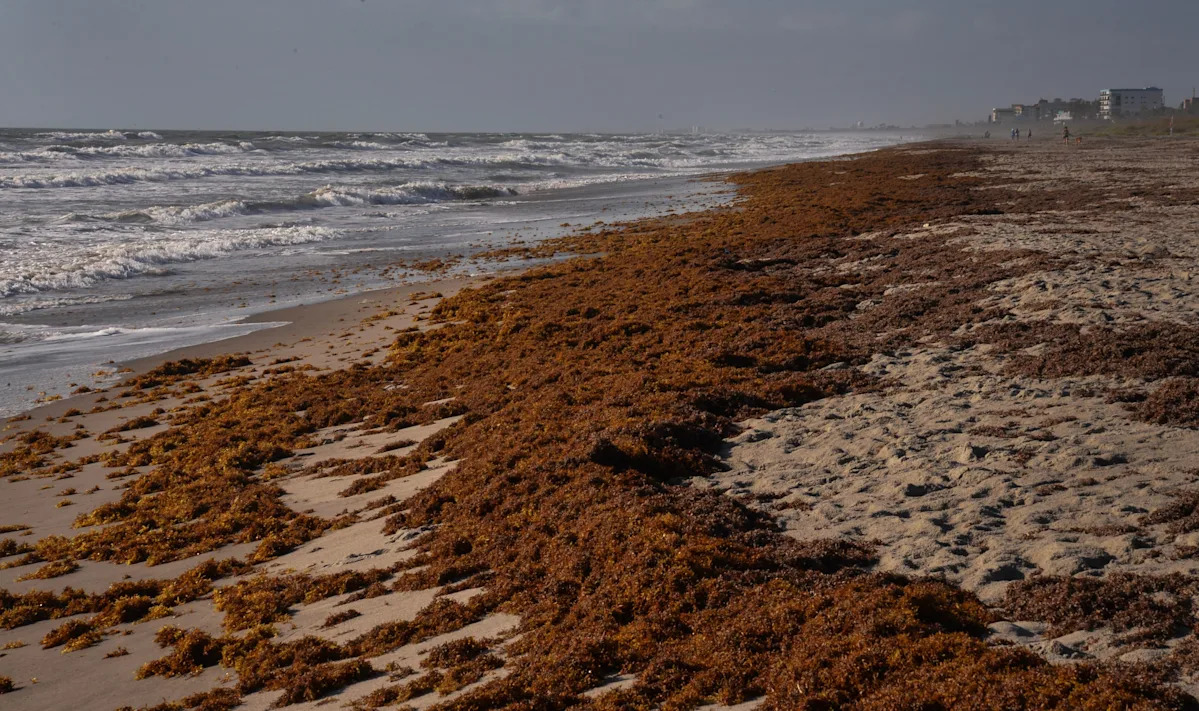
It’s back, again.
Sargassum, the stinky, slimy bane of beachgoers worldwide, is forecast to swarm over Florida’s beaches this summer, experts say.
“2026 is set to be another major sargassum year, and likely a record year,” according to scientists at the University of South Florida.
Specifically, Florida’s East Coast is bracing for another sargassum onslaught as the thick, smelly seaweed appeared in places such as Cocoa Beach in April.
What is sargassum?
Sargassum is floating macroalgae that has inundated beaches in Florida and the Caribbean since 2011, damaging tourism, harming the health of humans and marine life and costing local governments millions of dollars a year to clean up.
It is also a lifeline for fish nurseries, hungry migratory birds and sea turtle hatchlings seeking shelter in its buoyant saltwater blooms.
But in mass quantities, it chokes life from canals, clogs boat propellers and is a killjoy at the beach, piling up several feet deep like a rotting bog emitting hydrogen sulfide – which smells like rotten eggs – as it decomposes. It can irritate the eyes, nose and throat.
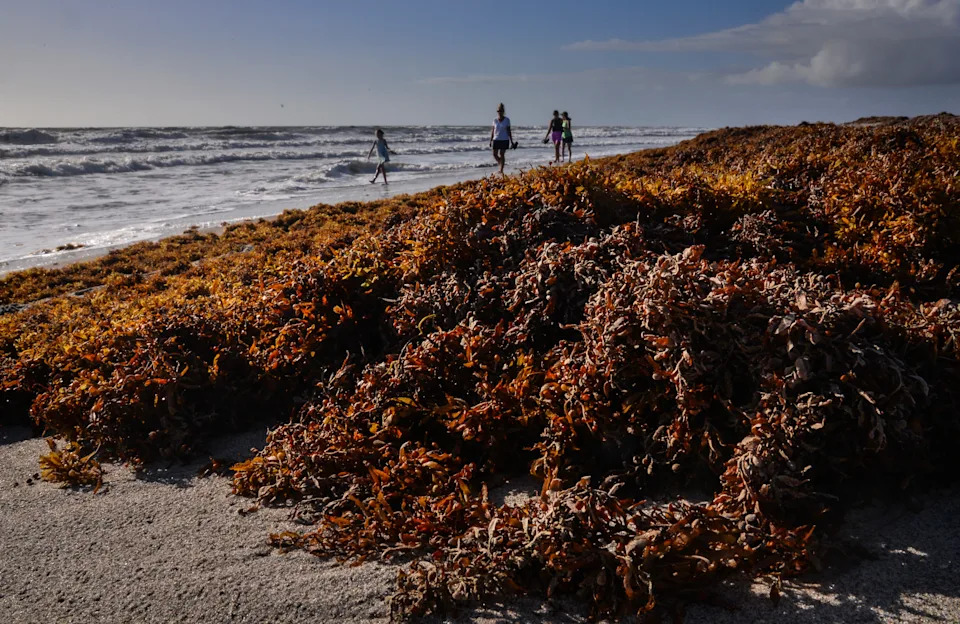
Rough seas and winds have brought sargassum seaweed ashore along beaches on the Space Coast. It is not unusual, but a seasonal thing for Florida beaches.
Brace for record ‘sargassum summer’
Scientists at USF, using satellite data, have been finding record masses of sargassum seaweed floating in the waters near Florida in recent years, way beyond what early Spanish explorers likely saw. Coastal pollution and climate change help fuel the excess growth.
And in 2026, USF researchers forecast another record for masses of the stringy stuff beaching in Florida. It’s worse now in the Caribbean and the Keys but on its way to southeast Florida, as storms push more seaweed toward the state.
“Sargassum amount in most regions will continue to increase in the coming month,” USF’s March 31 sargassum bulletin says.
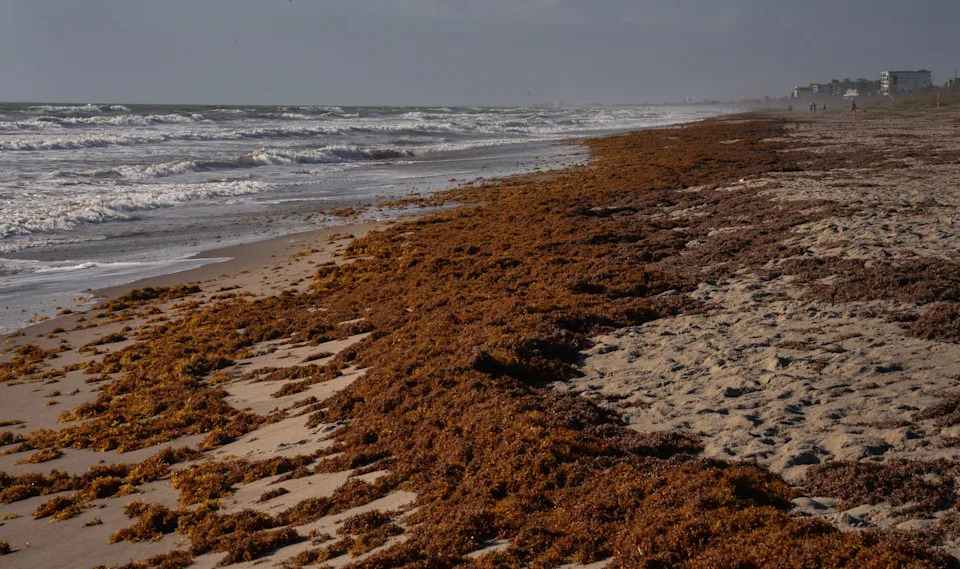
Rough seas bring Sargassum seaweed ashore in Cocoa Beach.
Is it safe to swim in sargassum?
Sargassum is generally safe to swim in but can turn the water an uninviting brown and be uncomfortable when it scratches your skin.
Additionally, tiny sea creatures that live in sargassum (larvae of jellyfish) can irritate skin if you touch them, according to the Florida Department of Health.
When the seaweed rots, hydrogen sulfide gas is emitted, which smells like rotten eggs. That gas can irritate your eyes, nose, and throat. Those with asthma or other breathing illnesses are more sensitive to hydrogen sulfide and may have trouble breathing after inhaling it.
Recent study: Seaweed costs Florida billions per year
A recent study by the Woods Hole Oceanographic Institution estimates sargassum’s economic impact to Florida may be in the billions. That’s via fouled beaches, disrupted fishing, damage to coastal infrastructure and tourists that catch a whiff of sargassum blooms online and just cancel their hotel reservations.
“The Southeast region is the most impacted region,” Di Jin, a senior scientist at Woods Hole’s Marine Policy Center, and the lead author on the study, published in Harmful Algae, told FLORIDA TODAY in January. “It’s a huge economy there.”
By far, Palm Beach, Broward, Miami-Dade and Monroe counties see the worst total economic impacts, as high as $10.2 billion, the study estimates.
Overall, the yearly economic fallout from sargassum could be as high as $13.5 billion statewide.
Climate change, pollution feed sargassum
Sargassum, which the Caribbean Sea delivers seasonally to the Gulf Stream and then Central Florida’s beaches, can dominate the surf zone, but usually only in the summer, to the bane of those fishing or surfing and all others who prefer weed-free wading.
Oceanographers have found sargassum seaweed and other macroalgae has been thickening on Florida’s beaches every year, due in part to climate change and more nutrients running off into Caribbean waters. Sargassum originates from the eastern Caribbean and spreads throughout Florida’s East Coast and elsewhere.
Since 2011, the Caribbean region has seen increasing buildups of sargassum onshore and in coastal waters. The algae blooms stretch from West Africa to the Caribbean and Gulf of Mexico, renamed by the U.S. government as Gulf of America.
Why can’t the seaweed just be cleaned off Florida beaches?
In Palm Beach County, for example, beach managers are often constrained by turtle nesting season, which began March 1. Most cities have specially licensed contractors who use tractors to clear the sargassum at least twice a week, but they are confined to areas below where turtles may nest.
Contributing: Kimberley Miller, USA TODAY NETWORK
This article originally appeared on USA TODAY: Sargassum seaweed forecast predicts record year for Florida beaches