
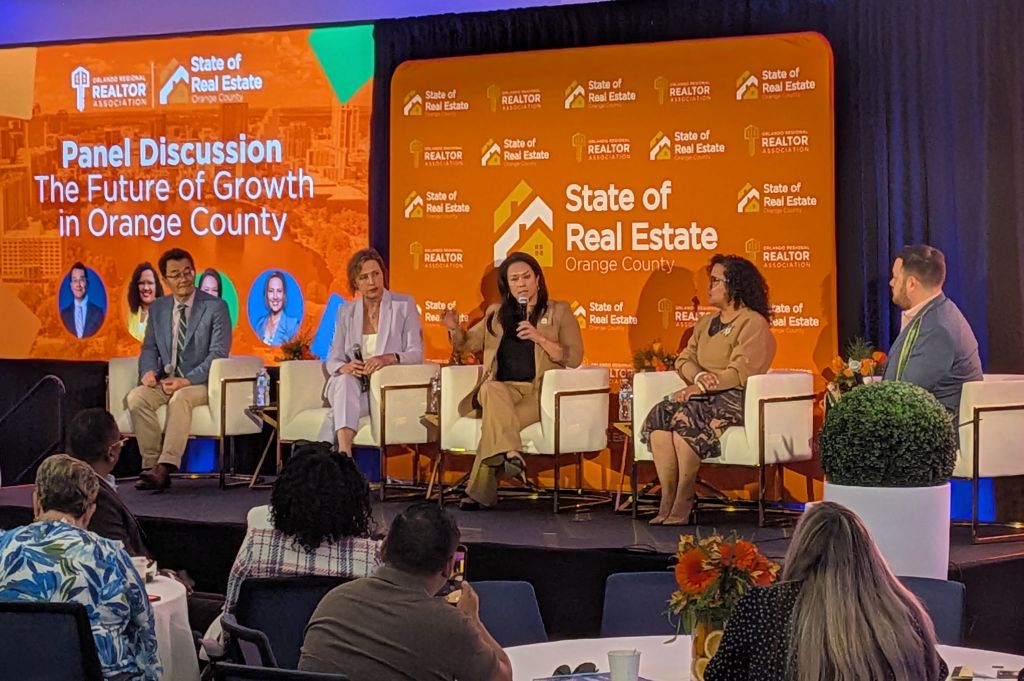
While it may not be news to the hundreds of Realtors who turned out last week for ORRA’s State of Real Estate in Orange County event, it was no doubt welcome to hear.
Orlando’s real estate market is thriving, and it’s doing better than the rest of the country, according to Dr. Lawrence Yun, chief economist for the National Association of Realtors, who pointed to the region’s 2.8% year-over-year increase in home sales in February.
“The rest of the country is zero or slightly negative, but Orlando is squeezing out a little gain,” Yun said. “But prices are lower this year compared to last year.”
The average home sale in the five-county region declined by about $15,000 from the previous year. In Orange County, home prices have grown 13.3% over the last three years.
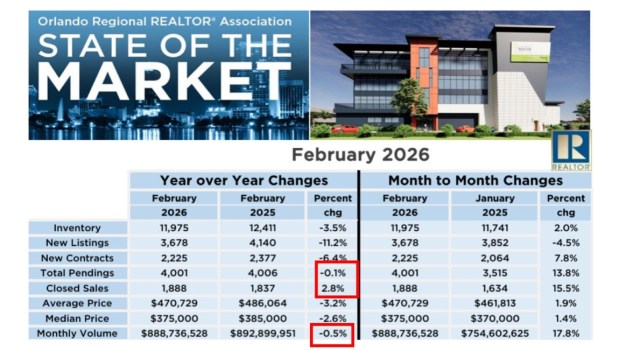 Orlando’s real estate market is healthier than the U.S. as whole. Total home sales in February were up 2.8% since January 2025, but home prices were slightly down. The average sale price was down about $15,000 year-over-year, or 3.2%. (Source: National Association of Realtors)
Here are nine more interesting facts we gleaned from the event:
Orange County’s tax roll has increased from $228 billion in 2021 to about $331 billion in 2025, or 53% over five years, according to Property Appraiser Amy Mercado.
“And this is where it breaks. On the residential side, that’s $176.9 billion, and this is the first year that residential actually surpasses commercial,” Mercado said.
Orlando’s population continues to grow by about 1,200 people per week, and those new residents are creating jobs and buying homes. So even if the U.S. economy experiences even modest growth, Orlando will outperform it. Yun is projecting sluggish GDP growth of about 1% this year. “Whatever happens to the country percentage-wise, here in Orlando, it will easily outpace — maybe twice as fast as the country,” he said. “So expect more people moving in, more people finding a job. And the most unique aspect is how many of the new jobs in Orlando will begin to transition from tourism-related industries to other businesses.”
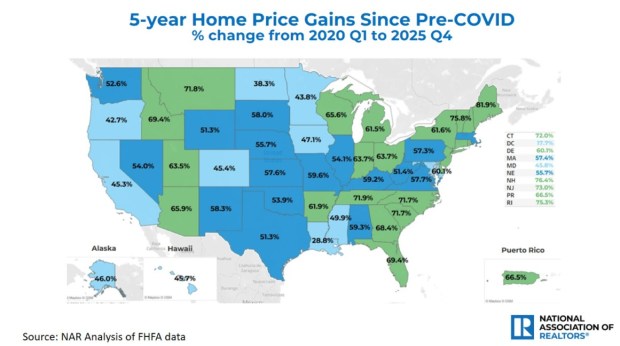 Florida home prices have risen nearly 70% since the COVID-19 pandemic. In Orange County, residential home values now exceed commercial properties for the first time. (Source: National Association of Realtors)
But tourism continues to be the region’s primary economic driver. In 2024 alone, Orlando welcomed 75.3 million visitors, making it the most visited destination in the U.S., according to Maria Henson, Visit Orlando Senior Director of Market Research & Insights. “Visitors spend about $164 million in this community every day,” she said.
About 90% of visitors to Orlando are domestic travelers. International tourists comprise about 10% of the total visits, but travel is down from Canada and Europe. One nation that is visiting more is Japan.
“Now, notice here that the US lost 6% of total international visitation last year,” Henson said. “We’ve only lost about 2.4%, so we have fared much better.”
Visit Orlando projects that international tourist visits will grow by 6% in 2026. “We’re looking at solid numbers of international visitor arrivals, and they’re important for us,” Henson said. “They stay longer and do end up spending more with our community. …So, this is really a great number for us to see.”
The Orlando metro is second only to Las Vegas with 105,000 hotel rooms. Hotel demand, or total room nights, grew by a healthy 2% in 2025, largely due to the opening of Epic Universe. But new hotel construction has dropped in half from the over 1,900 rooms added in 2025.
“We’re probably going to add less than 1,000 rooms to the inventory by the end of 2026,” Henson said. “So, occupancy is going to be able to build up a little bit. So, the demand and rates and the ADR are going to gain about 2% by the end of this year, which is really healthy.”
The next few years will also see significant changes in mobility, as the Central Florida Expressway Authority advances several key toll road projects. CFX Spokeswoman Racquel Asa said the toll road agency will start construction on two major projects: the S.R. 408 improvements between I-4 and Tampa Avenue and the 14-mile Osceola Parkway Extension.
Asa said the S.R. 408 project will take three years to complete, but the local road improvements should be finished by April 2027.
The first segment of S.R. 516 from S.R. 429 to S.R. 534 will open at the same time, and the entire corridor to U.S. 27 will open by 2029.
Have a tip about Central Florida development? Contact me at lkinsler@GrowthSpotter.com or (407) 420-6261. Follow GrowthSpotter on Facebook and LinkedIn.