
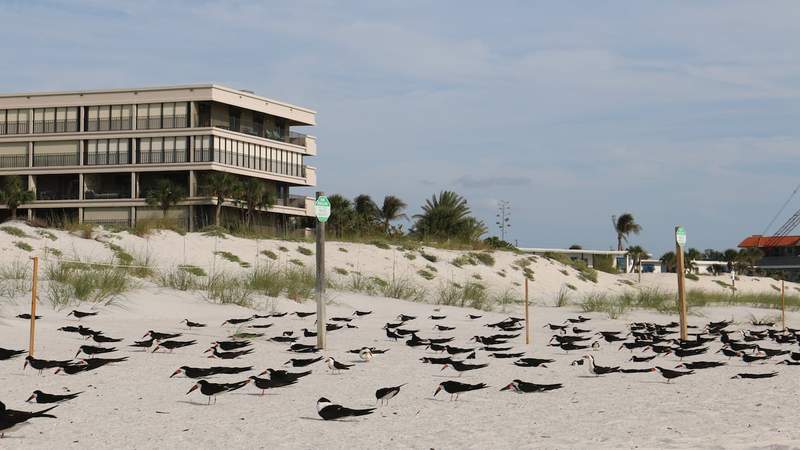
Florida wildlife officials are trying to determine who scattered hundreds of toxic mothballs Monday across a stretch of St. Pete Beach near a colony of protected black skimmers that had gathered near the dunes.
An acrid smell wafted in the air just west of the Lido Residences condominiums on Gulf Boulevard when the Tampa Bay Times visited the beach in the early afternoon. In a trash can nearby, a plastic bag was full of dozens of mothballs volunteers had collected during an hourslong cleanup.
Brian Ferguson, a senior officer with Florida’s wildlife agency who is investigating the incident, said he believes the person who spread the mothballs was trying to deter the skimmers from nesting on the beach.
“There are serious toxicity issues with these mothballs,” Ferguson said in an interview. “Our thoughts are that the individual put them out here to deter the skimmers from nesting on the beach, because nesting season is coming up.”
Skimmers are considered a state-designated threatened species by the Florida Fish and Wildlife Conservation Commission, with habitat loss from coastal development as the largest threat to the species.
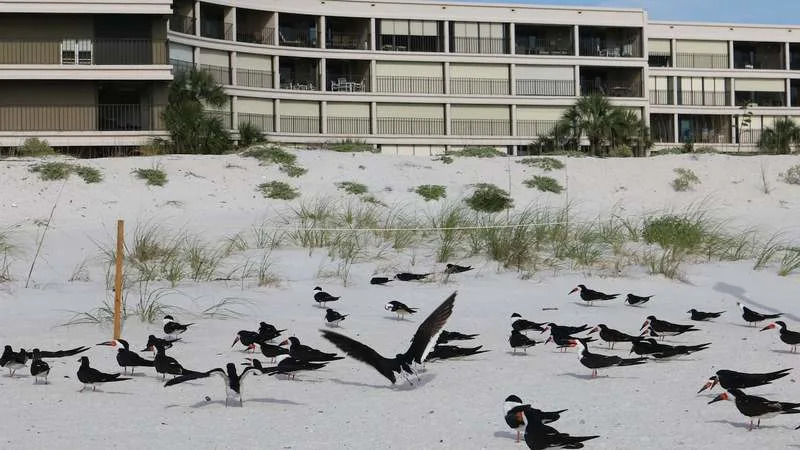
Ferguson said he was notified anonymously around 8 a.m. Monday. When he arrived to the shore, he joined about a half dozen beachgoers and Audubon Florida volunteers picking up as many mothballs as possible. The mothballs had stretched from the water’s edge to the top of the beach, he said.
Ferguson said he alone picked up about 200.
A Times reporter counted dozens of black skimmers, making nasally barking calls with their bright flashy necks and orange-brown beaks, gathered outside a cordoned-off dune beside the Lido Residences condominiums Monday afternoon.
Ferguson said he found mothballs “inches away” from the birds.
Mothballs contain high concentrations of chemicals like naphthalene and paradichlorobenzene, according to National Pesticide Information Center. It’s illegal to use mothballs in Florida as wildlife repellants because they can be harmful to people, pets and wild animals.
“Mothballs are intended for indoor use and should not be used to repel wildlife,” Florida wildlife agency spokesperson Shannon Knowles said in a statement. She said they are regulated at the state and federal level, and violations can result in citations and fines.
“Placement of them on the beach is harmful, as wildlife can ingest them whether on the sand or if blown into the water,” she said.
The agency encourages the public to report wildlife violations, and a person who provides information leading to an arrest could be eligible for a reward up to $1,000, Knowles said.
As of Monday afternoon, Ferguson said he had not yet identified a suspect but was continuing to investigate. A spokesperson for the agency’s law enforcement division did not immediately provide a copy of an incident report.
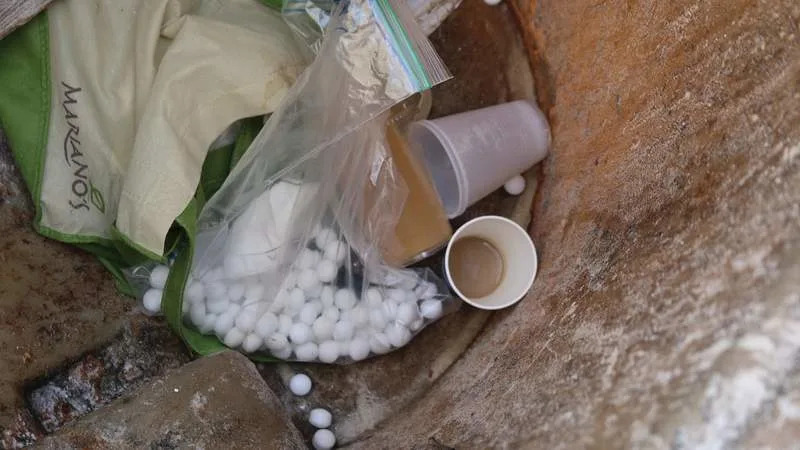
News of the cleanup quickly hit Nextdoor, a popular neighborhood social media app:
“I am absolutely disgusted,” wrote one St. Pete Beach user, Maryalice. “Obviously it was done to deter the skimmers from establishing their nests in this area… This is an environmental hazard and harmful to humans as well as to wildlife.”
She wrote that she had participated in the cleanup efforts with a handful of volunteers and together they cleaned up over 1,000 mothballs. Still, not all of them were likely found, meaning there’s still a risk to the birds.
People can report possible bird violations to the state’s Wildlife Alert Hotline by calling 888-404-3922.
The Tampa Bay Times launched the Environment Hub in 2025 to focus on some of Florida‘s most urgent and enduring challenges. You can contribute through our journalism fund by clicking here.