
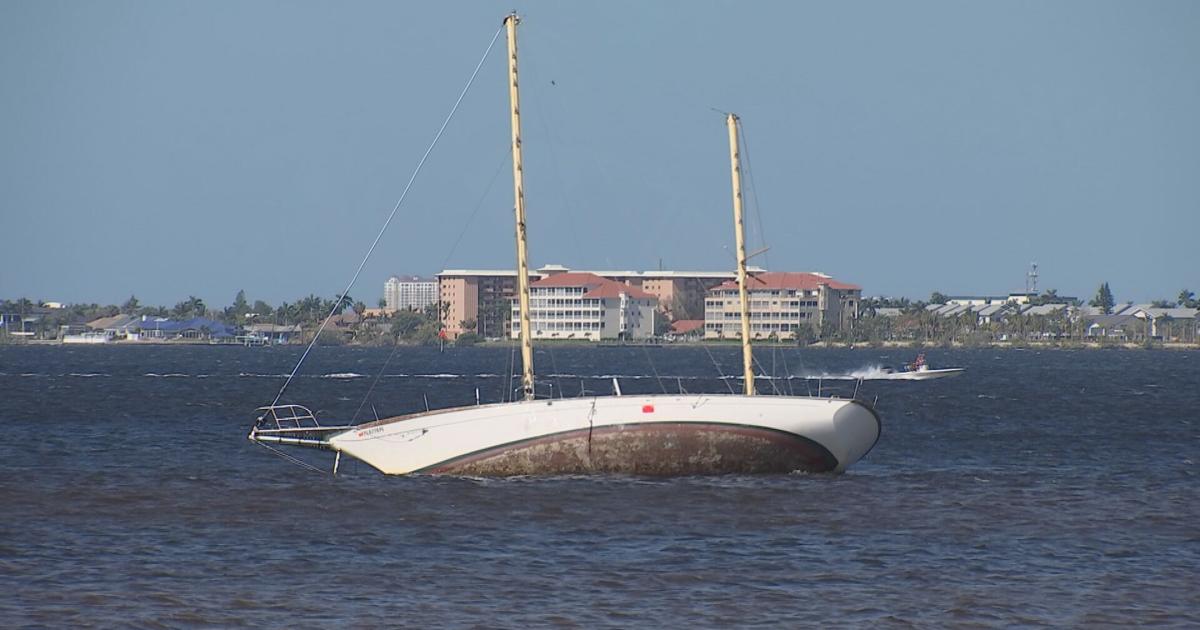
FORT MYERS, Fla. (WINK) — There may be relief on the horizon for Florida homeowners who say their waterfront properties have turned into “dumping grounds” for abandoned boats.
On Monday, Governor Ron DeSantis officially signed House Bill 1103 into law, a move that grants local municipalities significantly more power to clear derelict boats from their waterways. For residents along the Caloosahatchee River and across Southwest Florida, the news couldn’t come at a more critical time.
A Growing Problem
Jeff East, a resident living off McGregor Boulevard in Lee County, has watched his backyard view deteriorate over the last two years. What began as one washed-up sailboat has turned into a recurring nightmare.
“About two years ago, we had our first sailboat wash ashore,” East said. “Five weeks ago, we had another. Last week, a third. It’s become a dumping ground.”
The issue isn’t just aesthetic; it’s a matter of property damage and environmental safety. During this past weekend, East watched as an anchored, abandoned boat began to drift, eventually wedging itself against his seawall and a remaining dock structure.
Despite immediate calls to the U.S. Coast Guard and the Florida Fish and Wildlife Conservation Commission (FWC), East says the red tape involved in removing these vessels has historically been a slow, frustrating process.
What HB 1103 Changes
Previously, the authority to designate and remove derelict vessels rested primarily with state-level agencies. House Bill 1103 shifts that dynamic by allowing counties and municipalities to pass their own ordinances to take charge of the problem.
Under the new law:
Local Enforcement: Local jurisdictions can authorize code enforcement officers to administer and enforce provisions relating to vessels at risk of becoming derelict.Faster Intervention: By empowering local officers, the state aims to identify “at-risk” boats—those taking on water or poorly anchored—before they become full-blown derelict hazards.FWC Oversight: While local governments gain power, their specific ordinances must still be reviewed and approved by the FWC to ensure statewide consistency.
The law is set to officially take effect on July 1, 2026.
While the law won’t be fully active for a few months, local agencies in Southwest Florida are already pivoting to address the backlog.
The Lee County Sheriff’s Office (LCSO) confirmed they are working in lockstep with the FWC to mitigate environmental impacts. LCSO has already designated a specialized detective within its Marine Unit specifically to handle derelict boat cases.
In a statement to WINK Investigates, the Sheriff’s Office noted that their partnership is “constantly ongoing,” with plans to remove 15 derelict boats from Lee County waterways in the coming week alone.
The Race Against Hurricane Season
For homeowners like East, the legislative win is a victory, but the timeline remains a concern. With hurricane season beginning June 1, there is an urgent need to clear these vessels before they can be transformed into floating projectiles by storm surges.
“We need as many people saying the same thing as possible to get people to respond,” East said. “We’d like to have this resolved before the summer storms come up.”
East’s neighbor Jake Goldberger is also worried and hoping for a solution.
“Very destructive, there’s no question we’ve seen it. It’s a terrible thing to have to deal with after a storm,” he said.
WINK Investigates reached out to the FWC regarding the upcoming rule-making process for local ordinances but has not yet received a response.
Lee County said the matter hasn’t been discussed yet by the Board of Supervisors so would not lay out any plans on how it will utilize the new law.