
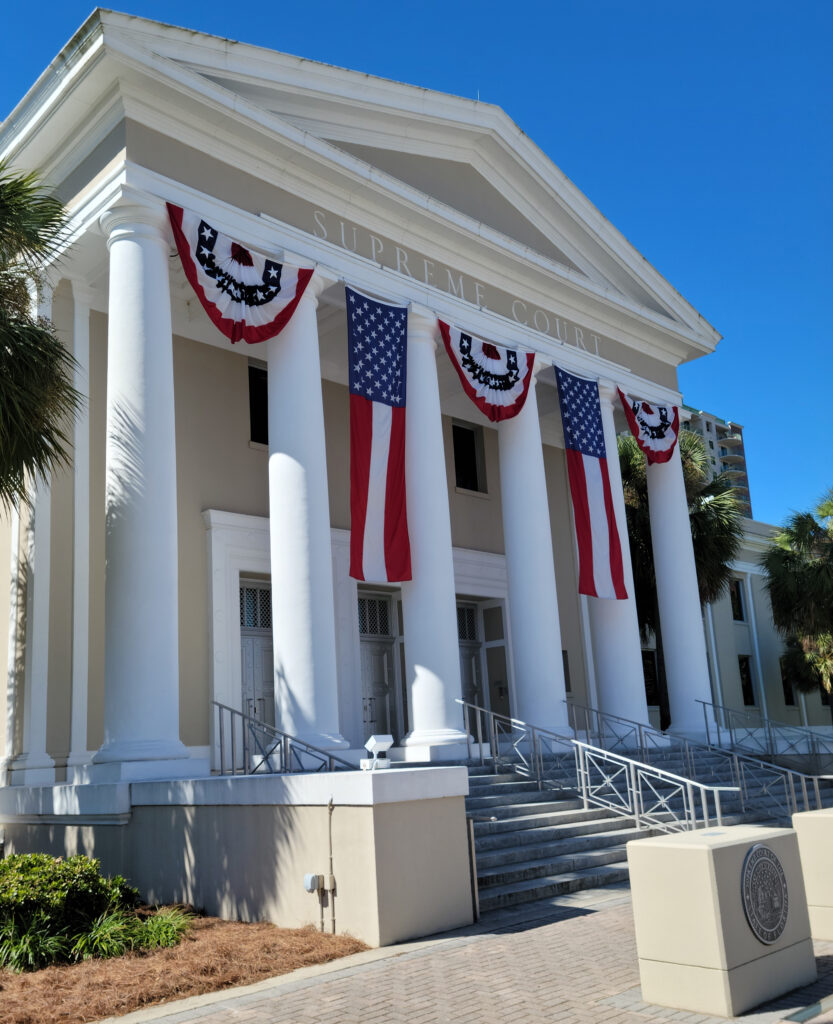
Do forwarded medical records trigger Florida jurisdiction?
 The Supreme Court will soon be asked to decide whether two New York doctors and the Memorial Sloan-Kettering Cancer Center can be sued in a Florida court for alleged malpractice by a patient who returned here for follow-up care.
The case centers, in part, on whether medical records the doctors forwarded to the patient’s Florida physicians constitute “products, materials, or things processed, serviced, or manufactured” under Florida’s “long-arm” statute.
The Sixth District Court of Appeal said “no” last year and affirmed the trial court.
The patient, Jennifer Palmer, had a tumor removed from her thigh at Sloan-Kettering when she lived in New York between 2012 and 2015, records show.
Palmer died in 2021 at age 34 after moving back to Orlando for further treatment, the records show. Her mother is named in the suit as a representative of Palmer’s estate.
The plaintiffs allege that the New York surgeon and a radiologist failed to detect the cancer that spread to Palmer’s bones and waited weeks after an MRI to schedule a follow-up visit.
The Sixth DCA found, among other things, that the plaintiffs failed to establish a “temporal” connection to the New York treatment. The forwarding of medical records doesn’t fit the long-arm statute’s definition, the Sixth DCA determined.
“While a report is certainly a ‘thing,’ the writing of a report does not constitute ‘processing,’ ‘servicing,’ or ‘manufacturing’ the report,” the opinion states. “The ordinary meaning of ‘processing,’ ‘servicing,’ or ‘manufacturing,’ a ‘thing’ does not include simply writing a written document.”
However, the Sixth DCA asked justices to resolve a conflict with a 2001 First DCA opinion, Dean v. Jones, that involved medical reports transmitted to Florida by an Alabama physician. The First DCA reached a different finding with regard to the reports, but the Sixth DCA stresses that the facts of the case “are very different.”
Dean held that writing a report and sending it to Florida “is precisely what section 48.193(1)(a)6.b. contemplates,” the plaintiffs stress.
Whether “injury in Florida” constitutes “a tortious act,” raises implications that stretch far beyond medical malpractice, the plaintiffs argue.
“Considering the unprecedented interconnectedness of the modern world, instances of Floridians being injured by nonresidents’ tortious behavior will likely only increase,” they wrote. “The time is ripe for this Court to resolve this conflict, thus clarifying and guiding the rights of thousands of these numerous, as-yet-unknown, future tort victims.”
The plaintiffs also argue that “alternatively,” Florida could exercise “general personal jurisdiction” over Memorial Sloan-Kettering based on a “Cooperative Research Agreement,” a “Data Collaboration Agreement,” and an “Alliance Relationship Agreement,” the center has with Baptist Health South Florida, a Coral Gables-based hospital.
The AMA and its Florida affiliate warn in an amicus brief that “exercising personal jurisdiction over out-of-state physicians” would risk the health of Florida patients who travel for specialty care.
“If specialists at Sloan Kettering, MD Anderson, the Cleveland Clinic and other facilities can be haled (sic) into court in Florida for alleged malpractice in their home states when transitioning or collaborating on patient care in Florida, they may be compelled to stop assisting Florida physicians to avoid the costs of such liability,” the amicus states.
The Supreme Court scheduled oral arguments for May 7.