
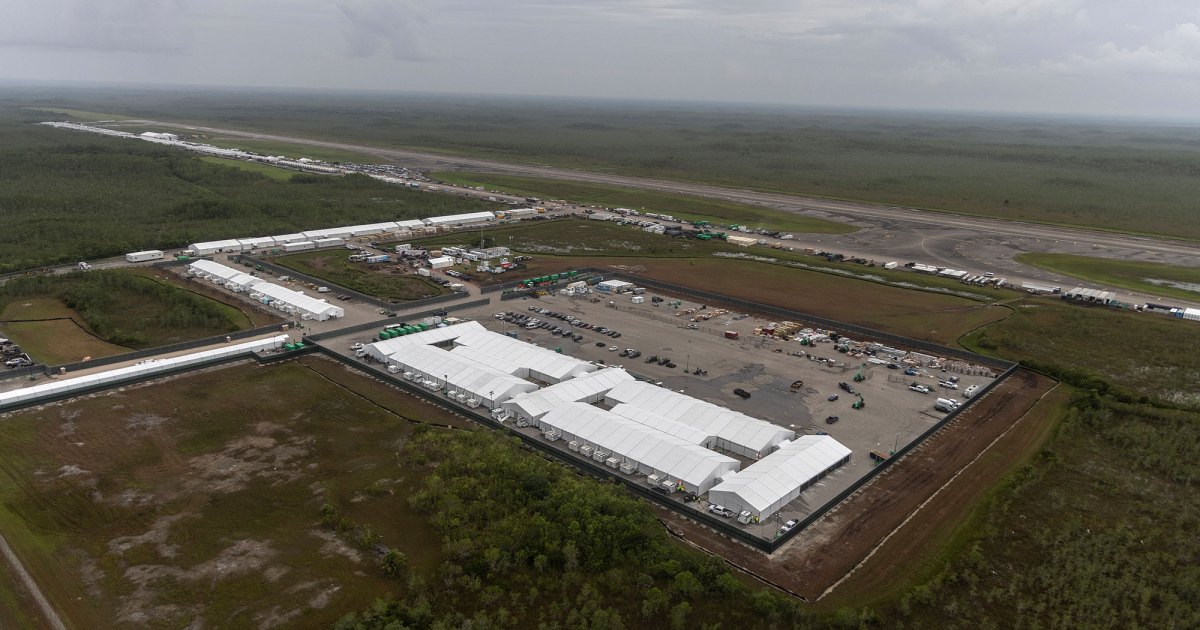
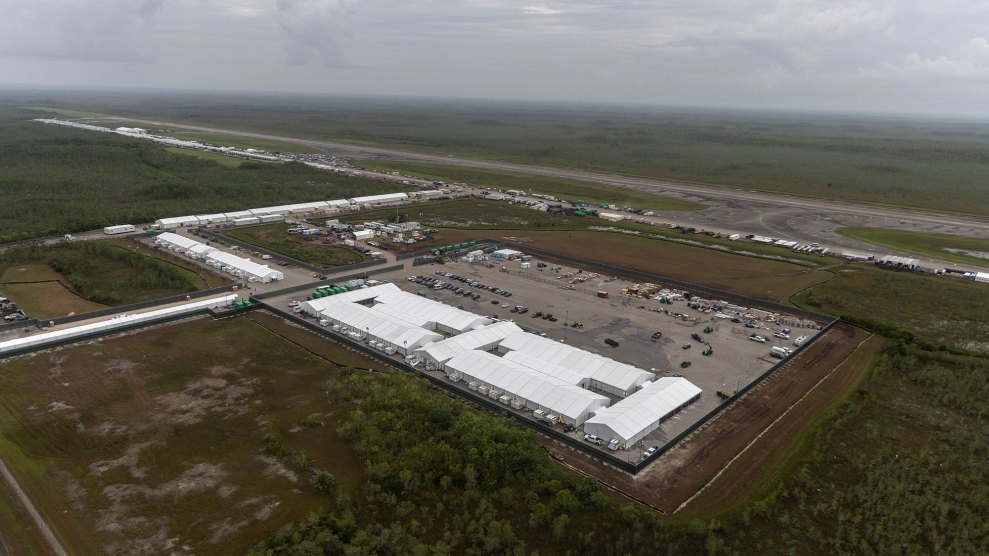
In an aerial view from a helicopter, the migrant detention center, dubbed “Alligator Alcatraz,” is seen located at the site of the Dade-Collier Training and Transition Airport on July 4, 2025, in Ochopee, Florida.Alon Skuy/Getty
Get your news from a source that’s not owned and controlled by oligarchs. Sign up for the free Mother Jones Daily.
The infamous Florida immigrant detention center known as “Alligator Alcatraz” can remain open, an appeals court ruled Tuesday, overturning a lower judge’s decision to close the facility because it violated federal environmental laws.
The ruling is the latest development in the months-long legal battle against the center, which was constructed in the Everglades last summer by Gov. Ron DeSantis’ administration when the Department of Homeland Security needed more detention space to house immigrants pending their deportations.
The center has come under fire for both its living conditions and its impact on the surrounding area. As I reported in March, thousands of people have been detained there despite ongoing reports of mosquito infestations, flooding, poor medical care, lackluster food, and limited water access. Last month, two US senators said they launched an investigation into reported abuses, including the use of “the box,” in which detainees were allegedly shackled and held in small cages in direct sunlight for hours at a time. (A spokesperson for the Florida Division of Emergency Management, which runs Alligator Alcatraz, told me recently that the allegations were “false.”) In recent weeks, the center landed in the spotlight once again after attorneys representing immigrants held there told a judge that guards had assaulted and pepper-sprayed detainees who protested after the phones were shut off, less than a week after a federal judge ordered legal access should be expanded at the facility.
Environmentalists have spent almost a year trying to shutter Alligator Alcatraz in an effort to protect the Everglades. The center was built on a little-used airfield next to the environmentally protected wetlands of Big Cypress National Preserve. “People get out, there’s not much waiting for them other than alligators and pythons,” Florida Attorney General James Uthmeier quipped in a video posted on social media late last June.
As I reported that month, environmental groups sued federal and state officials to halt the project. They argued that the construction had proceeded without an environmental review or opportunity for public comment, in violation of the National Environmental Policy Act (NEPA). They filed declarations in the case documenting how the camp could potentially affect the neighboring ecosystems and wildlife. Traffic to and from the detention site increases the likelihood of panthers being struck by vehicles, according to court filings, and light pollution could destroy the nighttime foraging abilities of bats in the area.
“Alligator Alcatraz will go down in history as a boondoggle to taxpayers and a flagrant assault on the Everglades.”
Florida and Trump officials argued that NEPA only applies to federal agencies, and that the facility was operated and funded by the state, which has spent at least $390 million to run it. But in August, a federal judge in Miami concluded that Alligator Alcatraz “exists for the sole purpose of detaining and deporting those subject to federal immigration enforcement” and ordered it to wind down operations within 60 days. The state of Florida appealed and the US Court of Appeals for the 11th Circuit blocked the judge’s decision, allowing Alligator Alcatraz to continue to operate.
Alligator Alcatraz has disrupted the vulnerable ecosystems that surround it, Eve Samples, executive director of Friends of the Everglades, one of the plaintiffs in the environmental lawsuit, told me last month. The high-intensity lighting, for example, has affected about 2,000 acres of habitat for the Florida panther, an endangered species with a population of about 200. “The evidence of that harm is clear,” she said in a phone interview.
The three-judge panel heard oral arguments in the case on April 7 and released a 38-page ruling late Tuesday afternoon. In the 2–1 decision, judges concluded that the environmentalists failed to prove Alligator Alcatraz was under federal control. Florida also hasn’t received any federal funding (though it is in the process of requesting reimbursement). “Federal authority is, at most, indirect: it is involved in the construction only insofar as it sets the terms for which the facility may be used for detention of aliens, but Florida officials dedicated its land to that use,” wrote Chief Judge William Pryor, who was appointed by President George W. Bush, in the majority opinion.
Judge Nancy Abudu, a Biden appointee, wrote in her dissent that immigration is ultimately a federal obligation and the majority’s ruling is “just plain wrong.” “So long as Florida remains a willing participant in the federal government’s immigration detention scheme, it subjects itself to the federal government’s substantial control over the parties’ joint efforts,” she wrote.
The case was sent back to the district court. “This fight is far from over,” Samples, the Friends of the Everglades director, said in a statement Tuesday night. “Alligator Alcatraz will go down in history as a boondoggle to taxpayers and a flagrant assault on the Everglades, and we look forward to returning to the District Court to advance our case to shut it down.”