
It had been a typical night for Ronald Wilson.
Just before midnight on Feb. 16, Wilson was headed home after spending time with friends, his daughter Megan Wilson told the South Florida Sun Sentinel.
But as Wilson, 73, tried to drive his truck across an intersection in Tamarac, he was caught in the middle of a Broward Sheriff’s Office pursuit.
A K-9 deputy was pursuing Sean Paul Holder after allegedly committing an aggravated battery on a law enforcement officer, a probable cause affidavit said. The K-9 deputy tried to stop Holder, who was fleeing in a stolen Jeep Cherokee, using a PIT maneuver, a controversial technique in which an officer’s cruiser forces a suspect’s car to spin out, according to the affidavit.
But Holder ran through a red light, and the deputy followed, crashing into the driver’s side of Wilson’s truck. Wilson was pronounced dead at a hospital an hour later.
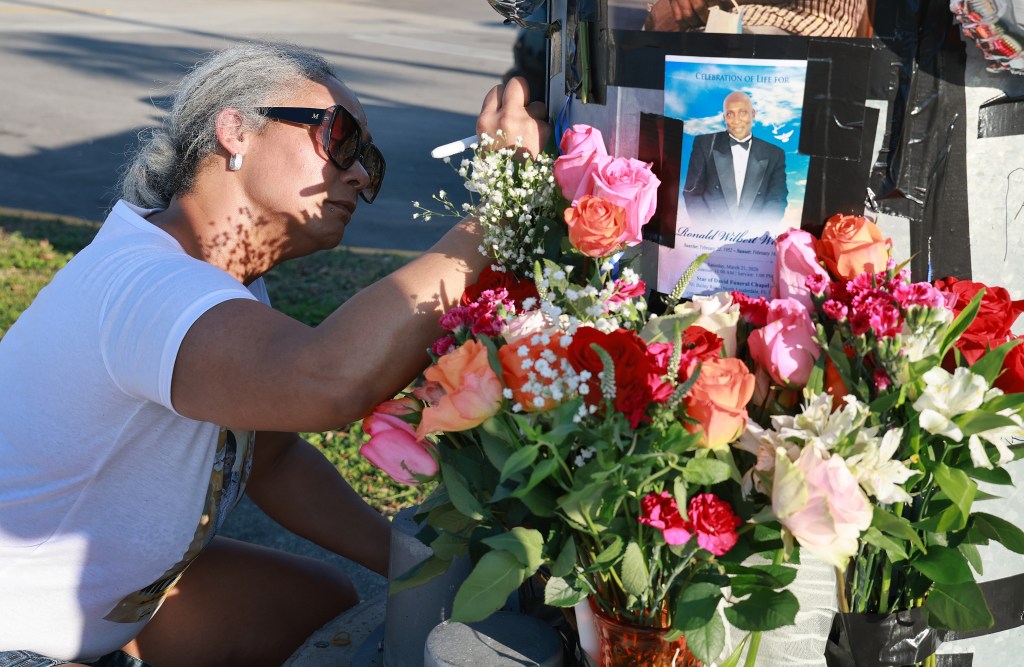
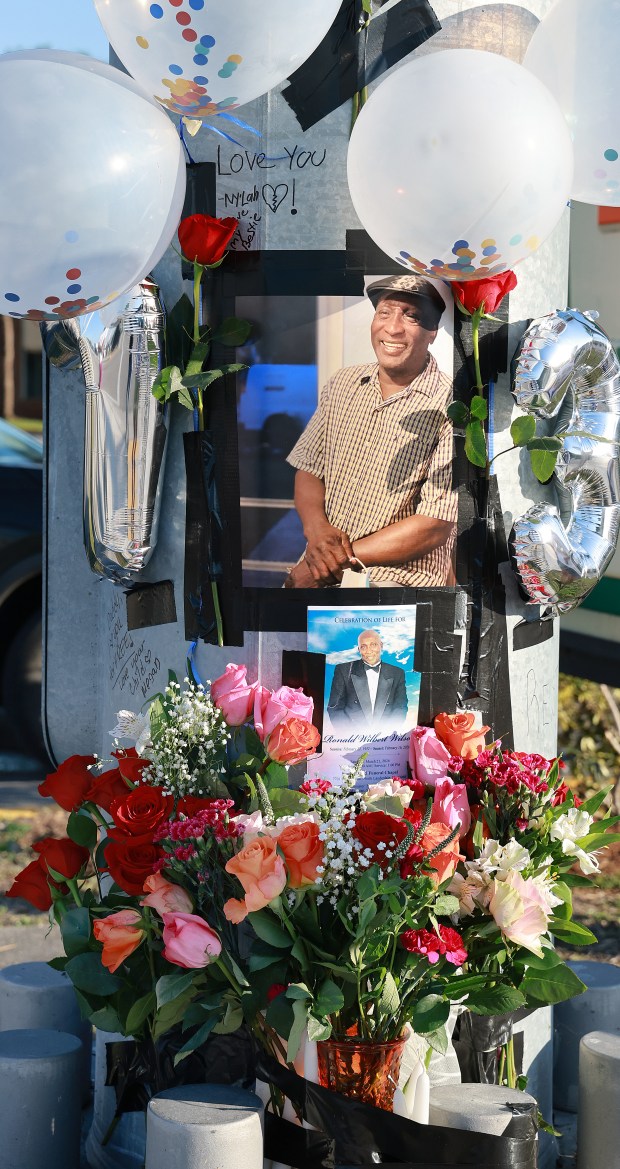 A makeshift memorial for Ronald Wilson is seen at the intersection of Prospect Road and Northwest 31st Avenue in Tamarac on Monday, March 23, 2026. Wilson was killed Feb. 16, 2026, during a pursuit after a Broward Sheriff’s Office deputy crashed into Wilson’s truck, a probable cause affidavit said. (Carline Jean/South Florida Sun Sentinel)
In the two months since Wilson’s death, three more pursuits ended in deadly crashes in Broward County, highlighting the longstanding, polarizing safety debate about police pursuits and the risks they present to the public.
During rush hour traffic on Feb. 26, Bonnie Bouffard, 74, saw flashing police lights in her rearview mirror on Florida’s Turnpike and pulled over to let Florida Highway Patrol and BSO cruisers pass, according to a Medical Examiner’s Office report.
The pursuit ended with a trooper performing a PIT maneuver against a stolen truck, driven by Laiken Randolph, 34, who then crashed into Bouffard’s Nissan Altima, according to the Medical Examiner’s Report and a probable cause affidavit. Bouffard was pronounced dead at the scene.
 Bonnie Bouffard, 74, was killed in a crash on Florida’s Turnpike near the Sunrise Boulevard exit that occurred during a pursuit with Florida Highway Patrol troopers and Broward Sheriff’s Office deputies on Thursday, Feb. 26, 2026. (Cindy Scurry/Courtesy)
A third deadly crash occurred March 22 during another pursuit.
The driver of a stolen van, whom police later identified as 18-year-old Michael Harvey, crashed into a canal in Fort Lauderdale during a chase with multiple police agencies, including BSO and FHP. Harvey and his passenger, a woman who has not been identified, were pulled from the water. The woman was pronounced dead at a hospital.
The three pursuits in February and March were initiated after the suspects allegedly committed aggravated battery or assault on a law enforcement officer, according to probable cause affidavits.
And last week, two men died after crashing into a canal in Parkland while fleeing from Sunrise Police. Early Friday morning, a man was robbed at gunpoint by two men, one of whom was later identified as Anthony Albert Davis. Sunrise Police’s policy permits pursuits of robbery suspects.
Davis was a passenger in a fleeing 2025 BMW X1 with two other suspects, a probable cause affidavit said. The BMW crashed into the canal, killing Jerome Turner, 32, and Kelby Broward-Richardson, 31. Officers found Davis hiding in bushes near the canal and arrested him.
A Sunrise Police spokesperson confirmed in an email to the Sun Sentinel the crash occurred during an active pursuit.
Across the state, at least 66 deadly crashes have involved pursuits between 2016 and 2023, the latest data available from the National Highway Traffic Safety Administration.
For South Florida, the NHTSA data shows seven deadly crashes during pursuits across those years. Some crashes are missing from the data, including a Dec. 26, 2021, crash that killed 13-year-old Stanley Davis Jr. during an unauthorized chase by an officer who had a history of violating Boynton Beach Police’s pursuit policy. The officer in that chase was fired after the department’s internal investigation.
NHTSA data from 2024 and 2025 is not yet available, which would include the deaths of Marcia Pochette and Jenice Woods — a mother and daughter who were killed in July 2024 when a man fleeing from seven West Palm Beach Police officers crashed into their car in Boynton Beach. All seven officers were fired and are facing criminal charges, including leaving the scene of a crash involving death, official misconduct or both, and have pleaded not guilty.
At least 15 people in South Florida have died in crashes during pursuits in the past 10 years, with the NHTSA data and the several recent instances combined.
NHTSA pursuit data is significantly underreported because the federal database only tracks deadly crashes, and police agencies submit those numbers voluntarily, according to a 2023 research report on pursuits from the think tank Police Executive Research Forum, referred to as PERF.
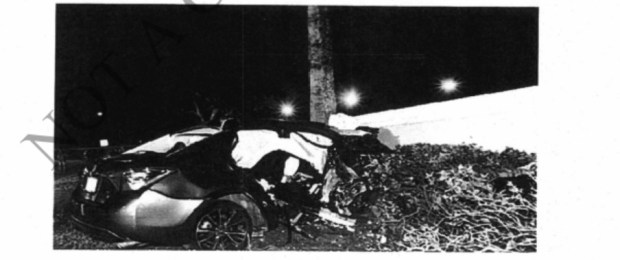 The Toyota Corolla that was destroyed in the July 30, 2024, crash in Boynton Beach, resulting in the deaths of Marcia Pochette, 57, and her daughter Jenice Woods, 27, is shown where it came to rest. The crash occurred as West Palm Beach Police pursued another driver. (Screenshot of court record)
The South Florida Sun Sentinel requested data on pursuits from 17 police agencies in Broward and Palm Beach counties. Data from nine agencies that responded by the time of publication show the majority of the hundreds of pursuits in recent years were within an agency’s policies.
But more than 100 of them were not, according to records.
Data provided by FHP does not specify whether its pursuits were within its policies.
Policies allow officers to exceed speed limits during pursuits under certain circumstances, but it is one of many factors that officers and supervisors must weigh in determining if it’s worth the risk.
Officers and troopers in South Florida have routinely sped at 100 mph and higher during chases, with multiple FHP chases in recent years reaching top speeds of 150 to 155 mph. Even when pursuits are within an agency’s rules, they end in crashes in some cases, injuries to uninvolved bystanders, and thousands of dollars in property damage, according to years of data, annual reports and internal affairs records.
At least 289 crashes have occurred during pursuits in recent years in Broward and Palm Beach counties, according to data provided by the nine local police agencies and FHP.
Pursuit policies
Many of South Florida’s major law enforcement agencies have restrictive policies that allow pursuits only when a driver poses an imminent threat to the public or is suspected of a violent or forcible felony, such as murder, sexual assault, home-invasion robbery, arson or kidnapping.
Those policies prohibit officers from pursuing a driver solely for traffic violations, stolen cars, suspicious drivers and nonviolent and misdemeanor offenses. Still, officers in South Florida in recent years have engaged in many high-speed pursuits for those offenses, police department records show.
Law enforcement officers face a difficult decision, experts say: Does the risk to the public outweigh the need to make an arrest? Multiple law enforcement officers in internal investigations described the stress and intensity of pursuits, stating they were “overwhelmed” and “overzealous,” and one who said he was “very animated” and had to make an effort to “bring himself down a little bit.”
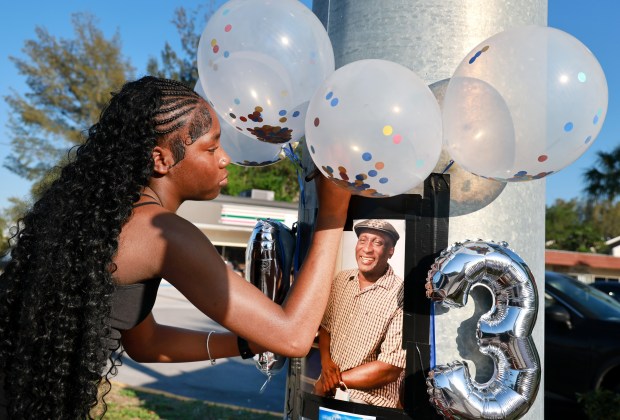 Nylah Simon, 14, places balloons at a makeshift memorial for her grandfather, Ronald Wilson, on Monday, March 23, 2026, a month after Wilson died during a crash that occurred as a Broward Sheriff’s Office deputy pursued a fleeing driver. (Carline Jean/South Florida Sun Sentinel)
The risk versus reward of pursuits has long been “the great debate” for law enforcement, said retired BSO Tamarac captain Neal Glassman. A driver’s choice to flee makes officers suspect they are wanted for or just committed a serious crime — a suspicion he said is frequently correct.
“You look at the other side, when God forbid it’s your family member … You’re saying, ‘Was it really worth having that person lose their life for a stolen tag, a stolen car, some kind of theft?’” he said.
Former law enforcement officer and Georgia lawyer Lance LoRusso, who represents police, said restricting chases to specific crimes is “problematic” because almost all dispatch calls are based on incomplete information. And when chases end up in tragedy, the fault lies solely with the driver who chose not to stop, he said.
“Invariably, that person is wanted or they’re engaged in criminal activity, and the police wind up being a very easy target for putting the blame when the blame really should be firmly placed on the person who was running,” LoRusso said.
Harvey, Randolph and Holder, the drivers in the February and March pursuits, are each facing charges in connection with the respective crashes.
Harvey is charged with manslaughter, vehicular homicide and aggravated assault on a law enforcement officer, among others, and has pleaded not guilty to all charges.
Randolph is charged with second-degree murder and aggravated assault and aggravated battery on a law enforcement officer, among others, totaling 44 charges. She has pleaded not guilty to all.
Holder is charged with second-degree murder and aggravated battery on a law enforcement officer, among others, totaling 33 charges. He has pleaded not guilty to all.
Neoni Copeland, who police identified as the fleeing driver who crashed into Pochette and Woods during the pursuit with West Palm Beach Police, is facing multiple felony charges, including two counts of vehicular homicide. He has pleaded not guilty to all charges.
Davis, the man arrested April 17 after the Sunrise Police pursuit, is facing charges of robbery by sudden snatching with a firearm and resisting an officer without violence. He had not entered a plea as of Wednesday.
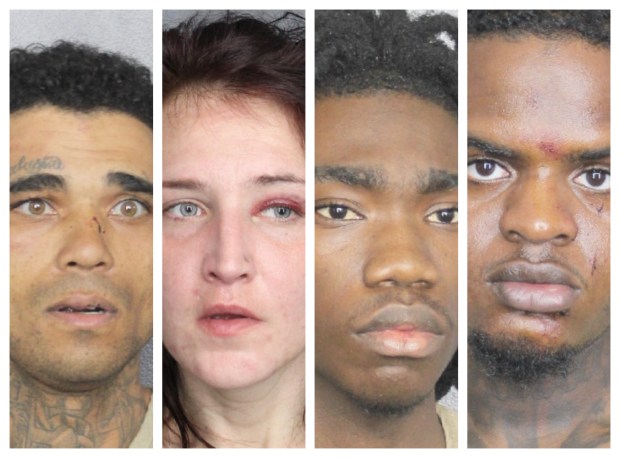 Sean Holder, Laiken Randolph, Michael Harvey and Anthony Davis were arrested in February, March and April after fleeing from police during four separate pursuits in Broward County where deadly crashes occurred. (Broward Sheriff’s Office/Courtesy)
Last year, Gov. Ron DeSantis approved a bill, HB 113, that increased the minimum punishment for fleeing and eluding officers and increased the penalty for repeat violators. In sponsoring the bill, Rep. Ryan Chamberlin, a Republican representative from the Ocala area, cited a “substantial increase” in people fleeing from police in recent years.
But there are many “myths” surrounding pursuits, including the belief that someone is only fleeing because they committed a serious crime, said Geoffrey Alpert, a criminal justice professor at the University of South Carolina. Albert, who has researched pursuits and policies for four decades, said suspects in a prolonged police chase rarely choose to stop, and national statistics show that between 30% and 40% of pursuits end in crashes.
“They want to catch the bad guy. That’s why they become cops. So how do we train them to understand there are really negative consequences if you don’t do it well? And I think that’s part of the problem,” Alpert said.
A police chase risks becoming self-justifying just because a suspect flees, warns Thomas Gleason, a retired Florida police captain and PursuitSAFETY advisory board member. He said it is critical to determine if a pursuit began for a reason allowed under policy, otherwise an unwarranted chase could be retroactively justified “because the pursuit itself caused it to turn into a forcible felony.”
“What we see so many times is something will happen, we’ll start a pursuit and all of a sudden, this guy is trying to get away, and then that gives us justification to go up on another level and pursue even more,” he said.
BSO investigations are ongoing into the recent pursuits, and the deputies involved in them remain on regular duty, spokesperson Carey Codd said in an email.
The agency’s Pursuit Review Board evaluates all pursuits and failures to yield and will refer any cases to Internal Affairs if the board finds a policy violation. When pursuits result in serious injury or death, however, Internal Affairs begins investigating before the review board evaluates it, Codd said. So far, there has been no determination whether the recent pursuits were according to policy.
The president of the Broward Sheriff’s deputies union did not respond to a voicemail seeking comment about the recent pursuits.
‘It was highly preventable’
Megan and Claudia Wilson and Ebony Seay told the Sun Sentinel they believe their father’s death in Tamarac in February was preventable.
Originally from the Parish of Manchester in Jamaica, Wilson’s proudest achievement was becoming a U.S. citizen. He was a hardworking owner of a carpet-cleaning business, Available Carpet Care.
His daughters described him as a protector and provider for his family, someone who cared to build relationships with his clients and a man whose generosity showed in small ways — giving change to those in need, offering rides or simply calling to check in.
“It was heartbreaking,” Megan Wilson said after visiting the crash site more than a month after her father’s death. “It was devastating to know that this was where my father’s life ended … It’s senseless, and it was highly preventable, and regardless of their policies and laws, I feel it was excessive and unwarranted.”
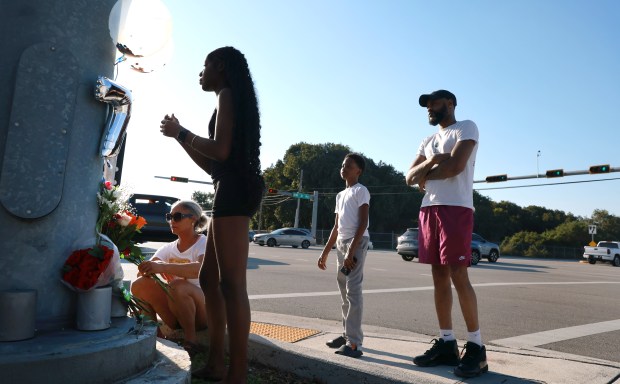 Family of Ronald Wilson gather to create a makeshift memorial at the intersection of Prospect Road and Northwest 31st Avenue in Tamarac on Monday, March 23, 2026. Wilson, an uninvolved bystander, died in a crash with a Broward Sheriff’s Office deputy that occurred during a pursuit of an aggravated battery suspect driving a stolen car, court records say. (Carline Jean/South Florida Sun Sentinel)
Stolen truck had tracking device
Pursuit policies for many South Florida police agencies, including BSO, urge officers to consider whether a chase is truly necessary if the suspect or vehicle can simply be tracked down later.
In the crash that killed Bouffard, the truck that Randolph is accused of stealing in Fort Lauderdale was equipped with a tracking device, according to the probable cause affidavit and police dispatch audio. From the moment the truck was reported stolen shortly before 4 p.m. on Feb. 26, law enforcement received updates every few minutes with the truck’s location, starting in Deerfield Beach.
Randolph drove into Coconut Creek, where an affidavit said she intentionally hit two police cars during an attempted traffic stop. Randolph fled, and deputies and troopers began chasing.
A BSO helicopter, referred to in the dispatch audio as the “Papa” unit, flew overhead shortly after 4:30 p.m., tracking the fleeing truck on the turnpike and relaying updates to officers who were in pursuit.
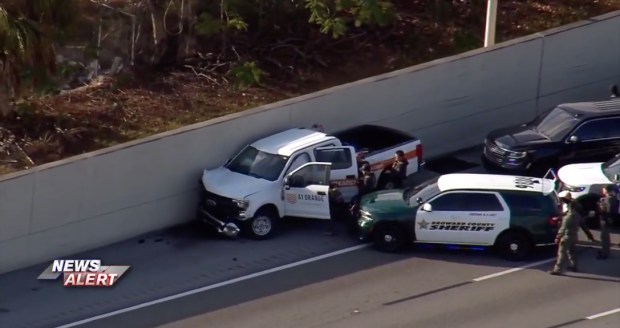 A woman was arrested after a law enforcement pursuit that ended in a deadly crash in the southbound lanes of Florida’s Turnpike near Sunrise Boulevard on Thursday, Feb. 26, 2026. (WSVN-Ch. 7/Courtesy)
Experts who contributed to the 2023 PERF report on pursuits recommend that policies prioritize whether a suspect can be tracked remotely — including by aircraft or GPS — and end a chase if tracking is possible.
LoRusso noted that jurisdictions seeing fewer injuries from pursuit — even while chasing more often — are ending chases quickly using PIT maneuvers, grappling devices, or other technology. Still, he warned that delaying an apprehension isn’t always safe for officers.
“Saying you can always arrest them later is not a viable option,” he said.
While it may seem against an officer’s nature to let a suspect go, both Gleason and Alpert said using available technology to catch someone later is likely a safer option.
West Palm Beach Police uses the StarChase system, according to its policy, which can track a fleeing car by launching a GPS tag onto it from a law enforcement car or a handheld device.
The technology was used in one recent pursuit.
During an authorized pursuit in 2023, a West Palm Beach officer who was chasing a stabbing suspect successfully shot a StarChase tracker onto the fleeing car after the driver had driven the wrong way into oncoming traffic on multiple main roads. A system error prevented it from tracking the car, according to a pursuit report. A supervisor allowed the pursuit to continue onto Interstate 95, where the fleeing driver drove onto the swale of an exit ramp and onto Forrest Hill Boulevard, where he crashed with a bystander’s car, the report said. Though the technology didn’t work in that instance, research has shown that apprehension rates of suspects driving tagged vehicles were greater than 80%, according to the PERF report.
The fleeing driver came to a stop after one officer “made contact” with the suspect’s car, according to the report. While the pursuit was deemed justified and according to policy, a captain recommended that the officer’s chain of command review how he ended the pursuit. That officer was one of the seven who would later be fired for his participation in the pursuit that ended in the deaths of the mother and daughter in Boynton Beach.
Local policies differ on PITs
Only one of the three PIT maneuvers in the recent pursuits was successful. The method is performed by an officer using his or her patrol car to force a suspect’s car to abruptly turn to the side and spin out.
Moments before the crash that killed Wilson in Tamarac, the K-9 deputy tried to stop the fleeing driver with a PIT maneuver but was unsuccessful and briefly lost control of his car. The deputy regained control before entering the intersection, then crashed into Wilson as he attempted to drive after the suspect, the probable cause affidavit said. A screenshot of a personnel record released by BSO shows that the deputy had passed training on the PIT maneuver in July, six months before the crash.
In the Feb. 26 pursuit on the turnpike, an FHP trooper performed a PIT maneuver 30 seconds after a BSO deputy chose not to perform the technique because of safety concerns, the probable cause affidavit said. The PIT maneuver forced the stolen truck to crash into the highway’s shoulder where it hit Bouffard’s car.
A Florida Department of Highway Safety and Motor Vehicles spokesperson did not provide answers to emailed questions, including about the trooper’s decision to perform a PIT maneuver.
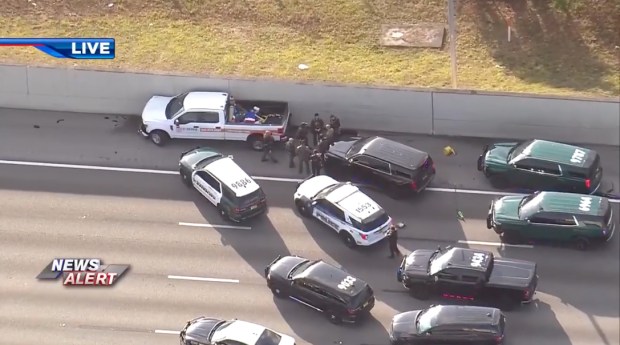 A police pursuit with Florida Highway Patrol and Broward Sheriff’s Office deputies on Feb. 26, 2026, ended during rush hour traffic on the southbound lanes of Florida’s Turnpike. A chain-reaction crash that ended the pursuit resulted in the death of a 74-year-old woman. (WSVN-Ch. 7/Courtesy)
During the pursuit of Harvey in March, in which his passenger died, a BSO deputy’s PIT maneuver failed to stop the suspect, according to a probable cause affidavit.
Both BSO’s and FHP’s policies permit PIT maneuvers.
Troopers have used PIT maneuvers in nearly 100 pursuits in Broward and Palm Beach counties in the past four years, FHP’s data shows.
In 2017, BSO recommended that the tactic be taught to all field personnel, considering it a valuable tool that can “stop pursuits before they start, which ultimately enhances the safety of the public.”
In 2023 and 2024, PIT maneuvers were the most common reason BSO’s pursuits ended, the agency’s annual reports show. Codd said two people were injured during PIT maneuvers in those years: a suspect driver in one crash and a passenger of a fleeing car in another.
But nationally recognized experts don’t agree on whether the technique should be permitted, and there is no consensus about the speeds at which they can be done safely, according to the PERF report.
Local police agencies also have differing policies. Coconut Creek Police prohibit PIT maneuvers at more than 45 mph unless the use of deadly force would be justified. Meanwhile, Boynton Beach and Wilton Manors police aren’t allowed to use the technique at all.
Gleason, who was a PIT maneuver instructor during his law enforcement career, said they should be used at lower speeds, unless deadly force is appropriate, and with a minimum of two police cars to perform them. The greater the speed of a PIT maneuver, the likelier a negative consequence, he said.
Some departments consider PIT maneuvers something to do to ensure public safety, not jeopardize it, he said.
“We do the PIT for public safety reasons, because if we let him go at 110 miles per hour and we don’t PIT, then he’s causing too much danger to the general public,” Gleason said. “But how many lives do we risk when we do pursue that way?”
Traffic infraction pursuits
On a dark, two-lane road in a Southwest Ranches neighborhood, a Davie Police officer tried to pull over a speeding driver late on a fall night in 2025. The driver fled, according to an investigative report.
After briefly losing sight of the car, the officer spotted it and attempted a second traffic stop, but the driver still refused to pull over, according to the report. Two other Davie officers saw the car crash into a nearby canal. The driver and his passenger managed to get out without visible injuries.
A supervisor later determined the pursuit reached speeds of 103 and 107 mph in a 35 mph speed limit zone, according to the investigative report.
Moments after the car’s driver was arrested the officer told another at the scene, “I didn’t pursue him. I turned my lights off and everything …,” police body cam footage shows.
In the later internal review, the officer said she was in pursuit of the car and that she should have ended the traffic stop when he fled, according to the supervisor’s report written two months later. The officer was given a written reprimand, disciplinary records show.
With the fleeing driver handcuffed and placed in the police car’s back seat, the officer told him she drove over 100 miles an hour while behind him, the body cam footage shows.
“This could have been resolved really easily, you know,” the officer told him. “And you going that fast down the street? You know people have horses there and cows, they’re always lost. I mean, they’re in the middle of the road all the time. If you hit a bull in that speed you were going, both of you would have died. You would not have been able to avoid a bull in the middle of the road, there is no way. And I couldn’t tell you how many times I had heard of cows in the middle of the road there.”
The instance was among dozens in recent years where an officer in South Florida chased someone for traffic violations, stolen cars, suspicious incidents or misdemeanors, according to police agencies’ records.
Before 2023, troopers were allowed to chase suspects in felonies, reckless driving and DUI. All other pursuits were prohibited. FHP changed its policy, giving troopers more discretion to decide when to start chases and eliminating the specifications.
Over half of FHP’s chases in Broward and Palm Beach counties were initiated for infractions while dozens of others were initiated for misdemeanors in 2024 and 2025 after the policy change, FHP’s data shows.
In 2020, a Davie junior officer began a pursuit over minor traffic infractions, driving up to 81 mph over nine blocks in a 30 mph zone, according to an investigative report. The officer continued the pursuit into Hollywood without getting supervisor approval until the fleeing car and another officer’s patrol car crashed at an RV park in Hollywood, causing $20,000 in damage. The officer received a written performance log for violating pursuit policy.
Asked during an internal review what probable cause he had to pursue, the Davie officer said he didn’t know at the time. He said he “tried to maintain constant visual of the car” in case the driver “did something in another city,” the report said.
The think tank’s research report on pursuits says more than 90% of pursuits across the country are initiated over traffic violations.
A traffic violation was the sole reason for the pursuit that ended in the crash that killed the mother and daughter Pochette and Woods in 2024, according to a pending federal civil lawsuit filed by their family against the city and each of the seven former officers, which alleges, in part, that West Palm Beach Police has a history of unauthorized pursuits.
Attorneys representing the seven officers and the city have not yet filed their responses in federal court to the allegations in the lawsuit.
One year before the West Palm Beach Police pursuit that ended in the deaths of Pochette and Woods, a West Palm Beach detective began pursuing a driver over a traffic violation. The officer chased the driver for four minutes, driving as fast as 118 mph, but never caught up with the car, according to a discipline report. A lieutenant wrote in the report that the chase would not have been authorized had he been aware of it. The detective received verbal counseling as discipline, the report shows.
West Palm Beach Police’s pursuit policy was revised four months after the deaths of Pochette and Woods, a copy obtained by the Sun Sentinel shows. In response to questions about what changed and why, the city’s director of communications, Kathleen Joy, said: “The City of West Palm Beach is unable to comment due to this being an active legal matter and investigation.”
Confusion, supervisors and conflicting conclusions
South Florida police departments generally define a pursuit as an active effort by officers to apprehend a driver who knows that officers are trying to stop them but evades by speeding or disobeying traffic laws. Several agencies also say that officers cannot circumvent pursuit policies by using terms like “following,” “shadowing,” “monitoring” or “tracking.”
In pursuits investigated by chains of command and internal affairs units in recent years, the Sun Sentinel identified cases where officers and supervisors expressed confusion about what constitutes a pursuit or disagreed whether one had actually occurred. In several cases, supervisors and high-ranking leaders reached conflicting conclusions about whether officers’ actions were pursuits and if they followed policy.
In one pursuit in Davie in 2021, a sergeant and lieutenant allowed an officer to chase a car driving without headlights and quickly learned the vehicle had been reported stolen. The officer continued the chase for 15 miles into another city, never communicating over the radio that his maximum speed reached 104 mph, according to an internal affairs report.
The lieutenant did not complete the required documentation because he didn’t view the incident as a pursuit, according to the investigative document. During the review, the sergeant said he would have canceled the chase had he known it reached 100 mph. The officer, sergeant and lieutenant were all found to have violated the policy.
In 2024, a Davie officer who chased a driver without any evidence of a forcible felony and a supervisor both failed to classify the event as a pursuit. The officer explained he “didn’t think it was really a pursuit” and “appeared confused” about whether and when it was considered one after he had chased a stolen car at speeds up to 92 mph along major roads until a sergeant called it off, according to a supervisory review form. The officer received a coaching form for the violation.
Supervisors bear much of the responsibility for a chase, and must constantly assess whether the evolving situation warrants continuing or canceling it, according to the South Florida pursuit policies reviewed by the Sun Sentinel.
In some cases reviewed by the Sun Sentinel, officers did not communicate to their supervisors that they were in a pursuit or provide critical information — such as speed and location — that would help supervisors decide whether to call off a chase, internal affairs and supervisory review reports show. And in some cases, supervisors themselves have been investigated or disciplined for their decision-making.
In one case in 2022, a BSO lieutenant with two decades on the force participated in a chase of a stolen scooter in Pompano Beach. He later told Internal Affairs the pursuit should not have happened and that no BSO employee should have done what he did, according to an investigative report. The lieutenant tried to get the scooter driver to stop by positioning his unmarked SUV in front of it, but the driver fled over a swale and ran a red light, nearly colliding with another car. The investigative report did not specify whether the lieutenant was disciplined or if the allegation of an unauthorized pursuit was sustained.
A sergeant had ordered twice over the radio for the pursuit to be canceled, but two of the deputies who participated in the chase — and who drove on the wrong side of Atlantic Boulevard during it — were using a different radio channel, according to the report.
Only one Sunrise Police pursuit in the past five years was deemed against policy, and even that one was initially ruled justified. In March 2025, a sergeant pursued a car for speeding at 65 mph in a 45 mph zone. The sergeant noticed that the driver looked to be wearing a “wig or disguise” that partly covered his face and appeared to be reaching beneath seats while driving, possibly trying to grab a gun, a lieutenant wrote in a report after the pursuit.
The lieutenant said the pursuit was within policy, but a major disagreed. The officer was given a written reprimand as discipline for violating the policy.
In another West Palm Beach Police chase from 2024, a lieutenant allowed an officer to chase a car that was involved in a shooting earlier that day. The officer drove at 102 mph, and both he and the suspect’s car crashed, resulting in an estimated $20,000 of damage, according to a pursuit report. Although the supervisor found the chase was within policy, the assistant chief in his own review determined the opposite, recommending the officer be suspended for eight hours and ordering remedial training. It’s unclear what discipline the officer ultimately received.
Causes of deaths pending
Two months later, Bouffard’s autopsy has not yet been finalized, according to the Medical Examiner’s Office.
Autopsy and investigative reports for the woman who died on March 22 and the two men who died April 17 are exempt from being released because of active criminal investigations, a Medical Examiner’s Office official said.
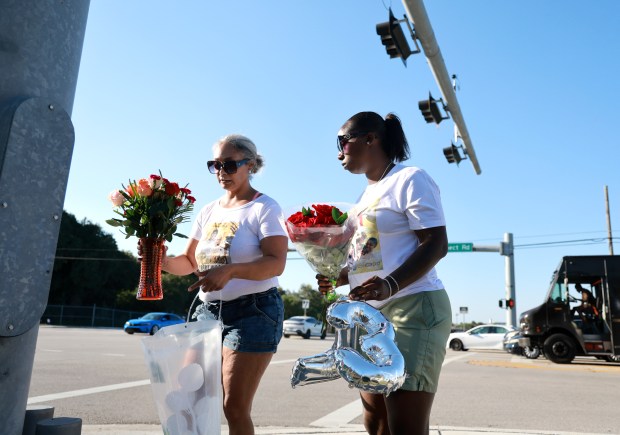 Megan Wilson, 43, left, and her sister Ebony Seay, 36, place flowers and balloons at the intersection where their father, Ronald Wilson, was killed in a February 16 pursuit by a BSO deputy in Tamarac. (Carline Jean/South Florida Sun Sentinel)
The cause and manner of death for Wilson is still pending further investigation.
“Did they slow down at the interaction? What was going on?” questioned Megan Wilson. “… I think there’s some loopholes or some gaps that need to be fixed or changed or something’s gotta be different because people can’t keep losing their lives senselessly like this. And obviously our father has not and will not be the last one.”
SOUTH FLORIDA DATA
Annual and investigative reports, internal logs and data provided by the departments that responded to the Sun Sentinel’s public records requests by publication show:
FHP troopers have participated in 306 pursuits in Broward and Palm Beach counties between 2021 and early 2026. Crashes occurred in 105 of them.
BSO deputies have participated in more than 350 chases between 2017 and 2024, the last year with a complete annual report available. At least 59 of those were not in compliance with policy.
During BSO pursuits in those years, at least seven bystanders or citizens were injured, at least nine passengers in fleeing cars were injured, at least 17 deputies were injured and at least 46 suspects were injured. The annual reports note injuries may be caused by crashes, use-of-force during arrest or if a suspect injured themselves while running away.
Crashes occurred in about 30 percent of BSO pursuits between 2017 and 2024.
For several years, BSO’s chases were terminated most often because a suspect crashed. That changed in 2023 and 2024, when pursuits were most often terminated by PIT maneuvers.
Palm Beach County Sheriff’s Office deputies have participated in at least 47 pursuits between 2021 and 2024, the last year with a complete annual report available. Crashes occurred in about 30 percent of them. Of the total number of pursuits, a quarter of them were not within the agency’s policy.
Coconut Creek Police officers have participated in at least 28 pursuits in the past five years. Only two were found not in compliance with policy.
Davie Police officers have participated in at least 19 pursuits in the past five years. Crashes occurred in eight of them. In one pursuit, a suspect and officers were injured and an uninvolved bystander’s car was damaged. In another, a suspect and an uninvolved bystander were injured. Data provided does not make it clear how the injuries in those instances occurred. At least eight officers or supervisors were found to have violated the pursuit policy in that time frame.
Davie Police officers reached maximum speeds between 100 mph and 130 mph in seven different pursuits between 2021 and 2025.
Margate Police officers have participated in at least 12 pursuits in the last five years. Crashes occurred in five of them. One pursuit was deemed unjustified and led a supervisor to recommend a more elaborate definition of what constitutes a pursuit.
Sunrise Police officers have participated in at least eight pursuits in the past five years, two of which involved crashes. Only one of the eight was deemed not within policy.
West Palm Beach Police officers have participated in at least 43 pursuits between 2021 and 2025, 18 of which included crashes. Of the total, 15 were not within policy.
Delray Beach Police officers have participated in at least six pursuits in the past five years, one of which was determined unjustified. Two of them resulted in a combined $4,000 worth of damage.
Boynton Beach Police officers have participated in at least 60 pursuits between January 2020 and January 2026. Crashes occurred in about 33 percent of them. Of the total, 25% were not within the agency’s policy.
Six of Boynton Beach Police’s pursuits were listed as being terminated due to public safety.
Boynton Beach Police officers in eight separate chases reached maximum speeds of 100 mph, including three where the initial violation was a traffic offense. In nearly two dozen others, officers chased at more than 100 mph, with the fastest speed being 135 mph.
Sun Sentinel data reporter Patrick McCaslin contributed to this report.