
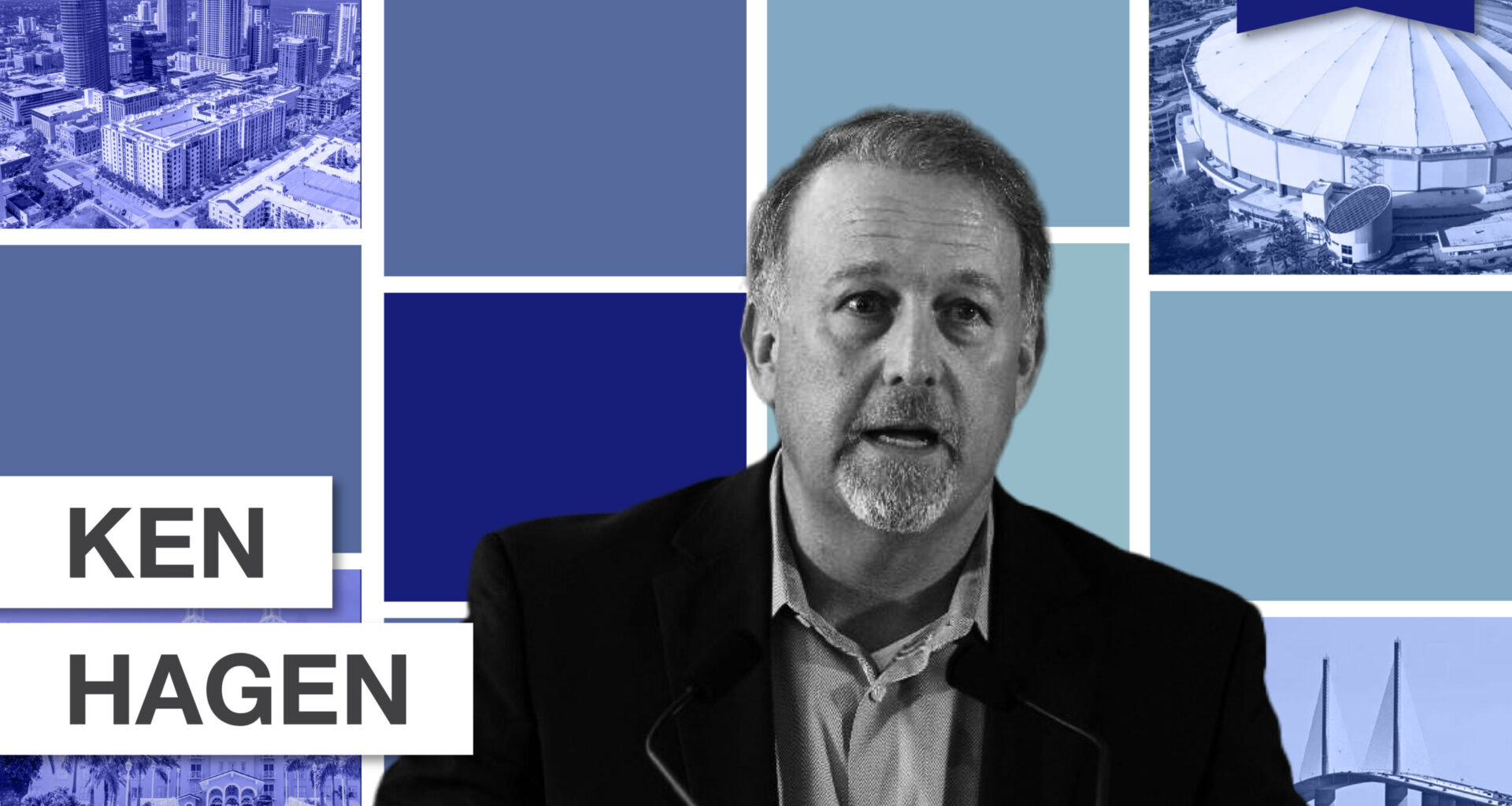
Hillsborough County Commissioner Ken Hagan’s influence in Tampa Bay politics has long been driven by his advocacy to bring the Tampa Bay Rays to his side of the bay.
With the Rays now actively pursuing a new stadium in Tampa, and the Hillsborough County Commission playing a key role in funding discussions, Hagan’s influence is perhaps stronger than ever. That’s likely the reason for his meteoric rise on this year’s list of Tampa Bay’s Most Powerful Politicians, from No. 15 last year to No. 8 this year.
“Throughout his tenure, Ken Hagan has led with both vision and discipline — working for years with others to bring the Rays to Tampa while championing transformative projects like the Fieldhouse, a world-class sports and community complex that will drive economic growth and expand opportunity for generations,” said Ana Cruz, Managing Partner in Ballard Partners’ Tampa Bay practice and Partner in the firm’s D.C. operations.
“His leadership is defined not just by what he builds, but how he builds it — with a level of decorum, professionalism, and bipartisan collaboration that consistently turns ambitious ideas into lasting impact.”
The Hillsborough County Commission is currently considering public funding options for a $1 billion new ballpark on the Hillsborough College Dale Mabry campus. As he has in the past, Hagan is largely leading efforts, outlining earlier this month the Commission’s goal to vote May 6 on a funding plan, with a Tampa City Council vote to follow the next day.

Hagan has been working to bring the Rays to Hillsborough County for some two decades. Punctuating how much the Rays issue defines his leadership, Hagan had been a mainstay on this list up until 2019, at a time when the Rays were actively trying to identify ways to build a stadium in Ybor City. But he fell off the list until 2023, likely because the Ybor deal fizzled and talks to build a stadium in St. Pete, at the site of the existing Tropicana Field, began to gain traction.
Now, Hillsborough is back in play. Hagan, the most senior member of the Hillsborough County Commission, is a top negotiator for the county on the current stadium proposal and is considering not just benefits of a stadium deal, but potential pitfalls.
The team is asking Hillsborough and the city of Tampa to commit roughly $1 billion in public funding.
The team’s public funding request from Hillsborough County includes $272 million in Community Investment Tax (CIT) funds, $268 million in Tourist Development Tax (TDT) funds, $132 million from reserve funds, and $30 million from Community Development Block Grant-Disaster Relief stormwater funds — bringing the team’s total ask from the county to $702 million.
It’s a big ask that is already facing pushback, including about the team’s suggestion that funding come from CIT dollars, which are already under threat due to the economic downturn.

Meanwhile, Hagan is warning about what might happen should the Hillsborough College pitch fall flat. Hagan has warned that if that happens, the Rays may not stay in the Tampa Bay area at all. Speaking in January, he cautioned that failure to secure a deal might mean the birth of the Orlando Rays.
But while the Rays have been Hagan’s passion project — and if they do wind up in Tampa, they will become his legacy — it is not all that defines him.
He has served from the dais for 23 years, a tenure facilitated by moving back and forth between single-member and countywide districts to thwart term limits. While many in the GOP have moved further and further to the right — shifts made to align with President Donald Trump’s MAGA brand of Republicanism — Hagan has largely stayed put.
Before the state preempted local governments on the issue, Hagan sided with Democratic colleague Harry Cohen on a move to keep fluoride in the county’s drinking water. Republican Joshua Wostal pushed to ban fluoride from the water, but with Hagan’s help in opposing the measure, the board deadlocked at 3-3, killing the measure.
Hagan also sided with Democrats on supporting arts funding, even as a Republican colleague called for slashing it.
He has often aligned with Democrats — though with caution — on transportation issues. Hagan neither endorsed nor opposed the All for Transportation referendum voters passed in 2018, which was later struck down by the courts. But he later voted with Democrats on the board to restore funding allocations that had been at the center of legal challenges, a move many hoped would have saved the referendum.
But perhaps Hagan’s biggest strength is just never losing. He was first elected in 2002 and, since then, has not only not lost, but has won by impressive margins. Last year, he won re-election by more than 10 percentage points. Two years before that, he won by nearly 14 percentage points. Even when races were closer, like in 2018 as Democrats in the county were surging, Hagan won re-election by more than 4 percentage points. It goes on and on.
“It is very important to have someone on the County Commission who has real, deep institutional knowledge, who knows why certain decisions were made 10, 20, 25 years ago. Without that historical perspective, the rest of us would be at a distinct disadvantage,” Cohen said of his Republican colleague.
___
As for methodology, the Tampa Bay region is defined as Pinellas, Hillsborough and Pasco counties, with Hernando, Polk and Sarasota included when their elected officials impact Pinellas or Hillsborough.
A politician is defined as someone currently in office or actively running for office.
Panelists ranked their Top 25, with a first-place vote earning 25 points, second place earning 24, and so on down to 1 point for 25th. Those totals were combined to produce the final list.
We also want to thank our experienced and knowledgeable panelists, who were essential to developing the 2026 list: Vinik Family Office Chief of Staff Christina Barker; former St. Petersburg City Council member Robert Blackmon; Mercury Public Affairs Managing Director Ashley Bauman; Michael Corcoran and Matt Blair of Corcoran Partners; former Sen. Jeff Brandes; Stephanie Cardozo of The Southern Group; Shumaker, Loop & Kendrick managing partner Ron Christaldi; political consultant/strategist Barry Edwards; Vicidial Group President Matt Florell; Sunrise Consulting Group President Shawn Foster; businessman Michael Griffin; St. Pete Catalyst Publisher Joe Hamilton; Clay Hollis of Tucker/Hall; Natalie King of RSA Consulting Group; Moffitt Cancer Center VP of Public Affairs and Communications Merritt Martin; political consultant Chris Mitchell; Mike Moore of The Southern Group; RSA President and CEO Ron Pierce; Tucker/Hall CEO Darren Richards; political consultant Jim Rimes; political consultant Preston Rudie of Catalyst Communications Group; TECO Vice President of State and Regional Affairs Stephanie Smith; lobbyist Alan Suskey of Shumaker Advisors; and Michelle and Peter Schorsch, publishers of Florida Politics.